Six weeks before her wedding, a friend of mine sat at her kitchen table with her officiant’s number on the screen and nothing to say. She knew she wanted KJV. The old language. Something that sounded like it came from centuries of people who actually meant it. But she’d Googled herself in circles and landed on the same numbered lists that didn’t tell her which verse to use where.
That’s what this guide is built to fix.
Below you’ll find 50 of the most meaningful KJV Bible verses about love and marriage — organized by situation, not by number. And because most people searching for these verses are planning a ceremony or writing in a wedding card, this post includes something no other article on this topic has: a complete KJV Wedding Ceremony Scripture Guide, formatted to hand directly to your officiant.
This is the section nobody else has. Most articles just list verses and leave you to figure out where they go. This guide places the right KJV passage at each key moment in the ceremony — with a note on exactly why it works. Print it. Hand it to your officiant. Or adapt it for a vow renewal, an anniversary celebration, or a wedding card that’s more than just a verse number scrawled inside.
Free Resource
Get Your FREE Prayer Guide Now
and join the Daily Way Devotional: Join 25,000+ Subscribers
Six moments. Six passages. Ready to hand to your officiant.
Moment 1 — Opening of the Ceremony
“What therefore God hath joined together, let not man put asunder.” — Matthew 19:6 (KJV)
Why it works: Three seconds. The entire theology of marriage in a single sentence. It immediately reframes the ceremony as something God is doing, not just two people doing. The archaic “hath” and “put asunder” carry weight that modern translations simply don’t.
Moment 2 — The Meaning of Marriage Reading
“And the LORD God said, It is not good that the man should be alone; I will make him an help meet for him… Therefore shall a man leave his father and his mother, and shall cleave unto his wife: and they shall be one flesh.” — Genesis 2:18, 24 (KJV)
Why it works: This is the creation foundation. “Leave and cleave” is the oldest marriage language in Scripture. The phrase “help meet” (Genesis 2:18) is also the most frequently misunderstood phrase in marriage theology — your officiant can take a moment to explain it here if they choose. (See the KJV Language Decoder below.)
Moment 3 — The Charge to the Couple
“Husbands, love your wives, even as Christ also loved the church, and gave himself for it… So ought men to love their wives as their own bodies. He that loveth his wife loveth himself.” — Ephesians 5:25, 28 (KJV)
Why it works: This gives the husband a charge — not authority, but sacrifice. Pairing this with a verse for the wife (Eph. 5:22) makes both charges visible in the same moment. No one hears only half the command.
Moment 4 — Ring Exchange
“I am my beloved’s, and my beloved is mine.” — Song of Solomon 6:3 (KJV)
Why it works: Short. Beautiful. Mutual. The rings go on during this verse, and the words match perfectly — possession and belonging, equally. Many couples also use Song of Solomon 8:6: “Set me as a seal upon thine heart.”
Moment 5 — The Love Chapter Reading
“Charity suffereth long, and is kind; charity envieth not; charity vaunteth not itself, is not puffed up… Beareth all things, believeth all things, hopeth all things, endureth all things. Charity never faileth.” — 1 Corinthians 13:4, 7–8 (KJV)
Why it works: The most beloved marriage passage in Scripture. In KJV, “charity” is used where modern translations say “love” — it carries the meaning of self-giving, not sentiment. Have the officiant note this translation choice. It changes how people hear the passage.
Moment 6 — The Benediction
“The LORD bless thee, and keep thee: The LORD make his face shine upon thee, and be gracious unto thee: The LORD lift up his countenance upon thee, and give thee peace.” — Numbers 6:24–26 (KJV)
Why it works: The Aaronic Blessing is the oldest scripted blessing in all of Scripture. It’s familiar enough that many guests recognize it, formal enough to feel like an ending, and theological enough to close a ceremony well. It’s also a gift to the couple, not just a statement about them.
A Real Moment
I’ve attended weddings where the officiant read a verse like it was a legal disclaimer and weddings where one sentence stopped the whole room. Every single time it was the second kind, they were reading KJV. There’s something about “God hath joined together” that a modern paraphrase just doesn’t replicate. The old language asks more of people — and people rise to it.
What God Says Marriage Is
Before you get to the wedding-day verses, these are the foundation passages — the ones that explain what marriage actually is according to Scripture. They come from Genesis and Matthew, and they show up in every serious marriage ceremony for a reason.
Genesis 1:27 (KJV)
“So God created man in his own image, in the image of God created he him; male and female created he them.”
Marriage begins here — with two image-bearers of God. The union of a man and woman reflects something about who God is.
📜 Ceremony Opening🖼️ Home Print
Genesis 2:18 (KJV)
“And the LORD God said, It is not good that the man should be alone; I will make him an help meet for him.”
The first recorded statement of God about human relationship. “Help meet” in KJV means a helper fit for him — not a servant, but a suitable partner. (Full explanation in the KJV Language Decoder.)
📜 Ceremony Reading💌 Wedding Card
Genesis 2:22–24 (KJV)
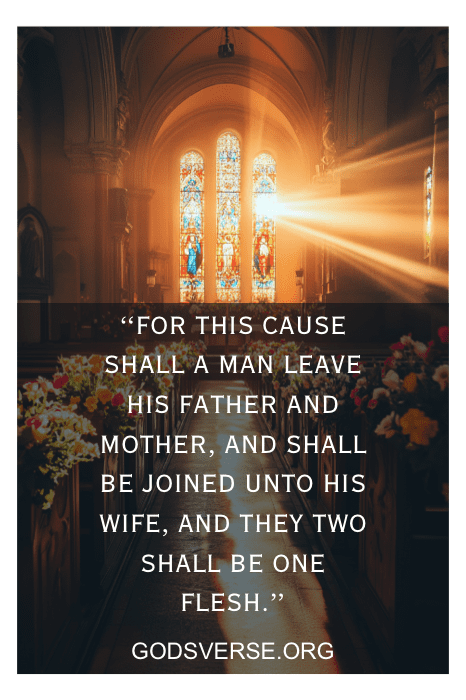
“And the rib, which the LORD God had taken from man, made he a woman, and brought her unto the man… Therefore shall a man leave his father and his mother, and shall cleave unto his wife: and they shall be one flesh.”
Every major marriage theology in the New Testament traces back to this passage. “Leave and cleave” is the oldest marriage command in Scripture. Jesus quotes it directly in Matthew 19.
📜 Ceremony Reading🖼️ Home Print
Matthew 19:4–6 (KJV)
“And he answered and said unto them, Have ye not read, that he which made them at the beginning made them male and female, And said, For this cause shall a man leave father and mother, and shall cleave to his wife: and they twain shall be one flesh? Wherefore they are no more twain, but one flesh. What therefore God hath joined together, let not man put asunder.”
Jesus is speaking here, which gives these words particular weight in a Christian ceremony. “Twain” is KJV for “two.” “Put asunder” means to separate or divide. The force of the statement is clear: what God joins, no human has the right to break.
📜 Ceremony Reading🎂 Anniversary
Husband, Love Your Wife: What KJV Actually Commands
Ephesians 5 is the most cited and most misunderstood marriage passage in the Bible. Most people quote verse 22 without reading verse 25. The command to husbands is longer, harder, and set at a higher standard than anything asked of wives. The KJV renders these passages with a directness that’s worth sitting with.
Ephesians 5:25–28 (KJV)
“Husbands, love your wives, even as Christ also loved the church, and gave himself for it; That he might sanctify and cleanse it with the washing of water by the word, That he might present it to himself a glorious church, not having spot, or wrinkle, or any such thing… So ought men to love their wives as their own bodies. He that loveth his wife loveth himself.”
The husband is not commanded to lead from comfort — he’s commanded to love the way Christ loved: by giving himself up. The phrase “washing of water by the word” refers to the sanctifying work of Scripture in the relationship. A husband who leads his wife toward God fulfills this command.
📜 Ceremony Reading🙏 Prayer / Devotional
1 Peter 3:7 (KJV)
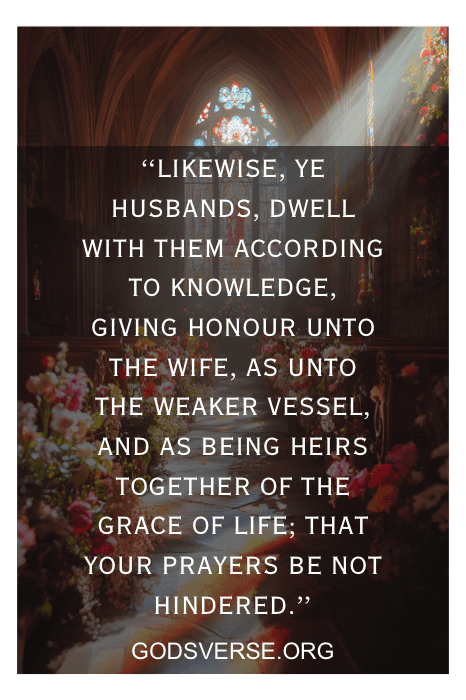
“Likewise, ye husbands, dwell with them according to knowledge, giving honour unto the wife, as unto the weaker vessel, and as being heirs together of the grace of life; that your prayers be not hindered.”
“Weaker vessel” does not mean inferior. It means physically more vulnerable — and the command is therefore to give her more honor, not less. The phrase “heirs together of the grace of life” establishes absolute spiritual equality. A husband who fails to honor his wife is warned: your prayers will be hindered. That is a serious statement.
🙏 Prayer / Devotional📖 Bible Study
Colossians 3:19 (KJV)
“Husbands, love your wives, and be not bitter against them.”
Short. Direct. “Be not bitter against them” is the part nobody quotes but everyone needs. Resentment in marriage grows slowly. This verse anticipates it.
💌 Card🙏 Prayer
Proverbs 5:18–19 (KJV)
“Let thy fountain be blessed: and rejoice with the wife of thy youth. Let her be as the loving hind and pleasant roe; let her breasts satisfy thee at all times; and be thou ravished always with her love.”
The Bible is not shy about marital love. “Rejoice with the wife of thy youth” — the instruction is not just to stay faithful but to delight in your wife. The word “ravished” here means captivated, overwhelmed with love. This is not a reluctant marriage — it’s an exuberant one.
Titus 2:4 uses the phrase “teach the young women to be sober, to love their husbands” — and the Greek word behind “love your husbands” (philandros) specifically refers to tender affection. It’s not a command to endure a husband. It’s a call to actively cherish him. That distinction matters, and the KJV captures it.
Ephesians 5:22–24 (KJV)
“Wives, submit yourselves unto your own husbands, as unto the Lord. For the husband is the head of the wife, even as Christ is the head of the church: and he is the saviour of the body. Therefore as the church is subject unto Christ, so let the wives be to their own husbands in every thing.”
Verse 22 is never properly understood without verse 21 (“Submitting yourselves one to another in the fear of God”) and verse 25. Submission here is voluntary, modeled on how the church relates to Christ — not coercion. See the What These Verses Are NOT Saying section for an important note on this.
📖 Bible Study🙏 Devotional
Titus 2:4–5 (KJV)
“That they may teach the young women to be sober, to love their husbands, to love their children, To be discreet, chaste, keepers at home, good, obedient to their own husbands, that the word of God be not blasphemed.”
This is older women instructing younger women — not men commanding women. The context is a mentoring relationship within the church. “Keepers at home” in the original Greek (oikourgos) means one who manages the household, not one who is confined to it.
📖 Bible Study🙏 Devotional
Proverbs 31:10–12 (KJV)
“Who can find a virtuous woman? for her price is far above rubies. The heart of her husband doth safely trust in her, so that he shall have no need of spoil. She will do him good and not evil all the days of her life.”
The “virtuous woman” passage in KJV is one of the most quoted in all of marriage literature. “Her price is far above rubies” is frequently engraved on wedding gifts. “The heart of her husband doth safely trust in her” — that safety is earned, not assumed. This is a portrait of character, not of quiet compliance.
💌 Wedding Card🖼️ Home Print🎂 Anniversary
1 Peter 3:1–4 (KJV)
“Likewise, ye wives, be in subjection to your own husbands… Whose adorning let it not be that outward adorning of plaiting the hair, and of wearing of gold, or of putting on of apparel; But let it be the hidden man of the heart, in that which is not corruptible, even the ornament of a meek and quiet spirit, which is in the sight of God of great price.”
A meek and quiet spirit is not a silent, doormat spirit. “Meek” in the New Testament consistently describes strength under control — not weakness. And “great price” in the eyes of God is a significant claim. God values inner character above outward appearance.
🙏 Devotional📖 Bible Study
Proverbs 19:14 (KJV)
“House and riches are the inheritance of fathers: and a prudent wife is from the LORD.”
Everything else in life can be inherited — money, property, status. But a prudent wife is described as a gift that only God gives. The word “prudent” (Hebrew sakal) means wise, discerning, full of understanding. This verse is a good reminder that a good marriage is not something you manufacture — it’s something you steward with gratitude.
💌 Wedding Card🎂 Anniversary
For more on what Scripture says specifically about a wife’s role and dignity, the guide on biblical verses on being a good wife goes deeper into the Hebrew and Greek behind many of these passages.
1 Corinthians 13 in KJV: The “Charity” Deep Dive
Every wedding ceremony in America has used this passage. Most people don’t realize that in the King James Version, the word “love” never appears here. KJV uses “charity” throughout — and that translation choice is intentional and meaningful.
The Greek word is agape. In 1611 when the KJV was translated, “charity” meant self-giving, unconditional love — not a donation box. Over 400 years the word shifted meaning in English, but the KJV never got updated. So now it sounds like we’re being told to be generous when what Paul actually wrote was: the kind of love that has nothing to do with how you feel today.
1 Corinthians 13:4–8 (KJV)
“Charity suffereth long, and is kind; charity envieth not; charity vaunteth not itself, is not puffed up, Doth not behave itself unseemly, seeketh not her own, is not easily provoked, thinketh no evil; Rejoiceth not in iniquity, but rejoiceth in the truth; Beareth all things, believeth all things, hopeth all things, endureth all things. Charity never faileth: but whether there be prophecies, they shall fail; whether there be tongues, they shall cease; whether there be knowledge, it shall vanish away.”
“Thinketh no evil” is the KJV rendering of what other versions call “keeps no record of wrongs.” “Vaunteth not itself” means does not boast. “Is not easily provoked” — Paul is describing the daily discipline of marriage, not a feeling you fall into. The “gift of prophecy” and knowledge mentioned in verse 8 are contrasted with love to make the point: love outlasts every spiritual gift and human achievement.
“And now abideth faith, hope, charity, these three; but the greatest of these is charity.”
The summary verse. If you’re choosing a single line for a wedding program, a framed print, or a wedding card, this is it. Simple enough to memorize. Weighty enough to spend a lifetime unpacking.
💌 Card🖼️ Home Print🎂 Anniversary
A Real Moment
I once sat with a couple who had a framed 1 Corinthians 13 print in their living room — NIV version, all “love.” They’d been married twenty-three years. When I read them the KJV version aloud, they both paused at “thinketh no evil.” The wife said, “That’s harder than ‘keeps no record of wrongs.’ Thinking is something you can’t hide from.” They went home and looked for a KJV print. I don’t think that’s a coincidence.
Song of Solomon: When the Bible Gets Romantic
The Song of Solomon (also called the Song of Songs) is eight chapters of romantic and erotic love poetry, and it’s in the Bible. The KJV rendering is particularly lyrical — the kind of language that belongs in a ceremony, a love letter, or a wedding toast. These are not metaphors for Israel or the church. They are love poems between a man and a woman.
Song of Solomon 2:16 (KJV)
“My beloved is mine, and I am his: he feedeth among the lilies.”
Mutual belonging. No hierarchy here — both belong to each other equally. This is the verse most often used for the ring exchange alongside Song 6:3.
📜 Ring Exchange💌 Card🖼️ Home Print
Song of Solomon 8:6–7 (KJV)
“Set me as a seal upon thine heart, as a seal upon thine arm: for love is strong as death; jealousy is cruel as the grave: the coals thereof are coals of fire, which hath a most vehement flame. Many waters cannot quench love, neither can the floods drown it: if a man would give all the substance of his house for love, it would utterly be contemned.”
“Flashes of fire” in some modern translations — KJV renders it “coals of fire, which hath a most vehement flame.” The point is the same: this kind of love cannot be extinguished by circumstances, suffering, or time. “Many waters cannot quench love” is one of the great marriage promises in Scripture — appropriate for a ceremony or an anniversary milestone.
📜 Ceremony Reading🎂 Anniversary💌 Wedding Card
Proverbs 30:18–19 (KJV)
“There be three things which are too wonderful for me, yea, four which I know not: The way of an eagle in the air; the way of a serpent upon a rock; the way of a ship in the midst of the sea; and the way of a man with a maid.”
A beautiful, almost mystical passage. The “way of a man with a maid” — the way a young man loves a young woman — is placed among the most wondrous things in creation. That’s the Bible saying romantic love is not mundane. It is extraordinary.
💌 Wedding Card📜 Ceremony
When Marriage Gets Hard
Not every KJV marriage verse is for a wedding day. Some of the most important ones are for the Tuesday nights when you can’t find anything to say to each other, or the years when the distance feels too wide to cross. These passages were written for those seasons too.
Ecclesiastes 4:9–12 (KJV)
“Two are better than one; because they have a good reward for their labour. For if they fall, the one will lift up his fellow: but woe to him that is alone when he falleth; for he hath not another to help him up. Again, if two lie together, then they have heat: but how can one be warm alone? And if one prevail against him, two shall withstand him; and a threefold cord is not quickly broken.”
The “threefold cord” — the two of you, and God — is one of the great images for Christian marriage. This passage acknowledges that marriage is hard and that you will fall. The point isn’t that marriage is easy. It’s that you’re better together than alone when things go wrong.
🎂 Anniversary📜 Ceremony🖼️ Home Print
Colossians 3:13–15 (KJV)
“Forbearing one another, and forgiving one another, if any man have a quarrel against any: even as Christ forgave you, so also do ye. And above all these things put on charity, which is the bond of perfectness. And let the peace of Christ rule in your hearts, to the which also ye are called in one body; and be ye thankful.”
“Bond of perfectness” in KJV — modern translations render this “bond of peace” or “perfect unity.” The word in Greek is syndesmos, meaning that which ties or binds together. Forgiveness isn’t optional in this passage — it’s what holds everything else together. Paul uses closely related language in Ephesians 4:3, where he calls believers to keep “the unity of the Spirit in the bond of peace” — a phrase that applies just as directly to marriage as it does to the church. “The peace of Christ rule in your hearts” is a command, not just a suggestion.
🙏 Devotional💌 Card
1 Peter 4:8 (KJV)
“And above all things have fervent charity among yourselves: for charity shall cover the multitude of sins.”
The principle that love covers — that charity shall cover the multitude of sins — is one of the most practical marriage truths in the Bible. Love does not pretend the sins didn’t happen. It covers them, meaning it absorbs the cost rather than broadcasting the offense. A marriage without this verse is a marriage keeping score.
🙏 Devotional💌 Card
A Real Moment
A couple I know kept a small framed card on their refrigerator for thirty-one years. Just the last line: “A threefold cord is not quickly broken.” They told me they’d chosen it on their wedding day, half-understanding it, and then came to understand it more every year. By year twenty, it had stopped being a decoration and started being a testimony.
If you’re looking for more passages to support a marriage in a difficult season, the post on Bible verses to fight for your marriage covers specific situations — conflict, broken trust, and wanting to give up — with both Scripture and prayer.
The Marriage Bed
The Bible has a clear, positive view of physical intimacy within marriage. These KJV verses state that plainly — and they push back on the idea that sex in marriage is something Christians should treat with embarrassment or suspicion.
Hebrews 13:4 (KJV)
“Marriage is honourable in all, and the bed undefiled: but whoremongers and adulterers God will judge.”
The “marriage bed” in KJV — the physical union of husband and wife — is called “undefiled.” It is not sinful, not dirty, not something to be minimized. The second half of the verse contrasts this with sexual immorality outside marriage, which the text says God will judge. The contrast is the point: what is holy inside marriage is wrong outside it.
📖 Bible Study🙏 Devotional
1 Corinthians 7:2 (KJV)
“Nevertheless, to avoid fornication, let every man have his own wife, and let every woman have her own husband.”
Paul’s practical counsel for avoiding sexual immorality is marriage — “let every man have his own wife.” This isn’t a reluctant concession. It’s an acknowledgment that God designed physical intimacy for the covenant of marriage, and that marriage itself is the good gift that fulfills that design.
📖 Bible Study
1 Corinthians 7:3–5 (KJV)
“Let the husband render unto the wife due benevolence: and likewise also the wife unto the husband. The wife hath not power of her own body, but the husband: and likewise also the husband hath not power of his own body, but the wife. Defraud ye not one the other, except it be with consent for a time, that ye may give yourselves to fasting and prayer; and come together again, that Satan tempt you not for your incontinency.”
“Defraud ye not” in KJV means “do not deprive each other.” The structure of this verse is striking: it gives the same authority over each other’s bodies to both the husband and the wife equally. That’s a significant statement for a text written in the first century. “Due benevolence” is KJV for the conjugal rights owed to a spouse. The practical instruction is about consent and rhythm — not a command, but wisdom for sustaining intimacy in a busy life.
📖 Bible Study🙏 Devotional
Quick-Reference: KJV Marriage Verses by Use Case
Use this table to find the right verse fast. Bookmark this page — you’ll use it every wedding season.
Use Case
Best KJV Verse
Reference
Ceremony opening
“What therefore God hath joined together…”
Matthew 19:6
Ring exchange
“I am my beloved’s, and my beloved is mine.”
Song of Solomon 6:3
Love chapter reading
“Charity suffereth long, and is kind…”
1 Corinthians 13:4–8
Closing benediction
“The LORD bless thee, and keep thee…”
Numbers 6:24–26
Wedding card
“And now abideth faith, hope, charity…”
1 Corinthians 13:13
Home print / engraving
“A threefold cord is not quickly broken.”
Ecclesiastes 4:12
Anniversary card
“Many waters cannot quench love…”
Song of Solomon 8:7
Marriage in a hard season
“Charity shall cover the multitude of sins.”
1 Peter 4:8
Prayer for your spouse
“Giving honour unto the wife, as unto the weaker vessel…”
1 Peter 3:7
For the couple’s home
“Her price is far above rubies.”
Proverbs 31:10
Vow renewal
“Rejoice with the wife of thy youth.”
Proverbs 5:18
For more passages organized around how a wife should love and support her husband, see our full list of encouraging Bible verses for wives.
What These Verses Are NOT Saying
A few of the most important KJV marriage passages are also the most frequently misread. These clarifications matter — not to soften the text, but to read it correctly.
These verses do not authorize a husband to control his wife.
Ephesians 5:23 says the husband is “head of the wife” — but the immediate context defines that headship as self-sacrifice (“gave himself for it”), not authority over her decisions. The passage says nothing about a husband making final decisions or having veto power over his wife’s life. The model given is Christ and the church — Christ served the church, died for it, and honored it. That is the standard.
“Submit yourselves” does not mean stay in an abusive marriage.
Ephesians 5:22 is addressed to wives voluntarily choosing to honor their husband’s leadership in the context of a mutually loving, God-honoring marriage. It is not a command to endure physical or emotional abuse. The verse before it (5:21) calls both husband and wife to mutual submission. No passage in Scripture requires a person to remain in danger. If you are in an unsafe situation, please reach out to the National Domestic Violence Hotline: 1-800-799-7233.
“Weaker vessel” is not a statement about women’s inferiority.
1 Peter 3:7 calls wives the “weaker vessel” in a physical sense — and immediately responds to that fact with a command to give her more honor, not less. The same verse calls her a co-heir of the grace of life, spiritually equal. A husband who uses “weaker vessel” to diminish his wife has read it exactly backwards.
The King James Bible was translated in 1611. Some of its most beautiful phrases for marriage are also the most confusing to modern ears. Here’s what they actually mean.
“Help meet” (Genesis 2:18)
Not a servant — a “helper fit for him.” The Hebrew is ezer kenegdo: one who comes alongside as a corresponding strength. The word ezer is used elsewhere in the Old Testament to describe God himself helping Israel. It carries no implication of inferiority.
“Charity” (1 Corinthians 13)
In 1611, “charity” meant agape — self-giving, unconditional love. Not a feeling, not a donation. The kind of love that acts regardless of how you feel today. When the KJV was written, “charity” was the best English word for that. Modern translations use “love,” but the KJV word carries weight that “love” in contemporary English has lost.
“Washing of water by the word” (Ephesians 5:26)
Paul describes how Christ sanctifies the church: through the water of baptism and the cleansing power of Scripture. A husband who applies this to his marriage is one who leads his wife toward God through prayer, Scripture, and spiritual care — not control.
“Defraud ye not” (1 Corinthians 7:5)
Modern translations say “do not deprive each other.” KJV’s “defraud” is stronger — it implies robbing someone of what they are owed. In context, this is about physical intimacy in marriage. Neither spouse should withhold from the other except by mutual agreement and for a limited time.
“Weaker vessel” (1 Peter 3:7)
A vessel is a container — the image is of a fragile jar versus a sturdy jar, not an inferior jar. Both carry what they carry. The command is to handle the fragile one with more care, not less respect. The spiritual standing of husband and wife is identical (“heirs together”).
“Due benevolence” (1 Corinthians 7:3)
Modern translations say “conjugal rights” or “what is owed.” KJV’s “benevolence” (from Latin bene volo: I wish you well) frames it as goodwill — the act of giving to your spouse out of genuine care, not reluctant duty. It’s a kinder framing of the same instruction.
You may also want to explore what the broader Bible says about a wife’s daily life in marriage — the post on what the Bible says about wives is one of the most thorough treatments of the subject we’ve published.
A Prayer for Your Marriage
A Prayer Based on These KJV Passages
Lord God,
You said it is not good for man to be alone. You made us for this — for the hard, holy work of belonging to another person. Thank you for that design.
Teach us to love the way 1 Corinthians 13 describes — not the easy kind that comes when everything is going well, but the charity that suffereth long, that thinketh no evil, that bears all things and endures all things and never fails.
Where we have kept records of wrongs, help us cover them. Where we have been bitter against one another, soften us. Where the distance has grown, bring us back.
Be the third strand in this cord. Be the one who holds it together when we cannot hold each other.
What you have joined together, we ask you to keep. Not put asunder — not by circumstances, not by time, not by our own failures. By your grace, let it hold.
What is the most popular KJV Bible verse used in wedding ceremonies?
Matthew 19:6 — “What therefore God hath joined together, let not man put asunder” — is the single most recognizable KJV verse in wedding ceremonies, typically used to open the service. For readings, 1 Corinthians 13:4–8 and Genesis 2:24 are the most frequently chosen.
Why does the KJV use “charity” instead of “love” in 1 Corinthians 13?
In 1611, the English word “charity” carried the meaning of agape — selfless, unconditional love. Over the following four centuries the word shifted to mean charitable giving. The translators used the best word available at the time. Modern translations use “love,” but many readers find the KJV version more striking precisely because “charity” sounds harder — it emphasizes action and will over emotion.
What does “help meet” mean in the KJV?
“Help meet” comes from Genesis 2:18: “I will make him an help meet for him.” The Hebrew is ezer kenegdo — a helper who corresponds to him, who fits alongside him as a suitable partner. It carries no implication of inferiority. The same word ezer is used in the Psalms to describe God as Israel’s helper.
What KJV verse is best for a wedding ring exchange?
Song of Solomon 6:3 — “I am my beloved’s, and my beloved is mine” — is the most popular. It’s short, beautiful, and mutual. Song of Solomon 8:6 (“Set me as a seal upon thine heart”) is a close second for couples who want something slightly longer and more poetic.
What does the KJV say about the husband being the “head of the wife”?
Ephesians 5:23 says “the husband is the head of the wife, even as Christ is the head of the church.” The passage immediately defines what that headship looks like: “Husbands, love your wives, even as Christ also loved the church, and gave himself for it” (v.25). The model is sacrificial service, not authority over decisions. The same passage calls both husband and wife to mutual submission in verse 21.
What is the difference between “love” and “charity” in the KJV Bible?
In KJV, “love” typically translates phileo (affectionate love between friends or family) while “charity” translates agape (unconditional, self-giving love). In 1 Corinthians 13, the original Greek is agape throughout — so KJV uses “charity” for every instance. Most other translations use “love” for both words, which can blur the distinction Paul is drawing.
What KJV verse talks about the “marriage bed”?
Hebrews 13:4: “Marriage is honourable in all, and the bed undefiled: but whoremongers and adulterers God will judge.” The KJV is direct — the marriage bed is called honourable and undefiled. Physical intimacy within marriage is viewed positively, not as something to minimize or be ashamed of.
What does 1 Peter 3:7 mean by “weaker vessel” in KJV?
It refers to physical vulnerability, not spiritual or intellectual inferiority. The same verse immediately calls wife and husband “heirs together of the grace of life” — equal in spiritual standing. The command following “weaker vessel” is to give her more honor, not less. A husband who uses this phrase to diminish his wife has read the verse backwards.
Are there KJV Bible verses about marriage between a man and a woman specifically?
Yes. Genesis 2:24, Matthew 19:4–6, and Ephesians 5:22–33 all address the marriage between a man and a woman specifically. For a comprehensive treatment of those passages and the broader scriptural framework, see our guide to Bible verses on marriage between man and woman.
George Hendricks is the founder and managing editor of Godsverse.org. He has written and published over 200 skit reviews, church resource guides, and Bible study articles. With a background in data-driven content strategy and digital publishing, George built Godsverse into one of the most comprehensive collections of church skit reviews and printable scripts online. When he's not writing, he's researching what churches actually need and figuring out how to deliver it.