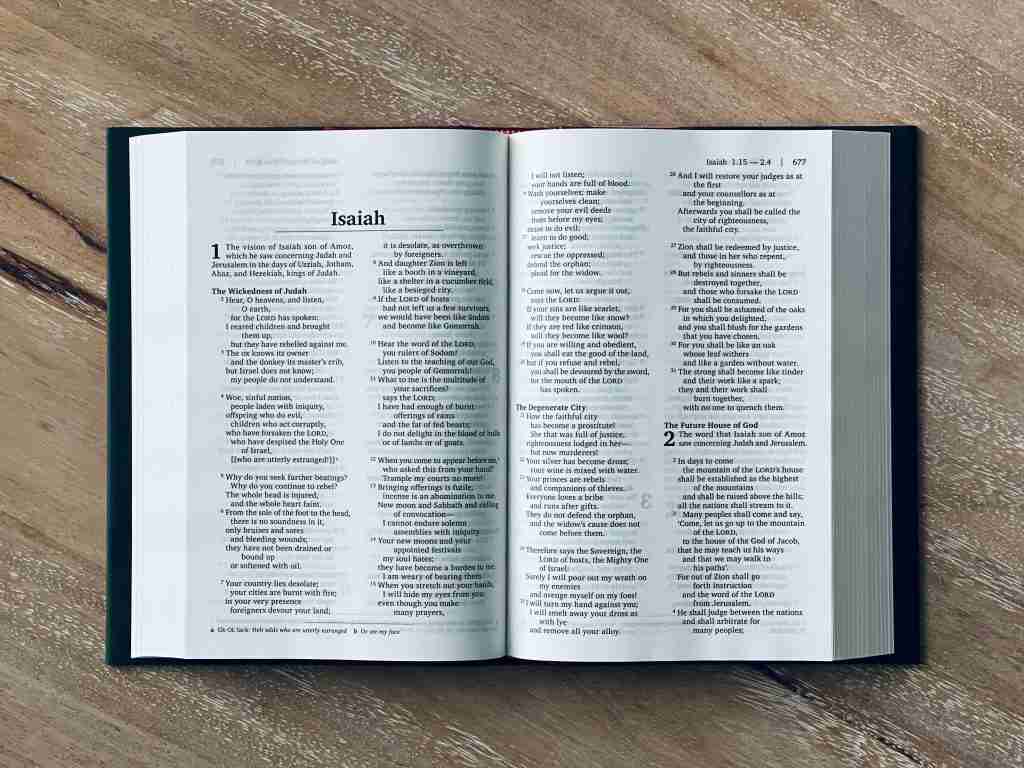
“Come now, let us settle the matter,” says the Lord. “Though your sins are like scarlet, they shall be as white as snow; though they are red as crimson, they shall be like wool.”
– Isaiah 1:18 NIV
Photo by Tim Wildsmith on Unsplash
Meaning of Isaiah 1:18 for modern believers
God’s Word is full of beautiful promises. Even though it was written thousands of years ago, it is still true today. God’s character does not change and He is the same yesterday, today, and forevermore (Hebrews 13:8) – so His promises do not change either. The last page of Revelation is not the last word in the story that God is writing. Christianity is based on the belief that God is still busy with His plan for redemption that will one day come in fullness when His Kingdom comes. Since the story is not over yet, God’s promises are still applicable today.
The promise in this verse is: There is no sin too big for God’s forgiveness to cover it. He washes our red stained hearts and makes them white as snow.
Photo by Monica Galentino on Unsplash
This is the good news of the Gospel message. God settles the matter once and for all, there’s no doubting His plan. He promises Isaiah that all the sins of humankind will be washed clean. The main message from this verse is that the love and compassion of God cover a multitude of scarlet sins.
There is nothing that you can do that is too big for God’s grace to cover. No matter the evil of your doings, the sacrifice of Christ paid the price for the forgiveness of sins. 1 John 1:9 says, “If we confess our sins, he is faithful and just to forgive us our sins and to cleanse us from all unrighteousness”. When we come before the sight of God with a contrite heart, we can approach the throne of grace with boldness. This is the basic meaning of this verse.
Quick Assessment
Why does your prayer life keep falling flat?
It's usually one of four things — and each one needs a completely different strategy to break through. This 2-minute assessment tells you exactly which pattern is blocking you.
An even deeper theological understanding is available to us when we move from considering the verse on its own to reading it in its full context. Let’s discover what we can learn about the book of Isaiah so that our interpretation of this verse can deepen even more.
Understanding the Book of Isaiah
In order to understand the verse at hand, we first have to understand the book in which it exists. This will help us to understand the significance of the imagery used in the vision of Isaiah. It is kind of like zooming out and looking at the picture as a whole.
Isaiah is a prophetic book found in the Old Testament of the Bible. It consists of a collection of beautiful poems and some narrative parts. The verse at hand is part of a poem. Of course, it might not seem this way because it does not rhyme in the English Bible, but it was originally written in the Hebrew language.
Free Resource
Get Your FREE Prayer Guide Now
and join the Daily Way Devotional: Join 25,000+ Subscribers
Isaiah was a prophet, which means he was God’s messenger, and this book records the messages he received from God for the people of Judah in the days of Uzziah, Jotham, Ahaz, and Hezekiah. (These were the kings who ruled during the days when Isaiah shared his message).
In many ways, the prophets of the Old Testament like the prophet Isaiah were pointing to something in the future.
The New Testament does not make a lot of sense when we try to read it on its own. That’s because Jesus Christ is the Messiah that the nation of Israel had been waiting for. We will see this in the part of Isaiah that we will study today. The promise made in Isaiah 1:18 is answered by none other than Christ himself.
Let’s look at the verses surrounding Isaiah 1:18 so that we can understand the context of the verse. Sometimes when we single out Bible verses, we lose their original meaning. The popular Bible verses that we often see on bumper stickers and tattoos are unfortunately often misinterpreted completely, because they are read on their own rather than as part of a whole. For example, if we read the text around the verse “I can do all things through Christ who strengthens me”, we will find that Paul was speaking about learning to live with little and trusting God for financial provision!
What might we discover about the true meaning of Isaiah 1:18 when we read the surrounding text?
Isaiah 1:18 in context
In the following section of this post, we are going to walk through the whole of Chapter 1 line by line. The whole vision stretches from Isaiah 1:2-31 before a second vision is given in Chapter 2. Some believe the first vision can be divided into two parts, marked by the repeat of the line “The Lord has spoken” that comes around again in verse 20. Overall, it is a beautiful poetic chapter with imagery based on animals, food, and plants.
“The chapter is the beginning of a conversation, not necessarily the last word.”
Professor of Religion, Blake Couey.
Let’s discover this first vision of the prophet Isaiah:
Opening and introduction
Firstly, the Bible describes the first vision of Isaiah as “the vision concerning Judah and Jerusalem that Isaiah son of Amoz saw during the reigns of Uzziah, Jotham, Ahaz and Hezekiah, kings of Judah.” This just tells us what the vision is about, who saw it, and when. Isaiah’s message was about Judah and Jerusalem. It was for the sake of the small remnant God spoke to Isaiah.
In the opening, Isaiah calls for the people’s attention. This also calls us to focus and give our attention to what is to come. (v. 1)
“Hear me, you heavens! Listen, earth! For the Lord has spoken…”
God explains how the people He created became rebellious. Even animals know their masters, but Israel (God’s people) has forgotten about God. This imagery shows the Father heart of God. (vv.2-3)
“I reared children and brought them up, but they have rebelled against me. The ox knows its master, the donkey its owner’s manger, but Israel does not know, my people do not understand.”
Then He describes how they’ve rebelled: they were sinful, evil, and corrupt; turning their backs on God. Notice the focus is put on their guilt and shame because of the wrongs they’ve done. (v.4)
“Woe to the sinful nation, a people whose guilt is great, a brood of evildoers, children given to corruption! They have forsaken the Lord; they have spurned the Holy One of Israel and turned their backs on him.”
The disaster that follows the rebellion
The people’s suffering is described along with the state that their nation is in. They seem to be suffering in every area of life, yet they continue to do what is evil in the Lord’s sight.(vv.5-7)
“Why should you be beaten anymore? Why do you persist in rebellion? Your whole head is injured, your whole heart afflicted. From the sole of your foot to the top of your head there is no soundness— only wounds and welts and open sores, not cleansed or bandaged or soothed with olive oil. Your country is desolate, your cities burned with fire; your fields are being stripped by foreigners right before you, laid waste as when overthrown by strangers.”
Then the hopelessness of the situation is likened to Sodom & Gomorrah, two wicked cities from the book of Genesis that are destroyed by God because of their evil acts. (vv.8-10)
“Daughter Zion is left like a shelter in a vineyard, like a hut in a cucumber field, like a city under siege. Unless the Lord Almighty had left us some survivors, we would have become like Sodom, we would have been like Gomorrah. Hear the word of the Lord, you rulers of Sodom, listen to the instruction of our God, you people of Gomorrah!”
The old way of fixing it is not working
The law books of the Old Testament make it very clear how sinners of every age can get rid of their sins. Here sinners had to jump through certain hoops in order to be set right with God. God explains that the festivals, sabbaths, burnt offerings, and sacrifices the people offer in the Temple are worth nothing if it does not lead to a whole life change. All the people knew was religious actions to repair their broken relationship with God. Now Isaiah is saying those things mean nothing to God if the people continue sinning. This kind of hypocrisy is something that still challenges modern believers. (vv.11-14)
“The multitude of your sacrifices— what are they to me?” says the Lord. “I have more than enough of burnt offerings, of rams and the fat of fattened animals; I have no pleasure in the blood of bulls and lambs and goats. When you come to appear before me, who has asked this of you, this trampling of my courts? Stop bringing meaningless offerings! Your incense is detestable to me. New Moons, Sabbaths and convocations— I cannot bear your worthless assemblies. Your New Moon feasts and your appointed festivals I hate with all my being. They have become a burden to me; I am weary of bearing them.”
He goes on to explain why He seems far from the people; they have probably sensed His absence. The last words about the hands full of brought evoke imagery of a bright red color or scarlet dye. Imagine if someone tries to offer you a cup of water but their hands are full of blood – The cup will be red and you might not even want to drink the water. (v.15)
“When you spread out your hands in prayer, I hide my eyes from you; even when you offer many prayers, I am not listening. Your hands are full of blood!”
Redemption and the hope of restoration
But then, in His kindness, God offers them a way out. He explains how they can do things differently. The only way that people could become clean from any transgression of the law was by making certain sacrifices of the law. Because of the righteousness of Christ and the blood of the lamb, we now have full access to God. (vv.16-17)
“Wash and make yourselves clean. Take your evil deeds out of my sight; stop doing wrong. Learn to do right; seek justice. Defend the oppressed.Take up the cause of the fatherless; plead the case of the widow.”
Instead of punishment, this is what God will do. The color red here reminds us of verse 15 just earlier where the people’s hands folded in prayer are described as being covered in blood from their sinful actions. God is offering a way out of difficult times for the nation of Judah. (v.18)
“Come now, let us settle the matter,” says the Lord. “Though your sins are like scarlet, they shall be as white as snow; though they are red as crimson, they shall be like wool.”
Photo by Zachary Olson on Unsplash
He gives a warning once more and concludes the first part of the poem by repeating the line “for the mouth of the Lord has spoken” (v.19-20) There is a clear decision available to the people of God, as seen in verses 19-20. These verses seem to say: If you are willing to repent and surrender, this will happen, but if you are not, your suffering will continue.
“If you are willing and obedient, you will eat the good things of the land; but if you resist and rebel, you will be devoured by the sword. For the mouth of the Lord has spoken.”
Warnings if wrongdoing persists
As mentioned above, some scholars consider the next part to be a second poem. Although, in our Bibles, it is part of the same chapter. In the rest of the chapter, the wrongdoings of the Israelites are described again. The theme of social justice repeats – caring for the orphans and the widows. (vv. 21-23)
“See how the faithful city has become a prostitute! She once was full of justice; righteousness used to dwell in her— but now murderers! Your silver has become dross, your choice wine is diluted with water. Your rulers are rebels, partners with thieves; they all love bribes and chase after gifts. They do not defend the cause of the fatherless; the widow’s case does not come before them.”
God’s wrath comes on His enemies. (vv. 24-25)
“Therefore the Lord, the Lord Almighty, the Mighty One of Israel, declares: “Ah! I will vent my wrath on my foes and avenge myself on my enemies. I will turn my hand against you; I will thoroughly purge away your dross and remove all your impurities.”
Restoration: City of Righteoussness
Then the restoration of God’s people is described. When we read of Zion or Daughter Zion it means the people of God. That is the Israelites whom Isaiah was talking to, but it is also you and me today. (vv. 26-27)
“I will restore your leaders as in days of old, your rulers as at the beginning. Afterward you will be called the City of Righteousness, the Faithful City.” Zion will be delivered with justice, her penitent ones with righteousness.”
A final warning is given to those who do not repent. These final verses have beautiful garden imagery that encourages the people to return to the Lord. It is this open-ended nature of the poem that allows it to move beyond its historical roots in the 8th century BCE Judah, and address modern believers. (vv.28-31)
“But rebels and sinners will both be broken, and those who forsake the Lord will perish. You will be ashamed because of the sacred oaks in which you have delighted; you will be disgraced because of the gardens that you have chosen. You will be like an oak with fading leaves, like a garden without water. The mighty man will become tinder and his work a spark; both will burn together, with no one to quench the fire.”
Summary of Isaiah Chapter 1 as a whole
God’s people have rebelled and there is a stain of sin on them. They are deserving of the wrath of God. It is clear that this passage of Isaiah 1:18 is part of a larger narrative. However, because of the goodness of God, He promises to wash them clean and restore their relationship that was damaged when they chose to sin.
The cross was needed because we were stained and unable to clean ourselves. “All have sinned and fall short of the glory of God” (Romans 3:23). “If we say we have no sin, we deceive ourselves, and the truth is not in us” 1 John 1:8-9.
But because of the ultimate price that Jesus paid for our sins, there is now nothing that stands between us and God. We have full access to the Holy Spirit and free access to God the Father through the loving sacrifice of Jesus Christ. We are washed clean and restored, praise God!
Reflect on the questions below as you digest this piece of Scripture.
Do you need to repent of any sins or transgressions?
Do you live as if you have really been washed clean?
Are you bringing God your worship with the equivalent of blood-stained hands?
Are you fighting for those who cannot fight for themselves?
Are you a tree planted by streams of water (Psalm 1) or more like the tree described at the end of this chapter?
______________
Resources:
– Bible verses were obtained from biblegateway.com
Eljoh Hartzer is combining theology and art to nurture faith journeys across generations. She is a Masters-level Practical Theologian with the University of Stellenbosch. She is also a writer and editor in the niche of Christianity and children's content and she illustrates children's books. Eljoh resides in the Swartland area in the Western Cape province of South Africa.
You can follow Eljoh on LinkedIn or Instagram.