A friend of mine sat across from me after a Sunday service, genuinely shaken. The pastor had said something about God choosing people before the world began — and now she couldn’t stop asking: if that’s true, does my faith even matter? I didn’t have a quick answer. What I did have was this: the same Bible that says God predestines also says “whoever believes.” Both are there. The question is what to do with that tension — and that’s exactly what these verses are about.
If you’ve ever been in a room where Calvinists and Arminians start debating, you know it can go sideways fast. But underneath all the theological labels is a genuinely important question: does God choose people for salvation, and if so, what does that mean for human freedom and responsibility?
Quick Assessment
Why does your prayer life keep falling flat?
It's usually one of four things — and each one needs a completely different strategy to break through. This 2-minute assessment tells you exactly which pattern is blocking you.
The honest answer is that the Bible holds both truths in tension. The Apostle Paul writes about God’s sovereign election in Romans 9 — and then commands people to repent and believe in Romans 10. Jesus says “no one can come to me unless the Father draws them” and also says “come to me, all who are weary.” Scripture doesn’t apologize for that tension. It holds it.
Below are the key Bible verses on predestination, organized by what they actually teach — not dumped in a numbered list. We’ll cover the foundational passages, the Old Testament roots, the free will tension, and what the doctrine of predestination does and doesn’t mean for everyday Christians.
There’s no better place to start with the verses on predestination than Romans 8:29-30. Theologians call it “the Golden Chain” — five unbroken links connecting God’s foreknowledge to His ultimate glory for His people.
“For those God foreknew he also predestined to be conformed to the image of his Son, that he might be the firstborn among many brothers and sisters. And those he predestined, he also called; those he called, he also justified; those he justified, he also glorified.” — Romans 8:29-30 (NIV)
Notice what the Apostle Paul is saying here. The goal of predestination isn’t only a ticket to eternal life — it’s transformation. Being conformed to the image of his Son is the destination. God doesn’t just choose people; He is shaping them into the likeness of his Son, Jesus Christ, over the course of a lifetime.
The five links in the chain: foreknew → predestined → called → justified → glorified. Every step is God’s action. Paul writes it all in the past tense — even “glorified” — because God’s purpose is that certain. In his mind, it’s already done.
Crucially, Paul didn’t write this to spark a theological debate. He wrote it to comfort Christians who were suffering. It comes right after Romans 8:28 — “all things work together for good for those called according to his purpose.” That’s the context: God’s sovereignty here is meant to be a source of peace, not anxiety. The foreknowledge of God leads not to fear but to an unshakeable confidence in eternal life.
A Real Moment
I’ve watched friends read Romans 8:28-30 during the hardest seasons of their lives — a miscarriage, a cancer diagnosis, a job that just collapsed. What struck me every time was how those five linked steps calmed something in them. Not because they suddenly understood all the theology, but because they glimpsed that they weren’t an accident. God had planned something — for them — before the world began. That changes how you carry grief.
Chosen Before the World Began — Ephesians 1
The first chapter of Ephesians is the richest single passage on predestination in the entire New Testament. The Apostle Paul piles up language about God’s choice before the foundation of the world, building into a kind of hymn of astonishment about God’s love.
He opens with: “Blessed be the God and Father of our Lord Jesus Christ, who hath blessed us with all spiritual blessings in heavenly places in Christ” (Ephesians 1:3). That phrase — spiritual blessings in heavenly places — sets the stage for everything that follows. We are already blessed, in Christ, in the heavenly realm. Before we did anything.
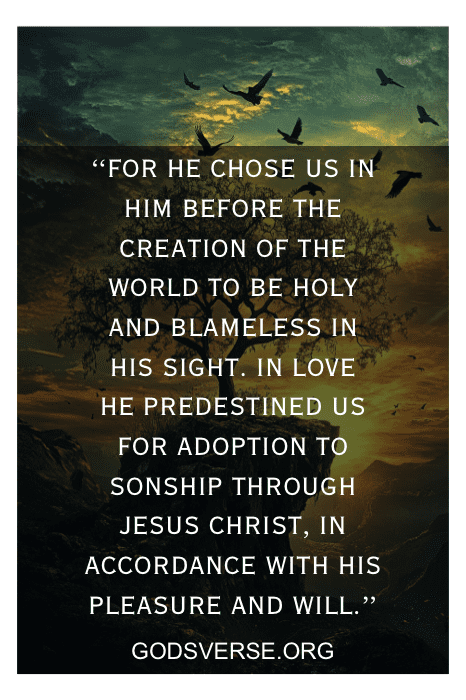
Ephesians 1:4-5 (NIV)
“For he chose us in him before the creation of the world to be holy and blameless in his sight. In love he predestined us for adoption to sonship through Jesus Christ, in accordance with his pleasure and will.”
Two things God chose us for: holiness and adoption. Before the foundation of the world, the adoption of children into His family was already His plan.
Ephesians 1:11 (NIV)
“In him we were also chosen, having been predestined according to the plan of him who works out everything in conformity with the purpose of his will.”
The counsel of his will runs through everything — not just individual salvation, but all of history. God’s plan for gathering all things in Christ encompasses the whole world.
Ephesians 1:9-10 (NIV)
“He made known to us the mystery of his will according to his good pleasure, which he purposed in Christ, to be put into effect when the times reach their fulfillment — to bring unity to all things in heaven and on earth under Christ.”
The fullness of the times — God is gathering all of history to one point. Predestination is part of a cosmic plan far bigger than any individual’s eternal destiny.
Ephesians 1:6 (KJV)
“To the praise of the glory of his grace, wherein he hath made us accepted in the beloved.”
The ultimate purpose of predestination isn’t personal comfort — it’s the praise of the glory of his grace. God’s love and generosity get all the credit.
What Ephesians 1 makes clear is that predestination isn’t an afterthought. It’s the opening movement of God’s eternal plan, rooted in the kind intention of his will, expressed through the Father of our Lord Jesus Christ, and aimed at adoption — bringing people into God’s family as children.
One phrase that gets overlooked: “in love he predestined us” (v. 4-5). The doctrine of predestination is not about cold mechanical sovereignty. It’s rooted in God’s love. That changes the feel of the entire discussion.
Paul closes the passage with a doxology: the whole plan — election, predestination, redemption, forgiveness — exists for the praise of the glory of his grace. Predestination points you toward worship, not worry.
God Draws and God Calls — Verses on Effectual Calling
One of the clearest teachings connected to predestination is what theologians call “effectual calling” — the idea that God doesn’t just invite people to salvation, He draws them. Jesus says this explicitly in John 6.
“No one can come to me unless the Father who sent me draws them, and I will raise them up at the last day.” — John 6:44 (NIV)
He says it again a few verses later: “No one can come to me unless the Father has enabled them” (John 6:65). The initiative is God’s. This is a linchpin verse for those who hold to unconditional election — the drawing isn’t a general invitation but a specific act of God toward particular people, with the promise of eternal life at the last day following.
Those who emphasize free will read “draws” differently. They point to John 12:32 — “And I, when I am lifted up from the earth, will draw all people to myself” — and argue the drawing is universal and resistible. Both readings are serious engagements with the same text. The debate is real.
Acts 13:48 (NIV)
“When the Gentiles heard this, they were glad and honored the word of the Lord; and all who were appointed for eternal life believed.”
The order matters: appointed first, then believed. Luke doesn’t say they believed and were therefore written in. The appointment to eternal life preceded their faith.
John 15:16 (NIV)
“You did not choose me, but I chose you and appointed you so that you might go and bear fruit — fruit that will last — and so that whatever you ask in my name the Father will give you.”
Jesus says this to His disciples on the night of His arrest. The choosing is God’s; the bearing fruit is ours. Both are real.
Matthew 22:14 (NIV)
“For many are invited, but few are chosen.”
Two distinct groups: the invited (many) and the chosen (fewer). This is the heart of the issue of predestination — an open invitation that not all respond to, and a choosing that runs deeper than the invitation.
2 Timothy 1:9 (NIV)
“He has saved us and called us to a holy calling — not because of anything we have done but because of his own purpose and grace. This grace was given us in Christ Jesus before the beginning of time.”
The calling and grace were established before the beginning of time. This is a holy calling rooted in God’s own purpose — it’s a gift of God, not a reward for performance.
For more on how these calling passages connect to God’s guidance in everyday life, the Bible verses about God’s will collection is worth reading alongside this one.
Old Testament Roots of Predestination
The doctrine of predestination is often treated as a New Testament innovation — Paul’s idea. But the roots run all the way through the Old Testament. God’s sovereignty over human destinies isn’t new in the letters of Christ Jesus. It’s the background music of the entire Bible.
“Before I formed you in the womb I knew you, before you were born I set you apart; I appointed you as a prophet to the nations.” — Jeremiah 1:5 (NIV)
God speaks this to Jeremiah before a single word of his prophetic ministry has begun. His calling wasn’t a response to his track record — it was established before his birth. This is the foreknowledge of God expressed in personal, intimate terms. God doesn’t just know future events in the abstract; He knows people.
Psalm 139:16 (NIV)
“Your eyes saw my unformed body; all the days ordained for me were written in your book before one of them came to be.”
David isn’t making a systematic theological argument here — he’s worshipping. God’s foreknowledge of every day of his life filled him with awe, not dread. That’s the posture these truths are meant to produce.
Isaiah 46:10 (NIV)
“I make known the end from the beginning, from ancient times, what is still to come. I say, ‘My purpose will stand, and I will do all that I please.'”
God’s knowledge stretches from ancient times to the last day. His purpose is declared and certain. What He has planned will stand — not because people cooperate, but because He is God.
Psalm 65:4 (NIV)
“Blessed are those you choose and bring near to live in your courts! We are filled with the good things of your house, of your holy temple.”
God’s choosing is described as a blessing — not as something frightening. Those He chooses, He brings near. Proximity to God is the fruit of election in this verse.
Isaiah 14:24 (NIV)
“The Lord Almighty has sworn, ‘Surely, as I have planned, so it will be, and as I have purposed, so it will happen.'”
The Lord of hosts doesn’t revise His plans. What He purposes in ancient times is what happens. This is the foundation of confidence in His promises for children of God.
Deuteronomy 7:6 is worth reading as corporate election: “The Lord your God has chosen you out of all the peoples on the face of the earth to be his people, his treasured possession.” God chose Israel not because they were great — He says explicitly it wasn’t because of their size or righteousness — but because of His love and His oath to their ancestors. The Apostle Paul grounds his whole argument about predestination in Romans 9-11 in exactly these kinds of Old Testament texts.
The Free Will Tension — Verses That Push Back
Here’s where honest Bible study gets interesting. The same Bible that says God predestines specific people also says He “desires all people to be saved and to come to a knowledge of the truth” (1 Timothy 2:4). Those two claims have to be held together.
If God predestines people for salvation, and God desires all people to be saved, then either “all” doesn’t mean every individual, or God’s desire is a genuine wish that doesn’t compel the outcome, or there’s something about the relationship between free will and predestination that we don’t fully understand. All three positions have serious thinkers behind them. None are careless readings.
1 Timothy 2:4 (NIV)
“Who wants all people to be saved and to come to a knowledge of the truth.”
God’s desire is for the whole world. Arminians read this as evidence that election is based on God’s foreknowledge of who will believe, not an unconditional choice without regard to human response.
2 Peter 3:9 (NIV)
“The Lord is not slow in keeping his promise, as some understand slowness. Instead he is patient with you, not wanting anyone to perish, but everyone to come to repentance.”
God’s patience in delaying judgment is evidence of His genuine desire to see people turn to Him. He is not willing for any to be lost to eternal death when repentance is available.
John 3:16 (NIV)
“For God so loved the world that he gave his one and only Son, that whoever believes in him shall not perish but have eternal life.”
The scope is the whole world. The offer is for whoever believes. The promise of eternal life is genuinely open-ended here. This is good news for all people.
Ezekiel 18:23 (NIV)
“Do I take any pleasure in the death of the wicked? declares the Sovereign Lord. Rather, am I not pleased when they turn from their ways and live?”
God’s own testimony about His character. He does not delight in judgment. He delights in repentance. This matters enormously for how we understand the idea of predestination and eternal destiny.
The Apostle Paul raises the objection himself in Romans 9: “What then shall we say? Is God unjust?” (v. 14). He doesn’t dismiss the question — he answers it by going back to God’s own words to Moses: “I will have mercy on whom I have mercy, and I will have compassion on whom I have compassion” (Romans 9:15). The mystery isn’t neatly resolved. It’s grounded in the character of God.
“But who are you, a human being, to talk back to God? Shall what is formed say to the one who formed it, ‘Why did you make me like this?’ Does not the potter have the right to make out of the same lump of clay some pottery for special purposes and some for common use?” — Romans 9:20-21 (NIV)
Paul’s response to the fairness question isn’t a logical proof — it’s a posture. We are clay; God is the potter. The creature doesn’t interrogate the Creator’s motives. O man, Paul says — and the O man here is meant to humble, not dismiss. These are difficult questions, and Paul knows it. He holds them by returning to God’s sovereignty and character rather than by solving the paradox.
Revelation 22:17 gives the invitation its widest possible scope: “The Spirit and the bride say, ‘Come!’ And let the one who hears say, ‘Come!’ Let the one who is thirsty come; and let the one who wishes take the free gift of the water of life.” The offer of eternal life is genuinely open. If you want it, it’s yours.
A Real Moment
I’ve sat with people who got genuinely scared by the idea of predestination — not intellectually scared, spiritually scared. “What if I’m not one of the chosen?” It’s a real fear and I take it seriously. What I always come back to: the Bible never says “examine God’s secret decree to see if you’re saved.” It says look to Christ. John 6:37 is the verse I always go back to: “Whoever comes to me I will never drive away.” If you want to come, there is nothing in the doctrine of predestination that should stop you.
Sovereignty and Human Responsibility — Both Are Real
One of the biggest mistakes in this debate is treating predestination and human responsibility as mutually exclusive. The Bible doesn’t do that. The Apostle Paul does both in the same breath.
In Philippians 2:12-13, he writes: “Work out your salvation with fear and trembling, for it is God who works in you to will and to act in order to fulfill his good purpose.” Both clauses live in the same sentence. You work it out. God works in you. That’s not a contradiction — it’s a mystery the Bible is comfortable holding.
2 Peter 1:10 (NIV)
“Therefore, my brothers and sisters, make every effort to confirm your calling and election. For if you do these things, you will never stumble.”
Peter doesn’t tell believers to examine God’s hidden decree. He tells them to confirm their calling through fruitful, growing faith. Election is confirmed through life, not logic.
1 Peter 1:2 (NIV)
“Who have been chosen according to the foreknowledge of God the Father, through the sanctifying work of the Spirit, to be obedient to Jesus Christ and sprinkled with his blood.”
Three agents working together: God’s foreknowledge, the Holy Spirit’s sanctifying work, Christ’s blood. Election in the New Testament is always Trinitarian — Father, Son, and Holy Spirit all involved.
John 10:28-29 (NIV)
“I give them eternal life, and they shall never perish; no one will snatch them out of my hand. My Father, who has given them to me, is greater than all; no one can snatch them out of my Father’s hand.”
The security of eternal life here doesn’t come from the believer’s grip on God — it comes from God’s grip on them. That’s a completely different kind of assurance.
Ephesians 2:8-9 (NIV)
“For it is by grace you have been saved, through faith — and this is not from yourselves, it is the gift of God — not by works, so that no one can boast.”
Salvation is a gift of God from start to finish. Even the faith through which we receive it is God’s work in us. There’s nothing in this transaction that earns a boast.
Romans 11:5 makes the connection between grace and election direct: “At the present time there is a remnant chosen by grace.” The remnant isn’t self-made. But belonging to it is expressed through living faith, not passive fatalism.
What Predestination Does NOT Mean
The biblical doctrine of predestination has been misused and misunderstood for centuries. It’s been used to frighten people, excuse passivity, and fuel arrogance. Before going further, here’s what these Bible verses are not saying.
It Does NOT Mean Your Choices Are Meaningless
The Bible commands people to repent, believe, seek God, and obey — hundreds of times across both the Old and New Testaments. Those commands assume your choices have real weight and real consequence. A God who commands belief while making it impossible without telling you would not be the God of Scripture. God’s sovereignty doesn’t flatten human responsibility — it operates through it.
It Does NOT Mean God Predestines People to Hell
Even theologians who hold to some form of double predestination are careful to say that election to salvation and reprobation are not symmetric. God elects by grace. People face judgment because of their own sin and rejection of God — not because God arbitrarily assigned them to eternal death. Most Christians, including many Calvinists, reject the idea that God takes pleasure in condemnation. Ezekiel 18:23 is explicit: God does not delight in the death of the wicked. God’s desire is that they turn and live.
It Does NOT Mean Evangelism and Prayer Are Pointless
The Apostle Paul believed in God’s sovereignty in salvation and preached the gospel relentlessly across the whole world. He wrote in Romans 10:14: “How can they believe in the one of whom they have not heard?” Paul saw no contradiction between God’s sovereign election and urgent proclamation of the good news. Charles Spurgeon, one of history’s greatest evangelists, was a convinced Calvinist. God’s plan for eternal life includes the means He uses to bring people in — and the preaching of the gospel is one of those means.
It Does NOT Mean You Can’t Know if You’re Chosen
Scripture never tells believers to peer anxiously into God’s eternal decree. Second Peter 1:10 tells them to “make your calling and election sure” — not by figuring out what’s hidden in God’s mind, but by pursuing the fruit of genuine faith. And John 6:37 gives the simplest promise: “whoever comes to me I will never drive away.” If you want to come to Christ, that desire is itself evidence of God’s grace at work. Come.
What Calvin, Arminius, Luther, Augustine, Spurgeon & MacArthur Said
The debate over the doctrine of predestination has produced some of history’s most careful theological thinking — and some of its bitterest arguments. Here’s where the major figures actually stood, based on their own words and writings.
Augustine of Hippo (354–430)
Augustine is the grandfather of the predestination debate in Western Christianity — centuries before John Calvin. After his own dramatic conversion, he became convinced that his own will had been captive to sin and that only God’s grace had freed him. He developed a theology of election in which God’s grace is not merely offered but effectively given to those He has chosen. His debates with Pelagius (who taught that humans could merit salvation through free will) shaped the entire subsequent tradition. Calvin credited Augustine heavily.
Martin Luther (1483–1546)
Martin Luther held a strong view of God’s sovereignty in salvation, arguing in “The Bondage of the Will” (1525) that the human will is captive to sin and cannot freely choose God without divine grace. Luther wrote this in direct response to Erasmus, who defended free will. Luther’s position is closer to Calvin’s than to Arminius, though he was not a systematic Calvinist and didn’t develop the doctrine as Calvin did.
John Calvin (1509–1564)
John Calvin is the name most associated with the doctrine of predestination in Christian theology. He taught unconditional election — God chooses people for salvation based purely on His own will and purpose, not on any foreseen merit or faith. For Calvin, this was the only view that fully protected the absolute sovereignty of God and the absolute gratuity of grace. His system is often summarized by TULIP: Total depravity, Unconditional election, Limited atonement, Irresistible grace, Perseverance of the saints.
Jacobus Arminius (1560–1609)
Arminius pushed back on Calvin’s unconditional election. He argued that God’s election is conditional — based on His foreknowledge of who would freely believe. The foreknowledge of God, in the Arminian view, includes God seeing ahead who would accept His grace, and He elects them on that basis. This preserves free will as a genuine factor in salvation. Methodists, Pentecostals, and many Baptist traditions lean Arminian.
Charles Spurgeon (1834–1892)
Charles Spurgeon was a convinced Calvinist and one of history’s most effective evangelists — and he saw no contradiction in that combination. He wrote: “I believe in the doctrine of election, because I am quite sure that if God had not chosen me I should never have chosen him.” He also made clear that God’s sovereignty in salvation was not a cold doctrine but a source of deep comfort and confidence. For Spurgeon, god’s sovereignty was the ground of his boldness in preaching the good news to everyone.
John MacArthur (b. 1939)
John MacArthur holds to the Calvinist view and emphasizes that election is the consistent teaching of the Apostle Paul from Romans through Ephesians. He regularly teaches that the issue of predestination shouldn’t produce anxiety about salvation — the presence of genuine faith is itself evidence of election. His teaching on Romans 9-11, the potter and the clay, and God’s plan for Israel and the Gentiles is detailed and worth engaging if you want to understand the Reformed position at its most careful.
A Real Moment
A close friend spent two years in what he called “predestination paralysis” — so worried about whether he was among God’s elect that he stopped reading his Bible, stopped going to church, and fell into a kind of spiritual depression. What eventually broke through was a pastor who asked him: “Stop trying to figure out what God decided in eternity. What is Christ offering you right now? ‘Come to me, all who are weary.’ Can you come? Then come.” He said that question changed everything. Doctrine should produce assurance — not a spiral.
What This Means for You Today
All of this theology eventually has to land somewhere. What does the doctrine of predestination actually mean for ordinary Christians in ordinary life?
If you believe in God’s sovereignty: Let it produce humility, not pride. Election is not a badge — it’s a gift. Paul’s response to all of Romans 9-11 (three chapters of dense predestination theology) is worship: “Oh, the depth of the riches of the wisdom and knowledge of God! How unsearchable his judgments, and his paths beyond tracing out!” (Romans 11:33). The right destination for these truths is doxology, not smugness.
If the doctrine frightens you: The biblical command is not to examine God’s eternal decree but to look to Christ. Jesus says in John 6:37: “whoever comes to me I will never drive away.” The word “whoever” is wide open. If you want to come to Christ, there is no predestination theology that should stop you. The door is open. Come.
For your prayer life: God’s sovereignty doesn’t make prayer pointless. Paul believed in predestination and prayed constantly. He writes in Ephesians 1:16-17 that he hasn’t stopped thanking God and praying for the people he loves. The Apostle Paul held God’s sovereignty and fervent prayer in the same hands. God’s plan for His children includes their prayers as part of how He works.
For evangelism: God’s sovereignty should make you bolder, not quieter. You don’t know who is in God’s elect — but you do know the gospel is the means God uses. You don’t need to solve the predestination debate before sharing your faith. Go with confidence that the good news about Christ Jesus is never wasted.
A Prayer for Those Wrestling With This
For Those Who Want to Trust and Can’t Quite Get There
Lord, this doctrine is bigger than I can hold. The idea that You chose me before the foundation of the world — I don’t fully know what to do with that. Part of me wants to rest in it. Part of me is afraid.
Help me to look at Christ instead of at mystery. Help me to hear the invitation — “come to me, all who are weary” — and actually come. Let the fact of Your sovereignty be a pillow under my head, not a stone in my chest.
If I am already in Your hands, let me feel the grip. If I am still searching, let this be the prayer that leads me home.
In the name of Jesus Christ, Your Son and our Lord. Amen.
Frequently Asked Questions
What does Romans 8:29 mean by “predestined”?
Romans 8:29 says that those God foreknew He also predestined “to be conformed to the image of his Son.” The goal isn’t only eternal life — it’s transformation into the image of his Son, into the likeness of his Son, Jesus Christ. God’s purpose is shaping people to reflect Christ’s character over a lifetime — conformed to the image of his Son in mind, heart, and life. The Greek word is proorizo, meaning to decide beforehand or mark out in advance. God’s plan wasn’t reactive to what people would do — it was fixed before anything happened. Paul uses the same word in Ephesians 1:5 and 1:11.
What does Ephesians 1 say about predestination?
Ephesians 1 is the most concentrated passage on predestination in all of Scripture. The Apostle Paul says God chose us in Christ “before the creation of the world” (v. 4), predestined us for adoption as children through Jesus Christ (v. 5), made known to us “the mystery of his will” (v. 9), and arranged all of this “in accordance with the purpose of his will” (v. 11). The culminating purpose is the praise of the glory of his grace — worship, not pride. Everything in Ephesians 1 is rooted in God’s love and aimed at His glory.
What does 1 Timothy 2:4 say about predestination?
First Timothy 2:4 says God “wants all people to be saved and to come to a knowledge of the truth.” This sits in tension with verses that speak of God’s sovereign election of specific people. Calvinists often read “all” as all types of people — all nations, all classes, all backgrounds — rather than every individual without exception. Arminians take “all” as inclusive of every individual and see this as evidence that election is based on God’s foreknowledge of who will freely believe. Both readings take the text seriously. Neither is sloppy.
How can I know if I am predestined by God?
The Bible doesn’t direct you to look at God’s hidden decree — it directs you to look to Christ. John 6:37 is the key promise: “whoever comes to me I will never drive away.” If you come in faith and repentance, you will not be turned away. Second Peter 1:10 tells believers to make their “calling and election sure” through a life of growing faith and fruitfulness. The evidence of election is a life increasingly shaped by God’s Spirit. If you want Jesus, the invitation is open. Come — and let that coming be your assurance.
What are the five points of Calvinist predestination?
The five points are summarized by the acronym TULIP: Total depravity (humans cannot choose God without grace), Unconditional election (God’s choice is not based on foreseen merit), Limited atonement (Christ’s atoning work is specifically effective for the elect), Irresistible grace (God’s effectual calling cannot ultimately be refused), and Perseverance of the saints (the truly elect will persevere in faith to eternal life). Not every Christian who believes in predestination holds all five. Many affirm God’s sovereignty in election without accepting every element of the classic Calvinist system.
Does the Bible teach double predestination?
Double predestination is the idea that God actively decrees both who will be saved and who will be damned. Some Reformed theologians affirm this, but most are careful to note that election to salvation and reprobation are not symmetric — election is by grace, reprobation is due to sin and justice. Most Christians, including many Calvinists, strongly reject any idea that God takes pleasure in condemning people. Ezekiel 18:23 and 2 Peter 3:9 both testify that God’s desire is for repentance, not judgment. Scripture holds God’s sovereignty and genuine invitation in tension without resolving it cleanly.
Why do we pray if God has already predestined everything?
Because God uses means to accomplish His purposes — and prayer is one of those means. The Apostle Paul believed in God’s sovereignty and prayed without ceasing (1 Thessalonians 5:17). Jesus Himself prayed constantly. God’s plan doesn’t bypass human participation — it operates through it. Prayer isn’t about changing God’s mind; it’s about participating in what He is already doing. God has ordained both the ends and the means, and prayer is one of the means He uses to accomplish His good purpose in the lives of His children.
Is predestination just a Calvinist idea?
No. The word “predestined” appears directly in Romans 8:29-30 and Ephesians 1:5, 11 — it’s a biblical term, not a Calvinist invention. Augustine of Hippo taught a strong form of predestination in the 4th century, long before Calvin. Martin Luther held to God’s sovereignty in salvation. The real debate isn’t whether predestination is biblical (it clearly is) but what kind — unconditional (God’s sovereign choice independent of foreseen faith) or conditional (based on God’s foreknowledge of who will believe). Both views affirm predestination. They disagree on what grounds it.
Is there an Old Testament basis for predestination?
Yes — the roots go deep. Jeremiah 1:5 shows God’s foreknowledge of individuals before birth. Psalm 139:16 shows God’s knowledge of every ordained day of David’s life. Isaiah 46:10 shows God declaring the end from ancient times. Deuteronomy 7:6 shows the corporate election of Israel as God’s people. The Apostle Paul grounds his entire argument about predestination in Romans 9-11 in Old Testament texts about Pharaoh, Jacob and Esau, and the potter and the clay. The doctrine of predestination isn’t Paul’s innovation — it’s his application of truths God’s people have known since ancient times.
George Hendricks is the founder and managing editor of Godsverse.org. He has written and published over 200 skit reviews, church resource guides, and Bible study articles. With a background in data-driven content strategy and digital publishing, George built Godsverse into one of the most comprehensive collections of church skit reviews and printable scripts online. When he's not writing, he's researching what churches actually need and figuring out how to deliver it.