Affiliate Disclosure: Godsverse may earn a small commission when you purchase through links on this page — at no extra cost to you. We only recommend gear we’d actually put in front of a worship team.
A digital mixer is the nerve center of your church’s audio system. It’s where you blend the pastor’s voice, the worship band, the backing tracks, and everything else that needs to be heard. The right mixer transforms a chaotic service into something controlled and professional. The wrong one turns your sound engineer into someone who’s constantly fighting the equipment instead of focusing on the service.
I’ve watched sound engineers work with bad mixers. They look stressed. They miss cues. They can’t focus on the worship. Then I’ve seen them with a good mixer—and suddenly they’re relaxed, responsive, and the whole service flows better because the audio is there and invisible.
The problem is there are dozens of digital mixers on the market. This guide cuts through the noise and gives you the six best options for churches of different sizes and budgets.
The X32 is the mixer that defined digital mixing in churches. It’s been around for over a decade because it works. 40 input channels. 25-bus configuration. Motorized faders. Midas preamps throughout. This is the mixer every worship team wants because it can handle anything they throw at it.
I’ve watched a church transition from a broken analog board to an X32 and the audio engineer literally sighed with relief the first time he hit a cue. That’s what the X32 does. It gives you power and control without confusion.
The Good
40 input channels. Room for everything and future expansion.
Motorized faders. Stores settings and recalls instantly.
iPad control via X-Air. Run wireless from anywhere in the room.
Intuitive signal flow. Logical layout for mixing.
Deep plugin architecture. Add processing and effects.
USB recording built in. Capture services for archiving.
The Not-So-Good
Price is significant. $1,800 is a serious investment.
Learning curve for volunteers. Takes training.
Console size. Requires proper mounting or a dedicated rack space.
Overkill for very small churches. More than they need.
Who it’s for: Medium to large churches with professional sound engineers or trained volunteers. Any worship team that needs flexible mixing, recording capability, and room to grow. This is what churches choose when they’re serious about audio.
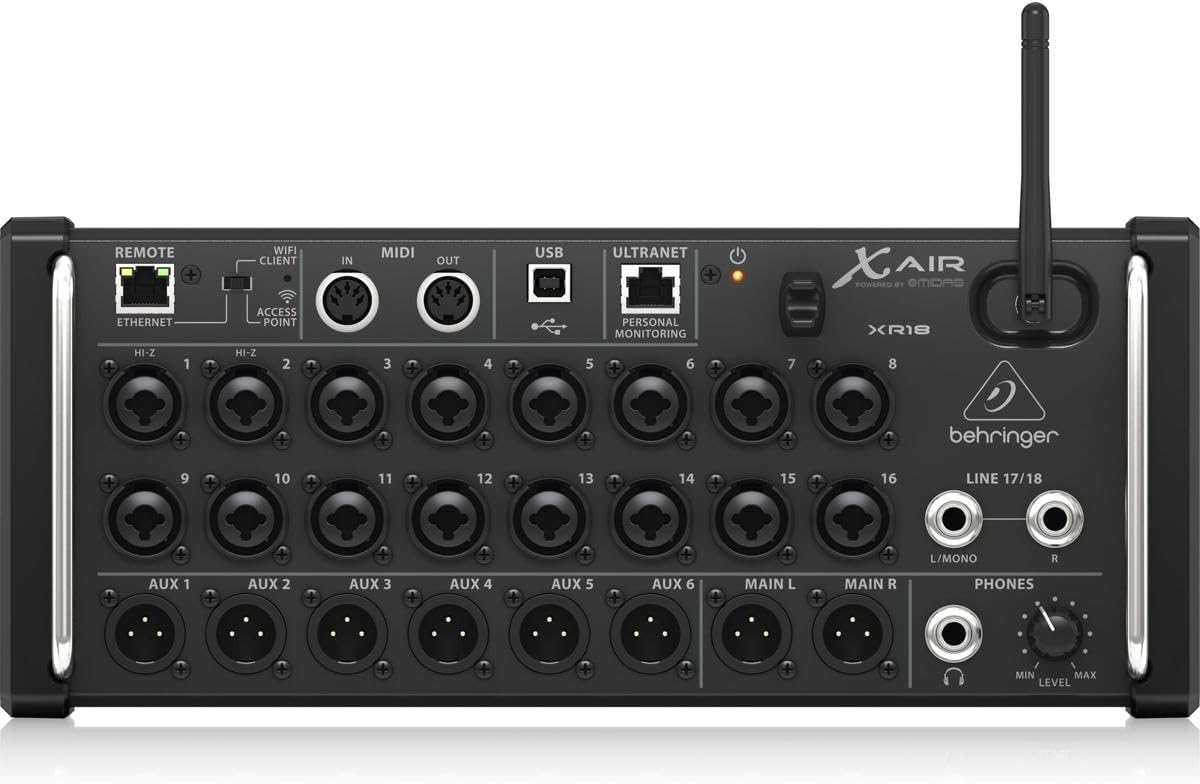
The XR18 is a surprise. It’s $459 and it’s genuinely professional. No gimmicks. No cost-cutting. Midas preamps, full digital processing, and it’s entirely tablet-controlled via iPad or Android. This is the mixer a church picks when budget is tight but they want real capability.
A church plant I know uses two XR18s daisy-chained together. For under $1,000 they have 36 channels of professional-grade mixing. The pastor said it was the best audio decision they made because it freed up money for other priorities.
The Good
Incredibly affordable. Under $500.
No physical console to learn. Everything on the iPad.
Midas preamps. Same quality as the $1,800 mixers.
18 channels with full processing and effects.
WiFi connectivity. Mix from anywhere in the building.
Compact. Can fit in a small control room or rack space.
Expandable. Add more units via networking.
The Not-So-Good
iPad-only operation. No physical faders or hardware console.
Requires WiFi. Network reliability matters.
18 channels may limit very large worship teams.
Takes time to learn the iPad interface even though it’s logical.
Who it’s for: Church plants and small churches on tight budgets. Any congregation under 200 people. Churches with 8-12 typical inputs. Also perfect for secondary spaces like prayer rooms or overflow areas.
Behringer X32 Compact — Best for Space Constraints
⭐ Smaller Footprint
★★★★★ 4.6/5 (920 reviews)
$1,399
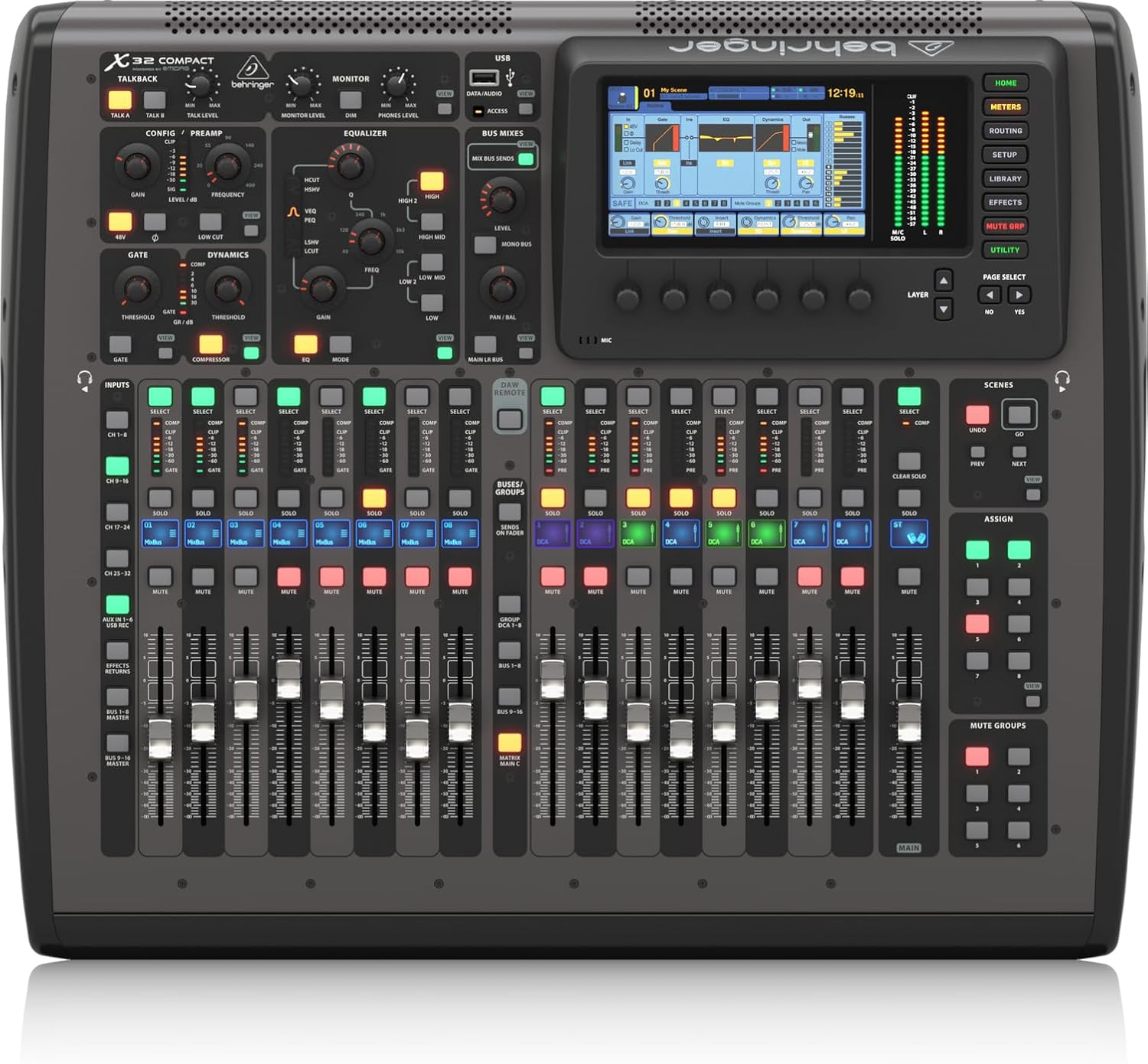
The X32 Compact is the X32 in a smaller body. You get 32 physical inputs (not 40) and 16 faders instead of 25, but the mixing power is identical. Everything else—the Midas preamps, the digital processing, the professional control—remains the same. It’s perfect for churches with limited control room space.
A church in an older building told me their control booth was tiny. The full X32 wouldn’t fit. The Compact solved it. They have the same mixer power but fit in the actual physical space they had available.
The Good
X32 power in a smaller size.
Smaller footprint fits tight control rooms.
32 input channels still handles most worship teams.
Same Midas preamps and digital processing as the full X32.
iPad control still available.
Motorized faders for recall and automation.
The Not-So-Good
$1,400 is still a significant investment.
Only 16 physical faders. Need to flip between layers for larger teams.
32 channels might feel limiting for very large worship bands.
Who it’s for: Churches that want X32 power but have limited physical space. Medium churches with 150-300 people. Any worship team needing professional capability in a compact form factor.
PreSonus StudioLive 16.0.2 — Best for Recording Services
🎙️ Recording Built-In
★★★★ 4.4/5 (670 reviews)
$999
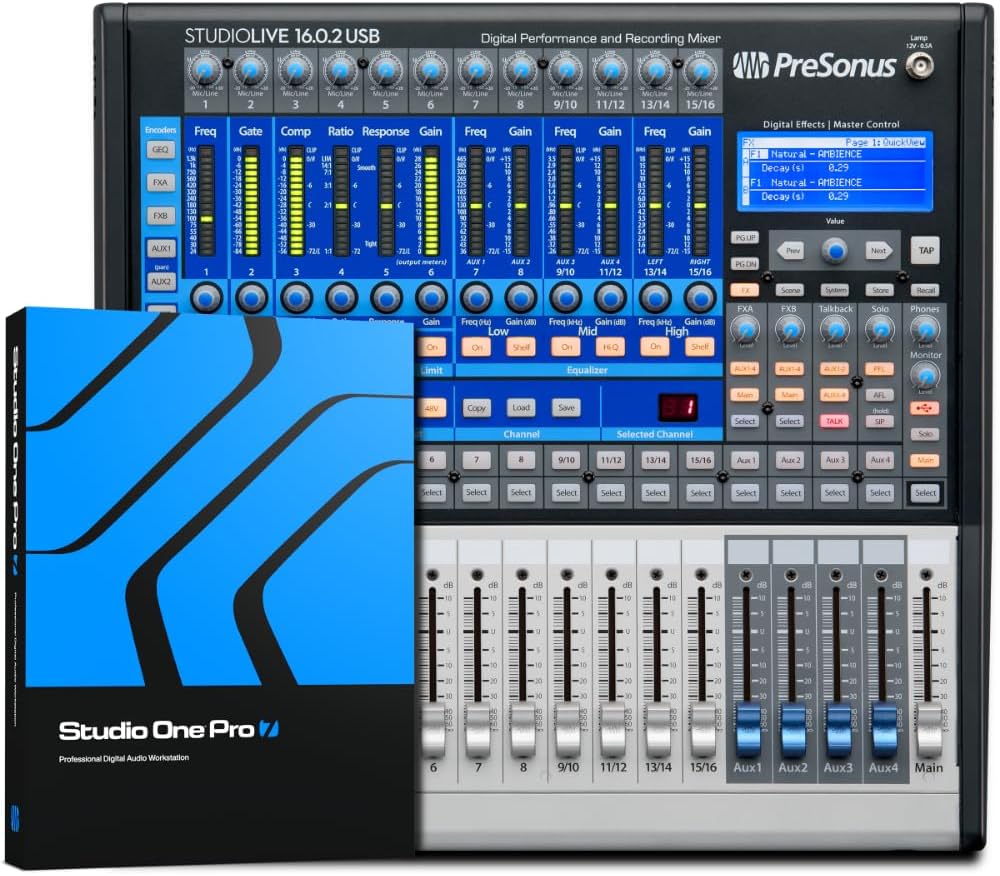
The PreSonus StudioLive is built for churches that want to record every service. It has a built-in USB interface that captures all 16 inputs to your computer. No additional audio interface needed. Affordable price for what you get. This is the mixer you choose when recording and podcasting matter as much as live mixing.
A church started a podcast after getting the StudioLive. They could mix for the live service and simultaneously capture everything to their computer. Two jobs with one mixer. That’s why PreSonus built it this way.
The Good
Built-in USB interface. No separate recorder needed.
Records all 16 channels individually. Mix for live and record simultaneously.
XMAX preamps. PreSonus’s professional preamp line.
16 channels with full digital processing.
iPad control available.
Affordable price for the feature set.
Great for churches that want to do podcast or streaming.
The Not-So-Good
Interface requires USB cable to computer for recording.
16 channels may limit very large worship bands.
Smaller display and fewer physical controls than some competitors.
Who it’s for: Churches that record and archive services. Any worship team doing podcasts or livestreaming. Congregations under 300 people that want one box to handle both live and recorded audio.
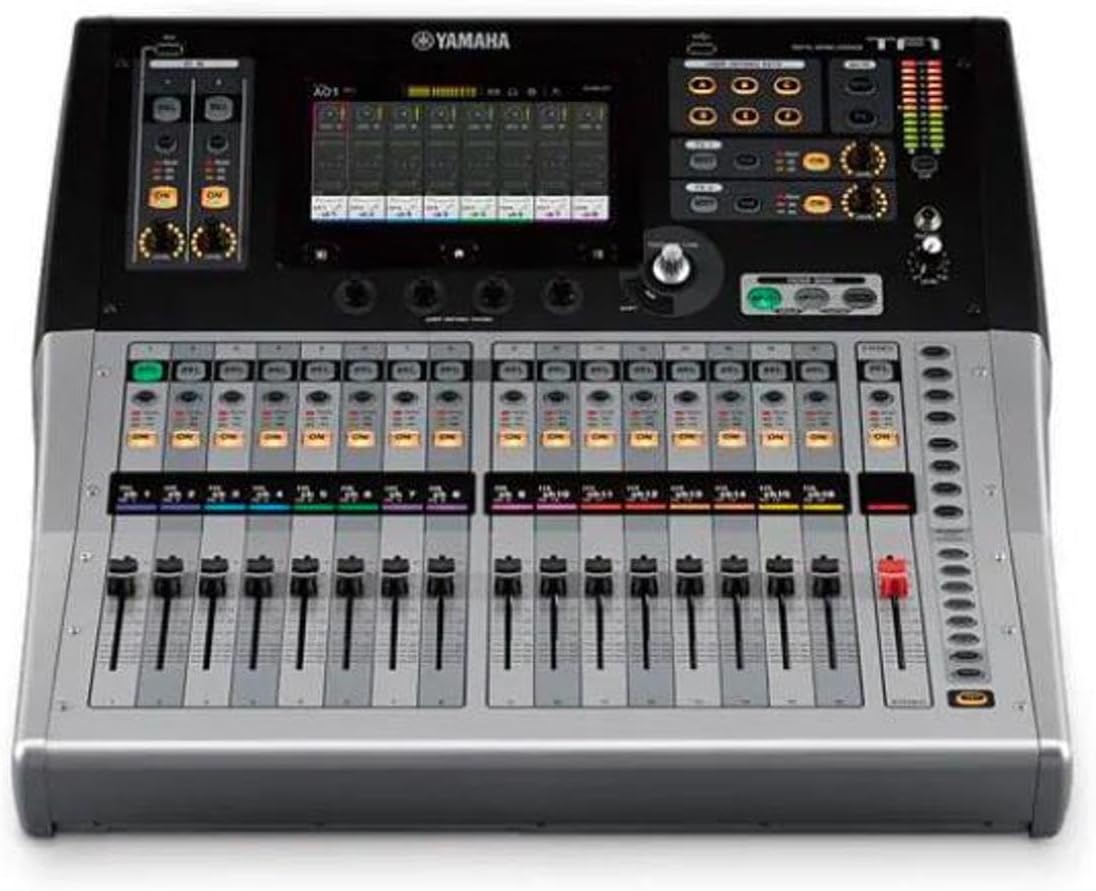
The Yamaha TF1 is what Yamaha learned from decades of building mixers for volunteers. The TF1 uses their TouchFlow operating system, which is genuinely intuitive. You can teach a volunteer to do basic mixing in minutes, not hours. This is the mixer you choose when you prioritize ease of use over raw feature count.
I watched a 17-year-old from the congregation run a TF1 successfully in his second week. No formal training. Just intuitive design that made sense to him. That’s the TF1 in action.
The Good
TouchFlow interface. Genuinely easy to learn and use.
16 channels with professional quality throughout.
Compact console size. Takes up less space than larger boards.
iPad control available for wireless mixing.
Great for volunteer operators. Intuitive design.
Professional preamps. Excellent sound quality.
Good price for the quality and ease of use.
The Not-So-Good
16 channels is a hard ceiling. You can’t expand inputs.
Fewer advanced features than some competitors.
Color display is smaller than full X32.
Who it’s for: Churches that rely heavily on volunteer operators. Any congregation prioritizing ease over features. Medium churches with 100-300 people. Perfect for churches that want professional quality without overwhelming complexity.
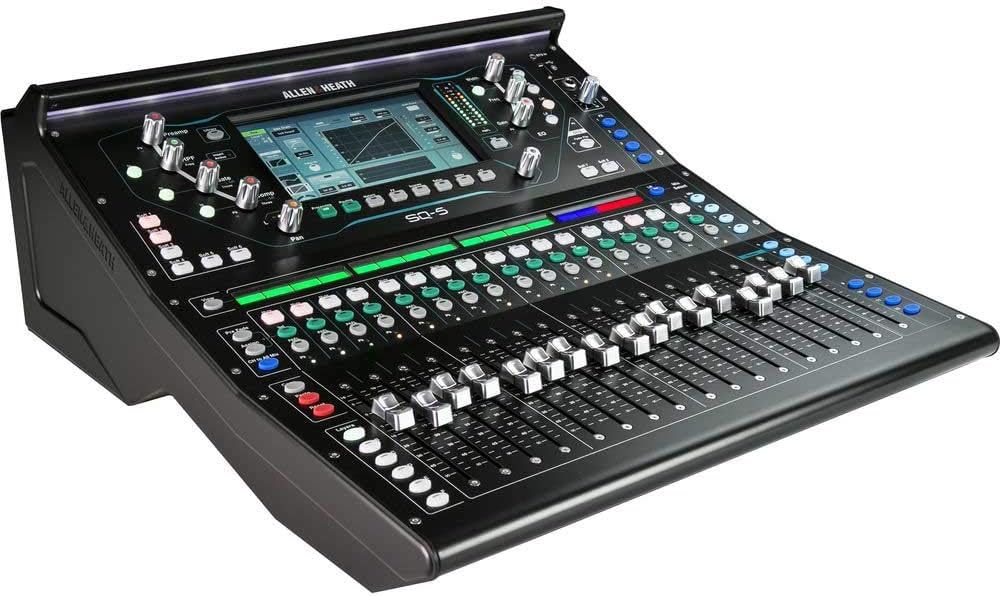
Allen & Heath is known for mixing consoles used by touring companies and major venues. The SQ-5 brings that professional DNA to churches. 48 input channels. Legendary Allen & Heath processing and plugins. Ultra-low latency. This is what you choose when you want zero limits and maximum flexibility.
Is it overkill for most churches? Probably. But if you’re serious about audio and have the budget, the SQ-5 is the mixer that gives you everything.
The Good
48 input channels. Room for everything you can imagine.
Allen & Heath’s legendary mixer architecture.
Extensive plugin and DSP options.
Ultra-low latency. No delay on monitoring.
Professional build quality and design.
Dual fader setup for smooth operation.
Deep iOS/Android control and recall.
The Not-So-Good
Price is very high. $2,300 is serious money.
Complexity. You need trained operators.
Overkill for small to medium churches.
Large footprint. Requires proper installation space.
Who it’s for: Large churches with 300+ people and professional audio engineers. Worship venues hosting major events. Congregations that want the absolute best mixing capability without compromise.
Before anything else, count the typical inputs you need. Pastor mic, worship leader mic, worship band (guitars, keyboards, drums), backing tracks, maybe a click track. Most churches need 8-16 channels. Larger teams might need 24+. Pick a mixer with at least 25% more channels than you currently need.
2. Consider Your Operators
Will volunteers run the mixer? Prioritize ease of use. The Yamaha TF1 and Behringer X Air XR18 are good choices. Do you have a professional engineer? You have more options. The X32 or SQ-5 give you raw power.
3. Think About Growth
Is your church growing? Buy a mixer with expansion capability. The X32 with 40 channels has room to grow. A 16-channel mixer will feel limiting in a few years if your worship team expands.
4. Recording Matters?
Do you record or livestream services? The PreSonus StudioLive has this built in. The X32 can record via USB. If recording is core to your strategy, factor that into your choice.
5. Budget Reality
Digital mixers range from $459 to $2,500+. Set your budget first. The XR18 is incredible value under $500. The X32 is the sweet spot for medium churches at $1,800. The SQ-5 is for those with budget for premium features.
Three Budget Setup Recommendations
Small Church Mixing Setup (Under $500)
Total: $459
Behringer X Air XR18 only. This is actually enough for most small worship situations. Full mixing capability on your iPad.
Medium Church Mixing Setup (Under $2,000)
Total: $1,950
Behringer X32 — $1,799
Monitor controller — $100
Cables and adapters — $50
The industry standard setup that works for churches up to 300 people.
Large Church with Recording (Under $2,500)
Total: $2,400
Yamaha TF1 — $1,599
Audio interface for recording — $200
Computer for archiving — $500
Cables and adapters — $100
Great option if recording and ease of use are both priorities.
Whether you call it a digital mixing console, a digital board, or just a digital audio mixer, the terminology all points to the same core shift in church audio: the move away from the analog console and toward software-driven control. Digital soundboards give sound techs access to scene recall, onboard effects channels, and digital snake connectivity that would have required an entire rack of gear in the analog era. For houses of worship that are scaling up — or simply trying to get consistent sound week after week — a digital live console changes the game. The difference between a digital mixer and a traditional analog board isn’t just in the controls; it’s in the repeatability. Sunday morning sounds the same as Sunday night rehearsal when your scene is saved.
Church sound systems built around a digital mixing console benefit from features that analog simply can’t offer: a touch screen interface, intuitive interface layouts, onboard preamp gain adjustment, and aux gain settings that can be dialed in by volunteers with minimal training. The control surface of a modern digital board handles routing logic that used to require a separate patchbay. Line inputs across the channel strip can be assigned to aux mixes, monitor feeds, or live streaming outputs without rewiring the stage. And for worship services that simulcast online, a digital board’s USB or AES50 outputs make it the natural centerpiece of a complete audio workflow.
The major digital console families each have their place in religious organizations and houses of worship. The SQ Series from Allen & Heath sits in a popular mid-range space for churches with 20–32 channel needs. The TF Series from Yamaha is a common recommendation for volunteer-heavy environments due to its guided setup features. The Si Impact, Si Expression, and RM Series from Soundcraft are regularly deployed in church applications where multi-track recording and remote control via tablet app matter. For churches that need to manage monitor mixes from the stage, the own mix software approach — where each musician controls their personal monitor from a phone — has become standard in modern worship music setups.
Processing power matters more than many church buyers expect. A digital mixer that handles 32 channels with onboard EQ, compression, and effects channels simultaneously requires stable DSP performance — particularly during live events where latency introduces perceptible delay. The control surface should respond instantly to fader moves, and the find fader function (which illuminates the physical fader corresponding to the on-screen channel) is one of those workflow features that sounds minor until you’re scrambling mid-service. Sound techs who have worked on both an analog console and a digital board for the first time often describe the learning curve as hard time well spent — the trade-off of an intuitive interface over physical knobs pays off within a few services once the team learns scene recall and aux mix routing. A solid option at any tier of digital mixing console will handle 90% of what a church needs — the question is whether the remaining 10% (recording, streaming, multi-campus routing) is worth the step up in budget.
Among the digital audio mixers competing for church budgets, a few names come up again and again. Midas M — specifically the Midas M32 — is a benchmark that a lot of people in pro audio use as a reference point for quality at scale. The PreSonus software suite, bundled with the StudioLive line, includes UC Surface and Studio One for recording and aux mix software management. The audio console space is not short on options, but the challenge is distinguishing what matters for a church service from what’s a feature built for recording studios. A volunteer sound tech doesn’t need a full-fledged DAW workflow; they need good sound, simple setup, and the confidence to make changes mid-service without fear. Digital consoles, unlike analog mixers with an actual knob for every function, require volunteers to navigate layers of menus — but the trade-off is that a well-configured scene makes it a super easy way to maintain a consistent, great sound from week to week. Digital sound board selection ultimately comes down to matching the board’s complexity to the team’s capacity.
Frequently Asked Questions
Can I use an older analog mixer instead?
You can, but digital mixers offer advantages: recall capability, wireless iPad control, built-in effects, routing flexibility, and smaller footprint. If you have a working analog mixer, keep using it. When you upgrade, go digital.
Do I need an iPad to use these mixers?
The XR18 requires an iPad or Android tablet since it has no physical console. The X32, Yamaha TF1, and others have physical consoles, and iPad control is optional. You can mix entirely from the hardware console if you want.
What’s the learning curve?
Digital mixers are easier than analog if you have guidance. Expect 1-2 hours for basics, a few weeks to get really comfortable, and months to master all features. The Yamaha TF1 has the gentlest learning curve. The X32 takes longer but teaches you more.
Can I use these mixers for streaming services?
Yes. All of these can output to a computer for streaming or recording via USB. The PreSonus StudioLive has built-in USB interface. Others require a separate interface, but the X32 can do direct USB output.
What about wireless connectivity?
Most digital mixers support WiFi or Ethernet for iPad control. The Behringer XR18 is WiFi-based. The X32 uses an optional module. Wired Ethernet is more reliable for critical services.
How long do these last?
Quality digital mixers last 10-15 years if maintained well. They’re professional equipment built for touring and venues. Your investment is solid for the long term.
What support is available?
All these manufacturers provide online documentation, YouTube tutorials, and customer support. User communities exist for each brand. You’ll have help when you need it.
George Hendricks is the founder and managing editor of Godsverse.org. He has written and published over 200 skit reviews, church resource guides, and Bible study articles. With a background in data-driven content strategy and digital publishing, George built Godsverse into one of the most comprehensive collections of church skit reviews and printable scripts online. When he's not writing, he's researching what churches actually need and figuring out how to deliver it.