Some Christians engage in premarital sex for a variety of reasons. Is premarital sex a sin in the Bible? Where in the Bible does it say so? No passage talks about sex before marriage as a sin. Just because there’s a lack of Bible verse that could explain it, this doesn’t mean that premarital sex isn’t a sin. Or is it?
First, let’s understand how the Bible describes premarital sex.
Quick Assessment
Why does your prayer life keep falling flat?
It's usually one of four things — and each one needs a completely different strategy to break through. This 2-minute assessment tells you exactly which pattern is blocking you.
The term doesn’t appear in the Bible. It’s a modern phrase that refers to voluntary sexual intercourse between two unmarried people. It’s important to note that, in today’s world, sex before marriage can still happen even when the people involved aren’t a “couple.”
Going back, premarital sex is a modern phrase that’s often justified by ideas like being in a committed relationship or testing compatibility. In biblical times, sexual acts were categorized as fornication or sexual immorality. These terms carry a lot of moral weight.
The New Testament uses the Greek word porneia frequently. In English, it means “fornication” or “sexual immorality.” It encloses all forms of illicit sexual behavior. These would include sex before marriage, incest, adultery, and sexual perversion.
Free Resource
Get Your FREE Prayer Guide Now
and join the Daily Way Devotional: Join 25,000+ Subscribers
In the King James version, the term fornication is often used and misunderstood in modern English. However, according to Biblical scholars, the word porneia or fornication in context includes premarital sex. The phrase itself, however, isn’t used directly.
God designed sexual union from the beginning of creation as a good gift. It’s a sacred bond between one man and one woman in the bonds of marriage.
Genesis 2:24 states:
“Therefore a man shall leave his father and mother and be joined to his wife, and they shall become one flesh.”
It’s the first image of sexual union in the Bible. This is tied to legal marriage and a lifelong commitment.
In God’s view, sex isn’t for sexual gratification or disease control. Rather, it represents total self-giving, emotional, spiritual, and physical unity within the confines of marriage. The Bible passages in both testaments reaffirmed this perspective.
The Bible highlights sexual purity and reserving sexual activity for the marriage bed. It’s a phrase that appears in Hebrews 13:4:
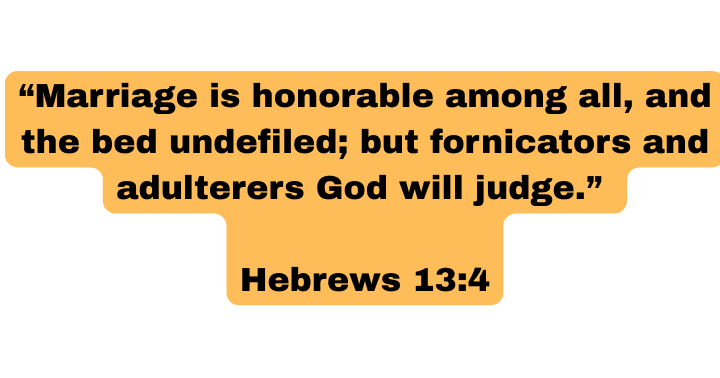
“Marriage is honorable among all, and the bed undefiled; but fornicators and adulterers God will judge.”
This verse draws a clear moral boundary. Sexual partners must be married to each other. Anyone who engages in sexual activity outside of that falls under the judgment of God.
You can find in the New Testament several verses that talk about how the apostle Paul addresses sexual sins. He recognizes these sins as a serious threat to both the body and soul. He wrote in 1 Corinthians 6:18-20. More about this verse later.
Paul clearly states that sexual immorality defiles one’s own body, which is sacred and set apart for God. It’s not just a physical consequence. Rather, it’s about honoring own image that God has created. Thus, we need to live according to His will.
God’s will for unmarried people is clearly stated in 1 Thessalonians 4:3-5:
“For this is the will of God, your sanctification: that you abstain from sexual immorality…”
The passage doesn’t condemn sexual desire. However, it does encourage control. The answer to this desire is marriage, as Paul explains in 1 Corinthians 7:1-2:
“Now concerning the things whereof ye wrote unto me: It is good for man not to touch a woman. Nevertheless, to avoid fornication, let every man have his own wife, and let every woman have her own husband.”
It’s also important to note that consensual sex outside marriage isn’t encouraged. Even if you’re in a committed relationship, this kind of sex must not be allowed. The only way to avoid the sin of fornication is to engage in sexual activity within the boundaries of marriage.
Is Premarital Sex a Sin in the bible or Just a Bad Idea?
Some would argue that premarital sex isn’t a sin. Rather, it’s just a bad idea with emotional or physical consequences. In that case, for them, it’s not necessarily a sin. Others, however, believe that it’s common knowledge that lots of sex before marriage is just part of being human. Unfortunately, the Bible disagrees.
Sexual immorality is even listed as one of the works of the flesh in Galatians 5:19-12:
“… those who do such a thing will not inherit the kingdom of God.”
It’s not a mere moral suggestion. Rather, it’s a stark spiritual warning. Living in sexual immorality without repentance can stop you from having eternal life. The standard remains high even under the new covenant. God designed sex hasn’t changed. It’s the cultural norms that changed.
Now, let’s look at the Song of Solomon to further verify the answer to the question, “Is premarital sex a sin in the Bible?”
Song of Solomon: Celebrating Sexual Desire
Some people point to the Song of Solomon as proof that the Bible does celebrate sexual desire. It does. However, it does so within the covenantal context of marriage. The erotic image and longing in Song of Solomon aren’t endorsements of casual sexual relationships. However, it’s a celebration of physical intimacy between a married person and their spouse.
The Role of the Early Church
The early church followed the moral legacy of Jewish tradition. That is, premarital sex was strictly forbidden. The Ten Commandments didn’t mention premarital sex directly. But they condemn adultery, which includes all forms of sexual sins outside the bonds of marriage.
Even in the story of the birth of Jesus Christ, Mother Mary is an unmarried woman and described as a virgin. This reinforces the value placed on purity before marriage in biblical times. Her engagement to Joseph implies that a legal marriage was pending. Sexual union didn’t occur before marriage.
Bible’s Guidance for Married and Single People
The Bible does offer guidance to both married and single people. If you’re not yet married, abstinence is the biblical standard. It means that no matter how strong your sex drive or emotional connection is, you should abstain.
Single people aren’t left without hope or dignity. They’re called to live with purpose. They must wait to share the good parts of sexual union in the safety and joy of marriage.
Obedience
At the core of the matter, “Is premarital sex a sin in the Bible?” the real issue is whether we’ll submit to God’s commands. The Bible connects obedience to blessings and disobedience to destruction. The Word of God speaks with authority across time and cultures. We’re called to lives of holiness and separation from the patterns of the world, even if they seem normal or justified.
In the discussion above, it’s clear that the answer to the question, “Is premarital sex a sin in the Bible?” is yes, in a way, it’s a sin. Premarital sex is categorized within the word fornication. The concept is sexual immorality. The repeated teachings of the apostle Paul and others confirm that voluntary sexual intercourse, if it’s outside the confines of marriage, is against God’s design.
If you fell into sexual sin, you shouldn’t be ashamed of it. You can still redeem yourself and ask God for forgiveness. The gospel calls us to repent, to be transformed, and to honor god with our own body. It’s also important to submit to the will of God and glorify Him in every sexual encounter, thought, and desire.
In the following section, let’s talk about the verses that relate to sex before marriage.
Bible Verses Related to Premarital Sex
As mentioned, the Bible doesn’t use the term premarital sex. But it does speak to the issue about sexual morality, purity, and the sanctity of marriage.
Here are the Bible passages that answer the question: “Is premarital sex a sin in the Bible?”
Hebrews 13:4
“Marriage is honorable among all, and the bed undefiled; but fornicators and adulterers God will judge.”
This verse explains biblical sexual ethics. It gives three declarations:
Marriage is honorable among all. This puts marriage as a sacred institution that God has ordained. It’s not just a cultural tradition or personal choice. Rather, it’s a divinely instituted covenant.
The bed is undefiled. Sexual intimacy is pure and righteous within the boundaries of marriage. The bed in this context is a euphemism for the sexual relationship between husband and wife. Sex is allowed in marriage. It’s even celebrated.
God will judge fornicators and adulterers. It’s a warning. If you engage in sexual activity outside the bounds of marriage, you’ll be held accountable by God.
This verse talks about premarital sex in the context of fornication. It’s not treated lightly. The language of judgment is a reminder that God takes sexual sin seriously. It doesn’t just describe a preference, but it also defines a moral boundary.
1 Corinthians 6:18-20
“Flee sexual immorality. Every sin that a man does is outside the body, but he who commits sexual immorality sins against his own body. Or do you not know that your body is the temple of the Holy Spirit who is in you, whom you have from God, and you are not your own? For you were bought at a price; therefore glorify God in your body and in your spirit, which are God’s.”
It’s one of the most direct teachings in the Bible about the consequences of sexual sin, and they include premarital sex.
Get away from sexual immorality. Paul suggests fleeing sexual immorality. But he doesn’t suggest managing, tolerating, or controlling sexual immorality. Rather, he commands to run from it. It indicates that sexual sin is dangerous. It’s also spiritually corrosive.
Sin Against Own Body
Unlike other sins, sexual immorality is a sin against “his own body.” It affects you in uniquely profound ways. It damages your identity, your relationship with others, and your capacity for intimacy in future relationships.
Your body is a temple of the Holy Spirit. It simply means that your body, our bodies, aren’t our own. Instead, they are sacred vessels for God’s presence. If you engage in sexual sin, you’re defiling the temple.
Another key takeaway from the verses mentioned above is that “you were bought at a price.” After Jesus sacrificed Himself on the cross, we now belong to God, body and soul. Sexual purity isn’t just a personal preference. Rather, it’s also an act of worship.
The Scripture teaches that sexual morality is spiritual. Premarital sex isn’t just a private decision. Rather, it’s a violation of your body’s divine purpose.
1 Thessalonians 4:3-5
“For this is the will of God, your sanctification: that you should abstain from sexual immorality; that each of you should know how to possess his own vessel is sanctification and honor, not in passion of lust, like the Gentiles who do not know God.”
This verse answers one of the most frequently asked questions, “What is God’s will for my life?” The clear answer here is sanctification or growing in holiness. And the vital part of it is abstaining from sexual immorality.
The passage teaches us to abstain from sexual immorality. It includes all forms of sexual activity outside of God’s design for marriage.
The verse, “Possess his own vessel in sanctification and honor,” calls to self-control. Whether vessel means to one’s body or to a spouse, the point is that believers must act in a way that’s holy and honorable.
Then, the “not in passion of lust, like the Gentiles” contrasts godly self-control with pagan lust. Sexual activity that’s driven by desire outside marriage is equivalent to the behavior of people who don’t know God.
It’s clear that sexual restraint is a sign of knowing and honoring God. If you engage in sex before marriage, you’re rejecting God’s will. You’re also following impulses of the flesh.
Galatians 5:19-21
“Now the works of the flesh are evident, which are: adultery, fornication, uncleanness, lewdness… of which I tell you beforehand, just as I also told you in time past, that those who practice such things will not inherit the kingdom of God.”
Again, the Greek word porneia appears in this context. It encompasses all illicit sexual activity that includes premarital sex. The words lewdness and uncleanness describe inappropriate sexual behaviors, attitudes, and fantasies.
Paul also refers to one-time sins after repentance. The warning is to those who live in habitual sexual sin who refuse to repent.
The part where it says, “…will not inherit the kingdom of God” is not a trivial issue. Sexual immorality can jeopardize your eternal destiny. That is, if you do it again and again that it becomes a lifestyle and you no longer repent of it.
The passage clearly highlights that premarital sex isn’t just an unfortunate mistake. Rather, it’s part of a larger sinful pattern that must be surrendered.
Ephesians 5:3
“But among you there must not be even a hint of sexual immorality, or any kind of impurity, or of greed, because these are improper for God’s holy people.”
The verse raises the standard to a higher level. Believers must avoid sexual sin and live in a way that there’s not a trace of it.
Paul calls the church to radical purity. It includes sexual thoughts, jokes, flirtation, and sexual relationships outside of marriage. Christians are also called to a different standard when Paul says, “Improper for God’s holy people.”
The world may see premarital sex as acceptable. However, for those in Christ, it’s improper and incompatible with our identity as holy.
Furthermore, Paul mentions greed in the same breath. It suggests that all self-indulgent behavior must be checked at the cross.
The standard for us Christians isn’t asking about “How far can I go?” Instead, ask, “How can I honor God with everything I am?” It includes our relationships, our thoughts, and our bodies.
Each of the verses above speaks to the topic of premarital sex. If you take them together, they do paint a clear picture. For one, God designed sexual intimacy. It exists only within marriage.
Then, premarital sex is also known as fornication or sexual immorality. It’s consistently condemned.
Then, sexual purity is part of God’s will. It’s God’s standard, and it’s His call to holiness. The consequences of ignoring this call are eternal and spiritual.
Grace
There’s always grace. If you’ve stumbled, Jesus offers forgiveness, cleansing, and renewal. We’re promised in 1 John 1:9:
“If we confess our sins, He is faithful and just to forgive us our sins and to cleanse us from all unrighteousness.”
Whether you’re struggling with sexual temptation, seeking to live purely, or recovering from a past of sexual sin, you must know that there’s God’s grace is greater than your sin. His spirit empowers you to talk in holiness.
Now, let’s talk in-depth about what the word fornication is in the Bible.
Fornication and Porneia in the Bible
In the above sections, we’ve discussed the term proneia many times. It’s found throughout the New Testament, and it’s translated as fornication, sexual immorality, and unchastity. We’ll cover this word in depth in the following section.
The root word of porneia is “porné.” It means prostitute. By extension, it’s a sexual conduct that’s outside of God’s design. The word includes a range of sexual sins, like adultery, prostitution, incest, homosexuality, and premarital sex.
The Theological Dictionary of the New Testament describes porneia as “every kind of sexual intercourse outside marriage.” It’s not limited to a specific act. Rather, it speaks broadly to any sexual behavior that violates God’s moral order.
Here are the passages where porneia is used:
Matthew 15:19
“Out of the heart come evil thoughts, murder, adultery, sexual immorality (porneia)…”
1 Corinthians 6:18
“Flee from sexual immorality (porneia)…”
Galatians 5:19-21
As mentioned earlier, it lists porneia as among the works of the flesh.
Porneia is condemned as contrary to God’s will. It’s placed alongside adultery, idolatry, and other serious offenses. It also represents not just a physical act. Rather, it also talks about a spiritual violation of God’s intended boundaries.
Does Porneia Include Premarital Sex?
Various scholarly sources affirm that the term includes premarital sex. For instance, in BDAG Lexicon, it defines porneia as unlawful sexual intercourse, prostitution, unchastity, and fornication.
Craig Keener notes that in first-century Jewish and Christian thought, all sexual intercourse outside of marriage was considered sinful and would fall under porneia.
Early church fathers also had the same view. For instance, Augustine and John Chrysostom spoke against premarital sex using this very term. The Didache instructs believers to abstain from porneia. It includes premarital relations.
Even though the Bible may not use the word “premarital sex,” the meaning is well covered by the broader concept of porneia.
Sex and Marriage in the Bible
Comprehending the word porneia in the Bible is just part of the equation. We must also examine the framework for sex and marriage. For instance, we need to understand how God designed them and why He placed boundaries around sexual intimacy.
Genesis 2:24
“Therefore a man shall leave his father and mother and be joined to his wife, and they shall become one flesh.”
It’s the foundation of biblical sexuality. From the start, God designed sex to be expressed within a covenant relationship, i.e., marriage. The one flesh union is physical and spiritual. It reflects God’s own relational nature.
Marriage was instituted by God as a sacred covenant. It wasn’t invented by culture or governments. Furthermore, sex was given as a gift within that covenant. Any sexual activity that arises outside of that relationship is a distortion of God’s intention.
Jesus reaffirms the same verse in the New Testament.
Matthew 19:4-6
“Have you not read that He who made them at the beginning ‘made them male and female,’ and said, ‘For this reason a man shall leave his father and mother and be joined to his wife, and the two shall become one flesh’? So then, they are no longer two but one flesh. Therefore, what God has joined together, let not man separate.”
Jesus does more than answer a legal question in response to a question about divorce. He reaffirms the original intent of marriage. He teaches us that sexual union or one flesh is designed for marriage only. Marriage isn’t just a social contract. Rather, it’s a divine union established by God. This union is also exclusive and lifelong.
Furthermore, Jesus underscores the same boundary in Genesis 2:24. That is, sexual intimacy is only appropriate within marriage. Anything that’s outside of it goes against God’s original plan. Since premarital sex is outside marriage, engaging in it is against God’s plan or design.
Paul’s Teachings About Sexual Intimacy
“Now concerning the things of which you wrote to me: It is good for a man not to touch a woman. Nevertheless, because of sexual immorality, let each man have his own wife, and let each woman have her own husband.” 1 Corinthians 7:1-2
He addresses the Corinthians’ confusion regarding marriage and sex. Celibacy is commended. However, Paul gives practical advice if you struggle with sexual temptation. He recommends marriage as the antidote to sexual immorality. He’s not saying that marriage only exists to curb lust. However, he does recognize that sexual desires are real. God’s appointed context for fulfilling them is in marital union.
Sex outside of this arrangement, therefore, is improper. It falls under the sin of porneia.
This aligns with the rest of Scripture. That is, sexual fulfillment is a blessing of marriage. Paul doesn’t condone or bless sexual activity before that union is established.
Many Christians Fail to Recognize the Teachings of the Church
There’s indeed no exact verse in the Bible that talks about premarital sex as a sin. Jesus did not explicitly say that it is a sin. However, as we’ve examined it in the earlier sections, sex before marriage falls under a certain category that goes against the will of God.
Even though it’s clear that the Scripture finds premarital sex as going against Jesus’ teachings, many Christians still ignore the teaching on this premise.
Culture Redefining Morality
One of the reasons many Christians continue to engage in premarital sex is that culture has already redefined morality. Sex is no longer considered sacred; that’s reserved for marriage. Rather, it’s now portrayed as a personal right. It’s a form of self-expression. In fact, many people think that it’s a sign of emotional maturity.
The prevailing message of many TV shows and music is that waiting for marriage is repressive, unnecessary, and outdated. Many Christians absorb these messages daily. Cultural values start to change biblical convictions. What was considered sin now feels normal. Some would even consider it harmless.
Because everyone is doing it, Christians may feel left out or old-fashioned. Many of them feel pressured to prove love through physical intimacy.
But Romans 12:2 warns us:
“Do not conform to the pattern of this world, but be transformed by the renewing of your mind.”
Many Christians do conform. But they do so because they let culture shape their conscience more than the Word of God.
Another reason is the lack of biblical teaching in churches. Many churches avoid addressing sexual sin, pornography, and cohabitation. They think that if they do so, they would alienate their members or sound judgmental. They also fear losing young audiences.
Furthermore, the term sexual purity is mentioned in the Bible, but without a clear definition. As a result, Christians grow up with a lack of understanding of biblical sexuality. Without consistent teaching, believers assume that as long as they love each other, sex outside marriage isn’t wrong. Then, there’s the belief that God understands, so it’s not really a big deal.
Many Christians continue in sexual sin because they assume that God will forgive them. Salvation is indeed grace. However, Jesus’ teaching is clear: habitual sinning hardens the heart. It also grieves the Holy Spirit. Still, the gospel offers a way out of it. You need to repent, renew, and restore through Jesus Christ. Don’t allow habitual sin to blind, harden and isolate you.
A Call to Conviction
Is premarital sex a sin in the Bible? In a way, yes, as it falls under sexual immorality. Sex is a beautiful gift from God. However, God designed sex to flourish within the boundaries of marriage. The church’s teaching isn’t outdated. Rather, it’s a warning of its consequences.
Jane is a Roman Catholic on a journey of re-learning about God and deepening her understanding of the Bible. She has over a decade of experience as a copywriter. Her goal is to blend her passion for writing with her spiritual journey. She writes content that doesn’t just uplift but also connects with people who wish to seek a deeper understanding of God’s word. Follow Jane on LinkedIn or Instagram.