You can’t underestimate the importance of giants in the Biblical narrative. But how tall were giants in the Bible? Some texts say they were six cubits and a span (9 feet 9 inches). But how enormous are they that set them apart from ordinary humans? The answers to these questions are listed below.
Measurements in Ancient Texts to Better Understand How Tall Giants Were According to the Bible
One of the biggest hurdles in determining the exact height of biblical giants lies in the differences between ancient texts. For instance, the Hebrew Masoretic Text and the Dead Sea Scrolls offer varying accounts of height measurements. As a result, it sparked debates among scholars.
Differences Among Hebrew, Greek, and Dead Sea Scrolls
The Hebrew Masoretic Text, which forms the basis for most modern Old Testament translations, states that Goliath stood six cubits and a span. This translates to approximately 9 feet 9 inches or 2.97 meters.
Quick Assessment
Why does your prayer life keep falling flat?
It's usually one of four things — and each one needs a completely different strategy to break through. This 2-minute assessment tells you exactly which pattern is blocking you.
But the Greek Septuagint, which is an early Greek translation of the Old Testament, records Goliath’s height as four cubits and a span. This is around 6 feet 9 inches or 2.06 meters.
This significant discrepancy has led scholars to question whether later scribes exaggerated his stature to emphasize his intimidating presence.
The Dead Sea Scrolls, discovered in the mid-20th century, contain some of the oldest biblical manuscripts. They list Goliath’s height as four cubits and a span. This information aligns more closely with the Septuagint.
Free Resource
Get Your FREE Prayer Guide Now
and join the Daily Way Devotional: Join 25,000+ Subscribers
It only suggests that the earlier version of the text described Goliath as a very tall but not necessarily superhuman figure. But the later traditions may have amplified his size for dramatic effect.
Og – King of Bashan
We encounter another biblical giant in Deuteronomy 3:11. His iron bed is described as nine cubits long and four cubits wide.
Depending on the cubit measurement used, it could mean his bed was around 13.5 feet or 4.11 meters long.
Some scholars interpret this as an indication of his height. Others suggest that it was simply a large ceremonial object. That is, the text just exaggerated his size.
Cubit Measurements and Modern Estimations
Understanding the height of these giants requires examining an ancient measurement system. It’s important to note that the primary unit of length in biblical times was cubit. However, its exact size varied.
Two types of cubits were used. The common one was approximately 17.5 inches or 44.5 cm. Then, there’s the royal cubit, which is approximately 20.5 inches or 52 cm.
If we use the common cubit, Goliath’s height, which was described as six cubits and a span, would be around 9 feet 9 inches or 2.97 meters. Then, the shorter Septuagint version of four cubits and a span will place him at 6 feet 9 inches or 2.06 meters.
On the same note, if Og’s bed was measured in royal cubits, it could have been 15 feet (4.57 meters) long. He could have been at least 9 to 10 feet tall.
Some argue that the description of the bed doesn’t necessarily confirm Og’s height. Rather, it only serves as a symbolic testament to his power or might.
Comparing Giant Height to Human Heights
To understand how tall were giants in the Bible, it’s vital to compare their height with the average human stature in biblical periods.
Archaeological studies suggest that the average height of an adult male in the ancient Near East ranged between 5 feet 4 inches and 5 feet 6 inches. It’s between 1.63 and 1.67 meters.
With these estimates, Goliath would have made him significantly taller than most people of his time. If we accept the 2.97-meter version, he would have been an absolute giant compared to his contemporaries. He could tower over entire armies.
Historical records also indicate that very tall people did exist in ancient times. However, they were rare.
Some Egyptian records mention soldiers over 7 feet tall. The remains of these extremely tall people have been found in burial sites across various ancient cultures.
Archaeological Insights
But is there any physical evidence of any biblical giants?
There’s no definitive skeletal remains have been found confirming the extreme heights described in the Bible. However, several historical findings suggest that taller-than-average individuals did exist.
For instance, archaeologists discovered remains of individuals over 7 feet tall in regions around the ancient Near East. But none as tall as 9 feet or more.
The findings could support the existence of warriors, such as Goliath, who were notably larger than their contemporaries.
Some scholars propose that the construction of massive structures, such as megalithic sites in Bashan. It suggests that a race of exceptionally large people may have existed or were at least believed to exist.
Ancient References to Giants Outside the Bible
Egyptian records describe some individuals reaching over 7 feet in height. These would include pharaohs like Rameses II. He was believed to be over 6 feet 3 inches or 1.91 meters. He was taller than the average but not necessarily a giant.
Greek historian Pliny the Elder wrote about giants in his Natural History. He described men who reached up to 10 feet tall. Some of these accounts are likely exaggerated. But they reflect a long-standing fascination with extraordinary human height.
Some scholars argue that biblical descriptions of giants may be symbolic rather than literal. In ancient warfare, exaggerating the height and strength of enemies was a common literary device to emphasize the might of one’s own people.
It could explain why Goliath’s height differs across ancient texts. Later scribes may have embellished his size to make David’s victory even more remarkable.
Some propose that references to giants may have stemmed from encounters with extremely tall due to genetic conditions, like gigantism or acromegaly. These result in excessive growth because of hormonal imbalances.
Who Were the Giants Mentioned in the Bible?
Nephilim
The Nephilim are among the most mysterious figures in biblical texts. They were mentioned in Genesis 6:4. They’re described as the offspring of the sons of God and the daughters of men.
This passage has led to various interpretations regarding their origins and stature. Some scholars suggest that the Nephilim were beings of great height and great physical strength.
Others believe they were simply mighty men of great stature.
Ancient texts provide additional insights into these figures. They’re linked to the days of Noah and the great flood.
The Masoretic Text describes them as men of renown. It suggests that their legend persisted through ancient civilizations. Some believe that the fossil record may also hold clues to their existence.
Unfortunately, there’s no definitive archaeological evidence found in modern times.
Anakim
They’re a group of biblical giants mentioned in Numbers 13:33. The Israelite spies reported seeing the sons of Anak. They described them as men of great stature who made the children of Israel feel like grasshoppers in comparison.
The descendants of Anak were also believed to have lived in the Land of Canaan. This was particularly true in the region later inhabited by the Jewish people.
The Hebrew word Nephilim appears in the context of the Anakim. It led some bible scholars to draw connections between these two groups.
Jewish literature and various interpretations suggest that the tribe of giants played a role in biblical history.
Some ancient texts also claim that their lineage continued into later generations.
Rephaim
The Rephraim are often considered a remnant of giants in the biblical account. Deuteronomy 2:10-11 describes these people as tall who once inhabited the region before being displaced.
The Rephaim are also mentioned in connection with other giants of the Bible, such as Anakim and the Nephilim.
The term Rephaim was used to describe giant figures or men of renown. This has sparked debates among biblical scholars about the actual existence of giants.
Some believe that Rephaim was a distinct group. Others, however, think that they were simply another name for the giants of the Bible.
Og – the King of Bashan
He was one of the most famous biblical giants. Deuteronomy 3:11 states that only King Og of Bashan remained from the remnants of giants. The passage describes his massive iron bed to be nine cubits long and four cubits wide. It translates to around 4.11 meters in modern measurements using the common cubit.
The description of his bed in Rabbath of the children of Ammon caused some scholars to speculate about his exact height. The biblical texts don’t explicitly state how tall he was. But some believe he may have been one of the tallest men mentioned in Scripture.
His story is an example of how giant warriors played a role in ancient conflicts.
Goliath
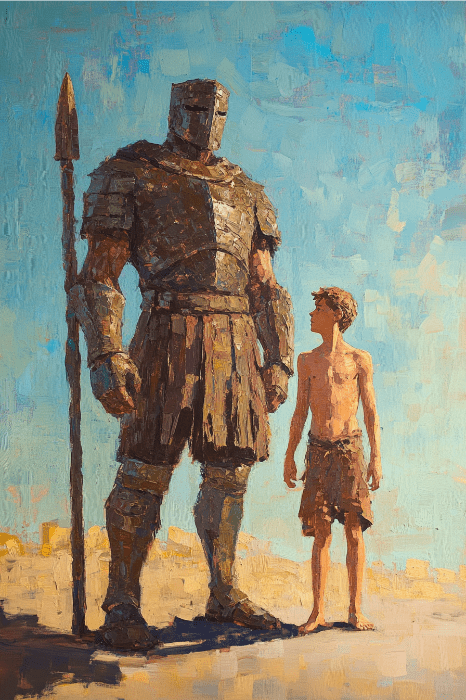
He is the most well-known giant warrior mentioned in the Hebrew Bible. Goliath of Gath’s story is one of the most famous narratives in the Old Testament. The passage described how a young shepherd defeated a giant of Gath with a single stone.
The Masoretic Text states that Goliath’s height is six cubits and a span. This is approximately 9 feet 9 inches or 2.97 meters.
However, as mentioned earlier, the Dead Sea Scrolls and the Septuagint offer a different reading. It lists Goliath’s height as four cubits and a span, which is around 2.06 meters or 6 feet 9 inches.
This discrepancy has led many bible scholars to debate the exact height of the giant Goliath.
The camp of the Philistines was terrified of Goliath’s great size. He was described as a large man with great physical strength. His mighty men included tall warriors.
However, none of them were as famous as Goliath of Gath.
Controversies and Debates About How Tall Giants Were in the Bible
The height of giants has been the subject of significant debate among bible scholars. This is particularly because of the variations in ancient texts, like the Dead Sea Scrolls, the Septuagint, and the Masoretic Text.
These sources sometimes provide conflicting measurements for figures like Goliath of Gath and King Og of Bashan.
For instance, the Masoretic Text lists Goliath’s height as 9 feet 9 inches. But the Dead Sea Scrolls and the Septuagint suggest that he was just 6 feet 9 inches.
This discrepancy raises questions about how measurements were recorded and interpreted in ancient times.
Og’s bed was also described as nine cubits long. However, scholars debate whether this was a literal description of his stature or just an exaggeration of his great size.
The Role of Myth and Symbolism
Some scholars also argue that the descriptions of great giants in the Hebrew Bible weren’t meant to be taken literally. Rather, it must serve as symbolic representations of powerful nations or significant historical figures.
The Nephilim as described in Genesis 6:4 are described as the offspring of the sons of God and the daughters of men. In that case, they weren’t literally tall people. Rather, they were men renowned for great physical strength and influence.
The book of Enoch, which is a non-canonical text, expands on this idea. It claims that the Nephilim were the result of sexual intercourse between divine beings and human women.
Thus, some researchers view the biblical giants as metaphors for corruption and divine punishment. Instead of historical figures of enormous size.
Skepticism
There is little evidence to support the existence of men of great stature in ancient civilizations. Some claim that the fossil record may reveal traces of giant figures.
However, most findings attributed to biblical giants have been debunked or explained as misinterpretations of natural phenomena.
One of the most well-known claims involves supposed giant skeletons. They’re found in northern Southern America and other regions.
However, experts have pointed out that these findings are often the result of hoaxes, misidentified fossils, or just exaggerated reports.
The absence of definitive remains makes it difficult to prove whether figures like the King of Og of Bashan or the sons of Anak truly reached such great heights.
Exaggeration Theories
Some scholars attempt to compare the giants of the Bible to people today.
For instance, Robert Wadlow is the tallest man recorded in history. He towers over 8 feet 11 inches. If people of such height existed in modern times, it could mean that giant warriors could have existed in ancient times as well.
However, it’s important to note that genetic disorders like gigantism provide medical explanations for extreme height. It suggests that the greatest man figures in the Bible may have been rare anomalies, instead of representatives of a land of giants.
Others argue that the biblical references to great physical strength and large man figures were exaggerated for dramatic effect. The story of David and Goliath of Gath could have been an embellished tale meant to highlight divine intervention, instead of an exact account of Goliath’s height.
Cultural Perspectives
The concept of giants of the bible has also been influenced by Jewish literature, English translations, and interpretations by religious figures, like St. Augustine.
Some see the Nephilim, Anakim, and Rephaim as part of broader spiritual battles between good and evil. It reinforces themes of divine justice in the Old Testament.
Others see them as remnants of pre-Israelite cultures in the land of Canan. They represent the challenges faced by the children of Israel in securing the Promised Land.
Some interpretations suggest that the sons of the Anakim were exaggerated to instill fear among the Israelite spies, instead of representing a literal race of giant warriors.
This idea aligns with the belief that biblical texts sometimes used great height as a metaphor for power and dominance, instead of a factual description of stature.
The debate over the existence of giants in the Hebrew text remains unresolved.
The Lasting Impact of Biblical Giants on Culture
The mention of giants has captured the imagination of readers, scholars, and artists alike. Their towering heights are described as extraordinary size and strength.
They’ve left an indelible mark on religious thought, cultural narratives, and even modern interpretations of history and science.
Apart from questioning how tall were giants in the Bible, many also want to know how their stature compares to Adam and Eve.
Adam and Eve – Are They Considered Giants in the Bible?
In contrast to the giants, the Bible doesn’t provide specific measurements for Adam and Eve. However, Jewish traditions have speculated about their height.
Some suggest that Adam and Eve were created as perfect beings. That is, they were larger and more robust than their descendants.
For example, the Talmud, which is a central text of Rabbinic Judaism, states that Adam was created as a giant.
His height reaches from the earth to the heavens. However, it was later reduced in size as a consequence of sin.
Other traditions propose that these two were around 30 meters tall. This is a figure that aligns with the idea of their initial perfection and closeness to God.
Adam and Eve
If these interpretations were taken at face value, Adam and Eve would have been significantly taller than the biblical giants, like Anakim and Goliath.
Then again, these claims are largely speculative. They aren’t supported by the biblical text itself. The lack of specific measurements for Adam and Eve leaves their height open to interpretation.
They allow for a wide range of cultural and theological perspectives.
The contrast between the height of Adam and Eve and the giants raises interesting questions about the nature of humanity and its relationship to the divine.
If Adam and Eve were indeed created as larger-than-life creatures, their reduction in size could symbolize the fall from grace and the loss of humanity’s original perfection.
On the other hand, the giants are portrayed as flawed or even malevolent. Several ancient texts suggest that physical stature doesn’t equate to moral or spiritual superiority.
The Symbolic Impact of Biblical Giants
The biblical giants have had a profound impact on culture and belief. They influence art, literature, and even modern media.
Their enormous presence has made them powerful symbols of strength, danger, and the unknown.
In art, giants are often depicted as monstrous figures. They embody chaos and opposition to divine order.
For instance, Renaissance paintings of the David and Goliath story frequently emphasize Goliath’s size and ferocity. This is in contrast with David’s youth and faith.
Giants have also appeared in countless works of art, from John Milton’s Paradise Lost to J.R.R. Tolkien’s The Lord of the Rings. These literary giants often serve as metaphors for overwhelming challenges and the struggle between good and evil.
In modern media, giants continue to captivate audiences. They appear in films, television shows, and video games as both antagonists and antiheroes.
Representing the Unknown
Their symbolic significance extends beyond their physical size. They represent the unknown and the otherworldly. Furthermore, they embody humanity’s fears and aspirations.
Giants are often associated with the consequences of sin and the dangers of pride in religious thought.
For instance, the story of Nephilim is sometimes interpreted as a cautionary tale about the mixing of divine and human realms. If you combine them, it can lead to corruption and destruction.
Fascination with Giants
The enduring fascination with biblical giants reflects humanity’s desire to understand the mysteries of the past and the nature of existence. The question of how tall these giants were, and how they compare to figures like Adam and Eve, taps into deeper questions about our origins as humans.
The biblical texts provide only glimpses into the world of giants. But these glimpses have inspired countless interpretations and speculations.
The fascination with giants in modern times has taken on new forms. Some people claim to have discovered evidence of ancient giant races through archaeological finds or pseudoscientific theories.
These claims are often dismissed by mainstream scholars. Instead, they highlight the enduring power of the giant archetype in the human imagination.
Fighting Giants
The biblical giants aren’t just physical beings. They’re also powerful metaphors for the challenges and obstacles we face in life.
Whether in the form of societal injustices or personal struggles, giants represent the seemingly insurmountable forces that stand in our way.
The story of David and Goliath, for instance, offers a timeless lesson on how to confront and overcome these metaphorical giants.
David and Goliath – How to Face Giants
In 1 Samuel 17, the story of David and Goliath is one of the most well-known narratives in the Bible. It provides a profound metaphor for facing giants in our own lives.
Goliath represents overwhelming power and intimidation of the. David, on the other hand, is the young shepherd. He embodies faith, courage, and resourcefulness.
David’s victory over the giant Goliath isn’t just a tale of physical triumph. Rather, it’s a lesson in how to approach life’s greatest challenges.
Faith and Trust in God
The first weapon of David against Goliath was his unwavering faith in God. The Israelite army trembled in fear. But David declared:
“The Lord who delivered me from the paw of the lion and the paw of the bear will deliver me from the hand of this Philistine.” – 1 Samuel 17:37
This faith gave David the confidence to face an impossible opponent. In our lives, whether in a higher power or in support of others, faith can provide the strength to confront our own giants.
When King Saul offered David his armor to fight the giant, David tried it on but found it ill-fitting. Thus, he chose to fight with what he knew best. That is, to use a sling and five smooth stones.
This decision symbolizes the importance of staying true to oneself and using our unique strengths, even when others suggest a different approach.
When we face our own giants, we must trust our instincts and rely on the tools and skills that are most authentic to us.
The Fascinating Truth About the Heights of Giants
The question of how tall were giants in the Bible is fascinating and complex. The most famous giant, Goliath is described as six cubits and a span tall. This is approximately 9 feet 9 inches.
While the exact measurements of these giants may remain a mystery, their symbolic significance is clear. The giants of the Bible represent the challenges and obstacles that seem insurmountable. The stories of biblical giants aren’t just about their physical stature. Rather, it’s about the lessons they teach us.
Jane is a Roman Catholic on a journey of re-learning about God and deepening her understanding of the Bible. She has over a decade of experience as a copywriter. Her goal is to blend her passion for writing with her spiritual journey. She writes content that doesn’t just uplift but also connects with people who wish to seek a deeper understanding of God’s word. Follow Jane on LinkedIn or Instagram.