Maybe you’re lying next to someone who feels like a stranger. Maybe the arguments have gotten so loud — or the silence so heavy — that you’re Googling Bible verses at midnight because you don’t know what else to do. Maybe a friend is going through it and you want to send them something that actually helps.
I’ve been close enough to troubled marriages to know that a numbered list of 47 verses with “Interpretation: this verse emphasizes unity” after each one isn’t going to cut it. What you need is the right verse for the right problem — and one honest thing you can do about it tonight.
That’s what this page is. Every verse is organized by the actual situation you’re facing, with a practical next step after each one. Because God’s Word isn’t just meant to be read. It’s meant to be lived — especially when your own marriage is on the line.
What’s in this guide
Free Resource
Get Your FREE Prayer Guide Now
and join the Daily Way Devotional: Join 25,000+ Subscribers
A lot of times, the trouble in a marriage isn’t one big explosion — it’s a hundred small cuts. Tone of voice. Eye rolls. The same argument recycled every two weeks with different words. Marriage conflict like this erodes a relationship slowly, and if you don’t address it, the distance becomes permanent. These bible verses speak to the root of it: how we talk to each other.
Proverbs 15:1 — The Verse That Saves Arguments
“A gentle answer turns away wrath, but a harsh word stirs up anger.”
A friend of mine told me his marriage hit rock bottom when he realized every conversation with his wife had become a debate. Not about big things — about groceries, bedtimes, whose turn it was to take out the trash. Proverbs 15:1 was the verse that changed things. He started responding with a gentle answer instead of matching her frustration, and within a month the whole atmosphere of their home shifted.
Do this tonight: The next time your spouse says something that makes you want to fire back, pause for five seconds. Then respond at half the volume. A gentle answer isn’t weakness — it’s great power under control.
Ephesians 4:29 — Guard What Comes Out of Your Mouth
“Do not let any unwholesome talk come out of your mouths, but only what is helpful for building others up according to their needs, that it may benefit those who listen.”
The Apostle Paul wrote this to the church at Ephesus, but it applies to every married couple in a struggling marriage. Unwholesome talk doesn’t just mean profanity — it means sarcasm, passive-aggression, and the corrupting talk that tears a person down while pretending to be a joke. The most important thing you can control in a marriage conflict is your own mouth.
Do this tonight: Before you go to bed, tell your spouse one specific thing they did today that you appreciated. Not a vague “you’re great” — something real. “I noticed you handled the kids’ meltdown without losing it. That was impressive.” Effective communication starts with choosing to build up instead of tear down.
Ephesians 4:26 — Don’t Let the Sun Go Down on Your Anger
“In your anger do not sin. Do not let the sun go down while you are still angry.”
This verse doesn’t say “don’t get angry.” Anger is a human emotion — even Christ Jesus got angry. The command is: don’t let it sit. Deal with it before bed. A lot of times in a struggling marriage, the damage isn’t caused by the argument itself — it’s caused by the three days of silence that follow. Don’t carry it into tomorrow.
Do this tonight: If there’s unresolved tension right now, say this: “I don’t want to go to sleep angry. Can we talk for five minutes — not to solve everything, just to clear the air?” That’s the best way to start.
James 1:19-20 — Quick to Listen, Slow to Speak
“My dear brothers and sisters, everyone should be quick to listen, slow to speak and slow to become angry, because human anger does not produce the righteousness that God desires.”
Human beings are wired to defend themselves. When your spouse says something that stings, your instinct is to counter-attack. James says: resist that. Listen first. Most marriage problems aren’t about the topic of the argument — they’re about one person feeling unheard. When you stop trying to win and start trying to understand, you’ll find the marriage conflict loses its power.
1 Timothy 6:10 — When the Fight Is Really About Money
“For the love of money is a root of all kinds of evil. Some people, eager for money, have wandered from the faith and pierced themselves with many griefs.”
Marital problems often trace back to finances. Not money itself — the love of money. The obsession with it, the fear of not having enough, the resentment when one spouse spends and the other saves. If your fights keep coming back to dollars, God’s Word says the real issue is priorities. A healthy marriage requires honest conversations about what you treasure — and whether you treasure the same things.
Colossians 3:19 — Husbands, Don’t Be Harsh
“Husbands, love your own wives and do not be harsh with them.”
Short and blunt. The Apostle Paul doesn’t mince words here. Harsh words from a husband can do more damage to a marriage today than almost anything else. If you’re a husband reading this and you know your tone has been sharp — this verse is for you. Your own wife needs kindness, not corrections. Love her the way Christ Jesus loved the church: gently, sacrificially, without keeping score.
When Trust Has Been Broken
Infidelity. Lies. Hidden debts. A broken marriage doesn’t always start with an affair — sometimes it’s a pattern of dishonesty that builds until the foundation cracks. These verses speak to forgiveness, accountability, and the hard work of marriage restoration.
Colossians 3:13 — Forgive as the Lord Forgave You
“Bear with each other and forgive one another if any of you has a grievance against someone. Forgive as the Lord forgave you.”
This is the hardest verse on this entire page. Forgiving someone who betrayed your trust feels like letting them off the hook. But the Word of God doesn’t say forgiveness means pretending it didn’t happen. It means choosing not to hold it over them forever. Christ Jesus forgave you at your worst — not because you deserved it, but because His steadfast love is greater than your failure. That’s the model.
Do this: Forgiveness isn’t a one-time event — it’s a decision you’ll make a lot of times. Each time the anger flares up, say out loud (even to yourself): “I chose to forgive. I’m choosing again today.” That’s not weakness. That’s great power.
1 Peter 4:8 — Love Covers a Multitude of Sins
“Above all, love each other deeply, because love covers over a multitude of sins.”
A multitude of sins doesn’t mean one small offense. It means the big ones too — the ones that make you wonder if the marriage can survive. Deep love doesn’t ignore sin. It absorbs the shock of it and still chooses to stay. That’s what makes a Christian marriage different from a contract. It’s a covenant held together by steadfast love, not by perfect behavior.
Psalm 51:10 — A Clean Heart
“Create in me a pure heart, O God, and renew a steadfast spirit within me.”
This is David’s prayer after his adultery with Bathsheba — the worst season of his life. If you’re the one who broke the trust, this is your verse. Don’t start with excuses. Start with this prayer. Ask your Heavenly Father for a clean heart and a renewed spirit. Marriage restoration begins with honesty before God, not damage control with your spouse.
Do this: Pray Psalm 51 out loud. All of it. Then go to your spouse and say: “I was wrong. I don’t have a defense. I want to rebuild this.” Those are the hardest words a human being can say — and the most powerful prayer for a failing marriage.
Proverbs 3:3-4 — Let Faithfulness Define You
“Let steadfast love and faithfulness never leave you; bind them around your neck, write them on the tablet of your heart.”
After trust has been broken, the only thing that rebuilds it is consistent faithfulness over an amount of time. Not grand gestures — daily reliability. Show up when you say you will. Be where you say you’ll be. Answer the phone. The steadfast love this verse describes isn’t a feeling — it’s a lifestyle. And it’s the best way to heal a broken marriage.
Matthew 6:14-15 — Forgiveness Is Not Optional
“For if you forgive other people when they sin against you, your Heavenly Father will also forgive you. But if you do not forgive others their sins, your Father will not forgive your sins.”
Christ Jesus ties your forgiveness from God to your willingness to forgive others. That’s sobering. If you’re holding onto bitterness toward your spouse — even justified bitterness — it’s blocking something between you and your Heavenly Father. Forgiveness doesn’t mean the marriage automatically heals. But unforgiveness guarantees it won’t.
When You’ve Grown Apart
This might be the most common form of a troubled marriage — and the quietest. No screaming matches, no betrayal, just two people living parallel lives under the same roof. The feelings of love have faded. You’re roommates who share a mortgage. These verses speak to rekindling what’s been lost.
Revelation 2:4-5 — Remember Your First Love
“Yet I hold this against you: You have forsaken the love you had at first. Consider how far you have fallen! Repent and do the things you did at first.”
Christ Jesus said this to a church, but it reads like a marriage counselor’s homework assignment. You’ve lost the love you had at first? Good — at least you’re honest about it. Now: remember what you used to do. Date nights? Long conversations? Actually laughing together? Go back and do those things again. Not because you feel like it — because feelings of love follow actions, not the other way around.
Do this: Plan something this week that you used to do when you were dating. It doesn’t have to be expensive. A walk. A meal without phones. The point is presence — giving each other your limited time and full attention. Good marriages are built on a lot of times like these.
Song of Solomon 2:16 — My Beloved Is Mine
“My beloved is mine and I am his.”
If you’ve drifted apart, this verse is a reclaiming statement. You belong to each other. Not to your career, not to your kids’ schedules, not to your own way of coping with stress. The marriage bed, the emotional connection, the spiritual life together — all of it. Reclaim it. Your own wife or own husband is still yours. Act like it.
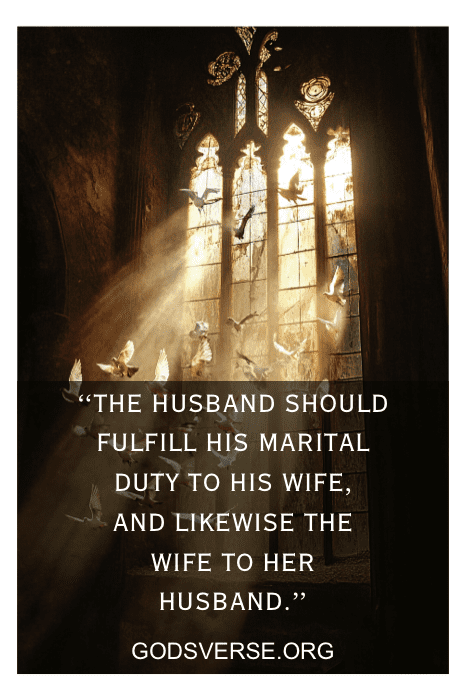
1 Corinthians 7:3-5 — Don’t Neglect Each Other
“The husband should fulfill his marital duty to his own wife, and likewise the wife to her own husband. The wife does not have authority over her own body but yields it to her husband. In the same way, the husband does not have authority over his own body but yields it to his own wife. Do not deprive each other except perhaps by mutual consent and for a limited time, so that you may devote yourselves to prayer.”
The Apostle Paul is blunt here. The marriage bed matters. Sexual relationships aren’t just a nice bonus in married life — they’re a required part of the covenant. Paul says deprivation opens the door to temptation because of your lack of self-control — that’s not an insult, it’s a recognition that human beings are designed for connection. If your own marriage has gone cold physically, this verse says: come back together. By mutual consent you can pause for prayer. But the default is closeness, not distance. The conjugal rights Paul describes go both ways — your own bodies belong to each other.
Do this: Have an honest conversation about your physical relationship. No blame, no guilt — just: “Where are we, and what do we both need?” That’s the marital duty Paul describes, and it starts with effective communication, not performance.
Ecclesiastes 9:9 — Enjoy Life Together
“Enjoy life with the wife whom you love, all the days of your fleeting life that he has given you under the sun — for this is your portion in married life.”
Stop enduring your marriage and start enjoying it. You have a limited time on this earth. God didn’t give you a spouse so you could coexist — He gave you a spouse so you could experience the good thing He designed marriage to be. If you’ve forgotten how to enjoy each other, the first thing to do is make time for it. Not when it’s convenient — now.
When One Spouse Wants Out
This is the section nobody wants to need. If your spouse has said “I want a divorce” — or if you can tell they’re thinking it — these verses speak to the fight for your own marriage when you might be fighting alone. For a deeper study on what Scripture says about divorce specifically, see our Bible verses about divorce and remarriage.
1 Corinthians 7:10-11 — The Lord’s Command
“To the married couple I give this command (not I, but the Lord): A wife must not separate from her own husband. But if she does, she must remain unmarried or else be reconciled to her husband. And a husband must not divorce his own wife.”
The Apostle Paul passes this along as coming directly from the Lord God Himself — not Paul’s opinion, the Lord’s command. The instruction is clear: don’t separate. But Paul is realistic — “if she does” — he knows it happens. And when it does, the goal is reconciliation, not replacement. If your spouse is pulling away, this verse gives you biblical ground to fight for marriage restoration.
Do this: Don’t beg. Don’t manipulate. Pray, and then say honestly: “I want us to try. I’m willing to do the hard work — counseling, changes, whatever it takes. But I can’t do it alone. Will you give us more time?” That’s the best way to honor both God’s Word and your spouse’s dignity.
Malachi 2:14-16 — God Is a Witness to Your Covenant
“The Lord God is the witness between you and the wife of your youth. You have been unfaithful to her, though she is your partner, the wife of your marriage covenant. Has not the one God made you? You belong to him in body and spirit. So be on your guard, and do not be unfaithful to the wife of your youth. ‘The man who hates and divorces his wife,’ says the Lord God, ‘does violence to the one he should protect.'”
God doesn’t just observe marriages — He’s a witness to the covenant. The Lord God of Israel takes your vows seriously even when you’ve forgotten them. If one spouse wants out, this passage is a reminder that the marriage covenant was made before God, and He hasn’t released either of you from it lightly. That doesn’t mean you can force someone to stay. But it does mean the vow carries weight in the eyes of God.
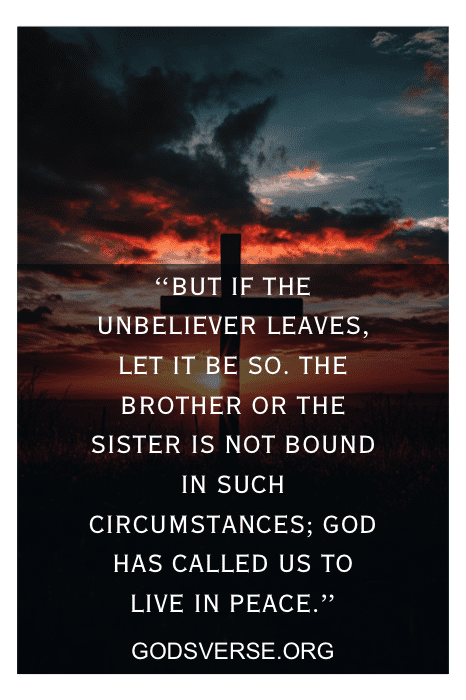
1 Corinthians 7:15 — When an Unbelieving Spouse Leaves
“But if the unbelieving partner separates, let it be so. The brother or the sister is not bound in such circumstances; God has called us to live in peace.”
If your spouse — particularly an unbelieving husband or unbelieving wife — is determined to leave, Paul says you are not bound. In such cases, in such circumstances, the believer is called to peace, not to bondage. This verse doesn’t celebrate divorce. It acknowledges reality: you can’t force a committed relationship on someone who refuses it. For more on what this means for your future, see our study on what the Bible says about remarrying after divorce.
Hosea 3:1 — Love Her Again
“The Lord said to me, ‘Go, show your love to your wife again, though she is loved by another man and is an adulteress. Love her as the Lord loves the Israelites, though they turn to other gods.'”
God told the prophet Hosea to take back a wife who had been unfaithful. That’s not a command for every situation — but it shows us the heart of God. His steadfast love pursues even when it’s not deserved. If you’re fighting for your own marriage and your spouse has strayed, this verse doesn’t demand you ignore reality. It shows you what redemptive love looks like — and it’s costly, painful, and sometimes the most Christlike thing a human being can do.
Matthew 19:6 — What God Has Joined Together
“So they are no longer two, but one flesh. Therefore what God has joined together, let no one separate.”
Let no one separate — not your spouse’s frustration, not your marital problems, not the world telling you to move on. Christ Jesus spoke these words to people who treated divorce casually. If your marriage today is in crisis, this verse is your anchor. God joined you. That means something.
When There’s Abuse or Addiction
This section is different from the others because the first priority isn’t saving the marriage — it’s saving the person. If you or your children are in physical danger, get safe first. The theology can come later. God is not asking you to be a martyr in your own home.
Psalm 82:3-4 — God Defends the Vulnerable
“Defend the weak and the fatherless; uphold the cause of the poor and the oppressed. Rescue the weak and the needy; deliver them from the hand of the wicked.”
God’s Word is clear: He stands with the vulnerable. If your own marriage involves abuse — physical, sexual, or severe emotional — you are not honoring God by staying silent. You are honoring God by getting safe. The Lord God defends the oppressed. You can too.
1 Corinthians 6:19-20 — Your Body Is a Temple
“Do you not know that your own bodies are temples of the Holy Spirit, who is in you, whom you have received from God? You are not your own; you were bought at a price. Therefore honor God with your own bodies.”
Your own body belongs to the Holy Spirit. No one — not even a spouse — has the right to harm it. Substance abuse, violence, and sexual coercion are violations of this principle. If someone is destroying the temple God lives in, that is not a marriage problem — it is a safety crisis.
If you are in danger: Call the National Domestic Violence Hotline at 800-799-7233. They provide free, confidential support 24/7. You can also text START to 88788. Getting safe is not giving up on your marriage — it’s giving your marriage the only chance it has.
Galatians 5:19-21 — The Works of the Flesh
“The acts of the flesh are obvious: sexual immorality, impurity and debauchery; idolatry and witchcraft; hatred, discord, jealousy, fits of rage, selfish ambition, dissensions, factions and envy; drunkenness, orgies, and the like.”
Substance abuse, fits of rage, and persistent drunkenness are named here as acts of the flesh — opposed to the Holy Spirit. If these patterns dominate your own marriage, the problem is spiritual, not just relational. Marriage restoration in such cases requires professional help, not just more prayer. God’s guidance often comes through counselors, pastors, and sometimes the legal system.
Verses That Remind You Why Marriage Matters
When you’re in the middle of tough times, it’s easy to forget what you’re fighting for. These verses take you back to the foundation — why God created marriage, what it’s supposed to look like, and why it’s worth the hard work of saving.
Genesis 2:23-24 — Bone of My Bones
“The man said, ‘This is now bone of my bones and flesh of my flesh; she shall be called woman, for she was taken out of man.’ That is why a man leaves his father and mother and is united to his own wife, and they become one flesh.”
Before there was a troubled marriage, there was this: wonder. Adam’s first words when he saw Eve — bone of my bones, flesh of my flesh — weren’t theology. They were awe. Marriage was designed to be a good thing, a profound mystery, and a source of joy. If your own marriage has become a source of pain, remember: this is what God intended. The design is good even when the execution is broken.
Ephesians 5:25-27 — Christ’s Love as the Standard
“Husbands, love your own wives, just as Christ Jesus loved the church and gave himself up for her to make her holy, cleansing her by the washing with water through the word.”
Christ Jesus is the head of the church — and His model of leadership is sacrifice, not domination. He is head of the wife not to control but to serve. The Apostle Paul calls this a profound mystery: that the relationship between a married couple is meant to mirror the relationship between Christ Jesus and His people. That’s a high standard. It’s also the best way to fight for a healthy marriage — not by demanding change, but by modeling it.
Ephesians 5:22-24 — Wives and the Church
“Wives, submit yourselves to your own husbands as you do to the Lord. For the husband is the head of the wife as Christ is the head of the church, his body, of which he is the Savior.”
This verse gets misused a lot of times to justify control. That’s not what the Apostle Paul is saying. He’s describing a mutual dance of love and respect — the husband as head of the wife leads through sacrifice (v.25), and the wife responds to sacrificial love with trust. Both spouses are accountable to the Lord God, not to each other’s demands. A Christian marriage built on this foundation is stronger than one built on who has more power.
1 Peter 3:7 — Honor Prevents Broken Prayers
“Husbands, in the same way be considerate as you live with your wives, and treat them with respect as the weaker vessel, and as heirs with you of the grace of life, so that nothing will hinder your prayers.”
Peter calls wives the weaker vessel — not weaker in value, but in a way that calls husbands to be protectors, not predators. He ties how you treat your own wife directly to the effectiveness of your prayers. The prayer of a righteous person has great power — but not if that person is dishonoring his wife. If your prayer life feels dead, check how you’re treating the person sleeping next to you. That’s often the first thing God wants you to address.
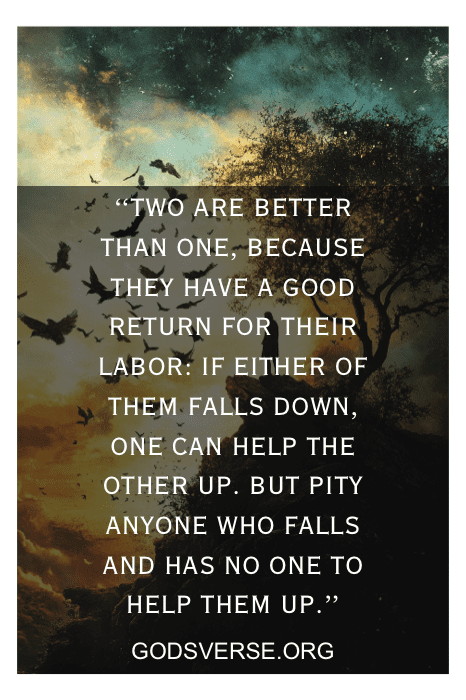
Ecclesiastes 4:9-12 — Two Are Better Than One
“Two are better than one, because they have a good return for their labor: If either of them falls down, one can help the other up. Though one may be overpowered, two can defend themselves. A cord of three strands is not quickly broken.”
A married couple gets a good reward for their hard work when they do it together. The “third strand” is God — and a marriage with God at the center is harder to break than one held together by feelings alone. Even in tough times, this verse reminds you: you’re not meant to fight alone. Your spouse isn’t your enemy. The enemy is whatever is trying to separate you.
Hebrews 13:4 — Honor the Marriage Bed
“Marriage should be honored by all, and the marriage bed kept pure, for God will judge the adulterer and all the sexually immoral.”
The marriage bed is sacred ground. Sexual relationships within marriage aren’t optional or secondary — they’re part of the design. Honoring the marriage bed means protecting the intimacy of your own marriage from outside threats: pornography, emotional affairs, neglect. Good marriages guard this space fiercely.
Mark 10:9 — Let No One Separate
“Therefore what God has joined together, let no one separate.”
Proverbs 18:22 — Marriage Is Still a Good Thing
“He who finds a wife finds a good thing and receives favor from the Lord God.”
Even in the middle of marital problems, this verse stands. Your marriage is still a good thing. It might not feel like it right now. But God’s favor rests on it — and what God favors, He’s willing to restore.
Romans 12:10 — Devotion and Honor
“Be devoted to one another in love. Honor one another above yourselves.”
Mutual respect isn’t a feeling — it’s a decision to treat the other person as more important than your own way. When both spouses honor each other above themselves, the power struggle that fuels most marriage conflict simply dissolves.
1 Corinthians 13:4-7 — What Love Actually Is
“Love is patient, love is kind. It does not envy, it does not boast, it is not proud. It does not dishonor others, it is not self-seeking, it is not easily angered, it keeps no record of wrongs. Love does not delight in evil but rejoices with the truth. It always protects, always trusts, always hopes, always perseveres.”
The Apostle Paul’s definition of love isn’t romantic — it’s rugged. Love perseveres. Love keeps no record of wrongs. Love is not easily angered. If your own marriage is struggling, read this list and ask honestly: “Which of these am I failing at?” That’s not condemnation — that’s the starting point for real change. The most important thing in a troubled marriage isn’t identifying what your spouse is doing wrong. It’s identifying what you can do differently.
Sometimes you don’t know what to say to God about your marriage. These Scripture-based prayers give you words when you have none. The prayer of a righteous person is powerful and effective (James 5:16) — even when that person is crying while they pray.
A Prayer When You’re Angry (Based on Psalm 4:4 and Ephesians 4:26)
Heavenly Father, I am angry. I don’t want to sin in my anger, but I don’t know how to let it go. Search my heart and show me what’s underneath the anger — is it hurt? Fear? Pride? Give me a gentle answer instead of harsh words. Help me not to let the sun go down on this. I bring this marriage conflict to you because I can’t carry it alone. In the name of our Lord Jesus Christ, amen.
A Prayer When You Feel Nothing (Based on Revelation 2:4-5)
Lord God, the feelings of love are gone. I don’t feel connected to my spouse. I don’t feel much of anything. But I remember what we had at first — help me to go back and do the things I did then. Not because I feel like it, but because You told me to. Rekindle what’s died. Show me the right time to speak and the right time to listen. Restore what the years of distance have taken. Father of our Lord Jesus Christ, bring life back to this marriage. Amen.
A Prayer When Trust Is Broken (Based on Psalm 51:10)
Heavenly Father, create in me a clean heart. I confess what I’ve done — and what I’ve failed to do. I don’t deserve forgiveness, but I ask for it anyway because Your steadfast love is greater than my sin. Help my spouse to heal in your limited time, not mine. Give me the patience to earn back what I destroyed. And if I’m the one who was betrayed — give me the strength to forgive even when everything in me resists it. In Christ Jesus, amen.
A Prayer When Your Spouse Won’t Engage (Based on Romans 12:12)
Heavenly Father, I’m fighting for this marriage alone. My spouse won’t talk, won’t try, won’t pray. I feel exhausted. But Your Word says to be joyful in hope, patient in affliction, and faithful in prayer — so that’s what I’m choosing today. I don’t know how this ends, but I trust Your steadfast love. Sustain me in this hard time. Show me the best way forward. And if there’s anything in me that’s making this harder, reveal it. I surrender this struggling marriage to you. In the name of our Lord Jesus Christ, amen.
James 5:16 — Pray Together If You Can
“Therefore confess your sins to each other and pray for each other so that you may be healed. The prayer of a righteous person is powerful and effective.”
If your spouse is willing, praying together — even one sentence each — has great power. The prayer of a righteous person doesn’t require eloquence. It requires honesty. “God, help us” is enough. A lot of times, the most powerful prayer for a struggling marriage is also the shortest. If you want more on what the Bible says about communication in marriage, we cover that in a separate guide.
What Scripture Does NOT Say About Troubled Marriages
A lot of harm gets done when people present their interpretations as if they were God’s Word. Here’s what the Bible does not say about troubled marriages:
1. The Bible does not say a struggling marriage is a failed marriage. Trouble doesn’t mean it’s over. Every marriage in the Bible — Abraham and Sarah, Isaac and Rebekah, David and Michal — had seasons of conflict, deception, or distance. There are no perfect marriages in Scripture. Not one. If there were, we wouldn’t need half the verses on this page.
2. The Bible does not say prayer alone will fix everything. Prayer matters — the prayer of a righteous person has great power. But God also gave us pastors, counselors, doctors, and wise friends. A lot of times, God’s guidance comes through other human beings, not just a quiet time. If your own marriage needs professional help, seeking it isn’t a lack of faith. It’s wisdom.
3. The Bible does not say you should stay in a marriage where you’re being physically harmed. God hates violence (Malachi 2:16). God defends the vulnerable (Psalm 82:3-4). God calls us to peace, not bondage (1 Corinthians 7:15). If your spouse is dangerous, leaving is not sin — it’s survival. Don’t let anyone use God’s Word to keep you in danger.
4. The Bible does not say “just forgive and forget.” Forgiveness is commanded (Colossians 3:13). Forgetting is not. You can forgive someone and still have boundaries. You can forgive and still require accountability. Trust is rebuilt over an amount of time through consistent behavior — not erased by a single apology.
5. The Bible does not say the wife is always the one who needs to try harder. Both spouses are accountable to God. The husband is called to love sacrificially (Ephesians 5:25). The wife is called to respect (Ephesians 5:33). Neither role excuses the other from doing hard work. Don’t pass judgment on which spouse is “more wrong” — focus on what you can control in your own marriage.
6. The Bible does not say marriage problems mean God is punishing you. Trouble in marriage is normal in a fallen world. Rain falls on the just and the unjust (Matthew 5:45). Your struggling marriage isn’t proof that God is angry with you — it might be proof that He’s refining you. There’s a difference.
7. The Bible does not say good marriages are easy. Good marriages are the result of hard work, mutual respect, effective communication, and steadfast love sustained by the Holy Spirit over decades. They are not the result of two people who never disagreed. Marriage today, like marriage in biblical times, requires everything you’ve got — and then the grace of God to cover the rest.
When to Get Help
Bible verses are powerful. But sometimes you need more than a verse — you need a person. Here’s a straightforward guide for when to move beyond reading and into action.
Talk to your pastor when you’ve hit a wall in your own marriage and need someone to mediate a conversation you can’t have alone. Most pastors have experience with marriage conflict and can either help directly or refer you to someone who can. A lot of times, just having a third person in the room changes the entire dynamic.
See a licensed Christian counselor when the same marital problems keep recurring despite your best efforts, when there’s been infidelity, or when one spouse is dealing with depression, anxiety, or trauma that’s affecting the marriage. God’s guidance often comes through trained professionals. It’s not a great resource to overlook.
Call the National Domestic Violence Hotline (800-799-7233) if there is any physical violence, threats of violence, sexual coercion, or substance abuse creating an unsafe environment. This is not a marriage problem — it’s a safety crisis. Getting help isn’t betraying your spouse. It’s protecting both of you.
Don’t wait for the “right time.” There is no right time to get help for a failing marriage — there’s only now or later, and later is always worse. The first thing most couples say in counseling is: “We should have done this years ago.” Don’t be that couple. Act at the right time — which is now.
Yes. Marriage restoration after infidelity is one of the hardest things a married couple can do — but God specializes in hard things. Hosea 3:1 shows God commanding a prophet to take back an unfaithful wife. Psalm 51 shows David’s path back after adultery. The road requires genuine repentance from the one who strayed, genuine forgiveness from the one who was betrayed, and a lot of times, professional counseling to rebuild what was destroyed. It won’t be quick. But the steadfast love of God is bigger than the worst thing that’s happened in your own marriage.
What does the Bible say about staying in an unhappy marriage?
The Bible doesn’t promise happiness — it promises faithfulness, and it calls you to the same. God’s Word encourages reconciliation (1 Corinthians 7:10-11), patience (Ephesians 4:2), and sacrificial love (Ephesians 5:25). But “unhappy” covers a wide range — from mild disappointment to genuine suffering. If your marriage is merely difficult, Scripture calls you to fight for it with hard work and prayer. If it’s dangerous, Scripture calls you to protect yourself and your children. There’s a difference between a struggling marriage and an abusive one, and God’s Word honors both situations differently.
Should I pray for my spouse to change?
You can — but start by praying for yourself to change first. Matthew 7:5 says to take the log out of your own eye before addressing the speck in your spouse’s. The prayer of a righteous person has great power (James 5:16), and the most powerful prayer you can pray for your own marriage might be: “Heavenly Father, change me. Show me my part in this.” That’s not letting your spouse off the hook — it’s giving God permission to work on the one person you can actually control.
What Bible verse helps with forgiveness in marriage?
Colossians 3:13 — “Forgive as the Lord forgave you.” Also Ephesians 4:32 — “Be kind and compassionate to one another, forgiving each other, just as in Christ God forgave you.” Forgiveness in a Christian marriage isn’t about excusing behavior. It’s about releasing the debt so bitterness doesn’t destroy you from the inside. It’s one of the most important things you’ll ever do for your own marriage — and one of the hardest.
What does the Apostle Paul teach about troubled marriages?
The Apostle Paul addresses marriage conflict extensively in 1 Corinthians 7. He teaches that a married couple should not separate (v.10-11), that a believing spouse should stay with an unbelieving husband or unbelieving wife if they’re willing (v.12-13), that sexual relationships in the marriage bed are a marital duty and conjugal rights that shouldn’t be neglected except by mutual consent for a limited time (v.3-5), and that if an unbeliever departs, the believer is not bound (v.15). Paul also calls marriage a profound mystery in Ephesians 5:32 — a picture of Christ Jesus and the church. His teaching is the most detailed practical guidance on married life in the entire New Testament, and it’s a great resource for any married couple going through tough times.
How do you rebuild a marriage after years of distance?
Start small. You can’t rebuild in a day what deteriorated over years. The best way is to do three things: (1) Create a no-phone zone for 30 minutes a day where you actually talk — that’s the beginning of effective communication. (2) Pray together, even if it’s awkward and short. (3) Read one verse from this page together each night and each share one sentence about what it means for your marriage today. Marriage restoration isn’t a lightning bolt. It’s a lot of times choosing to show up when you don’t feel like it. Over an amount of time, those choices become a healthy marriage again.
Is it wrong to separate from your spouse?
The Bible discourages separation (1 Corinthians 7:10) but acknowledges it happens. In such cases involving danger, substance abuse, or unrepentant sin, separation can be the wisest and most loving thing to do — for both spouses. Separation isn’t the same as divorce. It can be a temporary measure to create safety, allow for counseling, and give both people space to hear from God. If you’re considering separation, talk to a pastor or Christian counselor before making the decision. Don’t go through it alone.
George Hendricks is the founder and managing editor of Godsverse.org. He has written and published over 200 skit reviews, church resource guides, and Bible study articles. With a background in data-driven content strategy and digital publishing, George built Godsverse into one of the most comprehensive collections of church skit reviews and printable scripts online. When he's not writing, he's researching what churches actually need and figuring out how to deliver it.