Amidst the abundant mentions of “living creatures,” cats in the Bible are clearly absent. Did the Bible neglect cats entirely? Not really. It does include specific wild cats – the lion and the leopard. In this post, let’s explore the reasons for the omission of cats in the bible and what it says about God’s care for all living beings.
The Roles of Animals in the Bible
Animals play a vital role in the Bible. They serve as part of God’s good creation and as tools for teaching moral lessons. They also illustrate divine principles.
Quick Assessment
Why does your prayer life keep falling flat?
It's usually one of four things — and each one needs a completely different strategy to break through. This 2-minute assessment tells you exactly which pattern is blocking you.
For instance, sheep are vital to the image of “paths of righteousness” in Psalm 23. In this verse, David reflects on God’s provision and tender mercies as the Good Shepherd who leads His flock through the valley of the shadow of death.
Oxen, on the other hand, symbolizes strength and service. Doves represent peace and the Holy Spirit.
Lions are known as the king of beasts and they appear throughout the Bible. They’re described as terrifying predators in lions’ dens and powerful symbols of Judah as seen in Genesis 49:9.
Free Resource
Get Your FREE Prayer Guide Now
and join the Daily Way Devotional: Join 25,000+ Subscribers
The leopards are also mentioned in various passages, such as Isaiah 11:6. These wild cats portray God’s kingdom where animals dwell in harmony with their prey.
These mentions remind us that every living thing, from the most majestic to the lowest creeping things is part of God’s planet for this Earth.
Animals also feature prominently in various laws and prophecies. Levitical laws, for instance, regulate the sacrifice of animals. Prophets like Isaiah utilize animals to envision a future of peace and restoration. These creatures are woven into the life of God’s people. They serve as a reflection of God’s tender mercies and care for creation.
However, the Bible’s focus on domesticated animals, like sheep and oxen, leaves little room for the domesticated cat. Thus, it raises questions about its cultural and symbolic role during biblical times.
Cats in Ancient Civilizations
To understand the absence of cats in biblical texts, let’s first consider their place in the ancient world. In some neighboring cultures, cats were revered. However, their significance was different from that of animals commonly mentioned in the Bible.
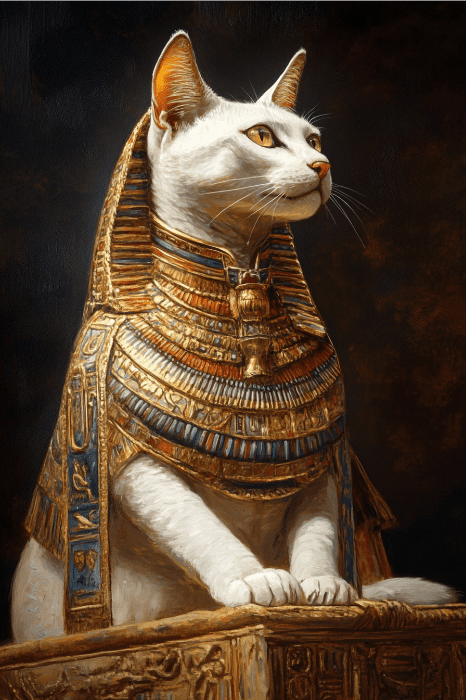
Cats were sacred in ancient Egypt. They were associated with the goddess Bastet. She represents protection, fertility, and domestic harmony.
Images of cats adorned temples and homes. They were also treated with reverence as divine beings.
Wild cats, such as lions and leopards, held symbolic importance in Mesopotamia and Canaan.
Again, domesticated cats were less prominent.
The domestication of cats likely didn’t hold the same practical or spiritual significance for the Hebrew people, even though they could historically traced back to agricultural societies.
Instead, the Bible focuses on God’s creation as it pertains to the daily lives of His people – shepherds, farmers, and fishermen. It means that the animals mentioned serve practical roles and they took precedence in scripture.
Cats did exist in regions influenced by Israelite culture. However, they didn’t play a vital role in the lives of God’s people. Lions indeed prowled the top of Senir and the summit of Hermon. But smaller cats may have simply not been noteworthy in the agrarian context that shaped much of the Bible’s narrative.
Cultural and Religious Factors
The cultural and religious backdrop of the Bible offers further insight into why cats in the Bible are absent. The Hebrew worldview emphasized animals with practical or spiritual importance, like sheep for sacrifices or eagles as messengers of divine power.
Cats, on the other hand, may not have been deemed essential to the life of His beasts or the spiritual life of His people. Neighboring cultures like Egypt elevated cats to near-divine status. It’s something that may have been incompatible with the biblical emphasis on worshipping God alone.
For instance, the Queen of Sheba’s visit to Solomon highlights a meeting of cultures. It doesn’t mention her bringing sacred animals, such as cats. This absence could reflect the Israelites’ desire to distance themselves from the religious practices of their neighbors.
Another possibility of the lack of references to cats in the Bible stems from theological reasons.
Cats’ traits, such as independence, mystery, and aloofness, might not align with the communal and sacrificial themes emphasized in the Bible. Unlike sheep which require shepherding and symbolize the flock under God’s care, cats’ solitary nature might not serve as an effective metaphor for God’s relationship with humanity.
Practical Reasons for the Absence of Cats in the Bible
Cats’ roles in ancient societies were limited to pest control. Keeping grain storage areas free of rodents, for one. This role was valuable. It’s true. However, it didn’t elevate cats to a status warranting mention in the Bible.
Sheep, oxen, and goats, on the other hand, were integral to agriculture, trade, and religious practices. That’s why they are prominent in biblical narratives.
The agrarian lifestyle of ancient Israel also shaped the types of animals that were included in scripture. Domesticated animals that provided food, clothing, or labor took precedence over animals like cats, which served more peripheral roles.
This focus reflects the Bible’s overarching themes of provision and God’s care for His people, instead of the broader roles of independent creatures.
Another reason could be that there was limited interaction between cats and the Hebrew people. Cats may not have been widespread or notable enough in the regions where biblical events took place to be included, unlike dogs that were sometimes viewed as unclean yet acknowledged in scripture.
If you’re a cat owner, it may be surprising to you considering that cats are perceived as cherished companions.
Symbolic Interpretation
The absence of cats in the Bible might also stem from their traits not aligning with the central themes and symbolism of the text. Keep in mind that biblical narratives emphasize qualities, like obedience, community, and dependence.
Cats, by contrast, are known for their independence and mysterious behavior. These are traits that may have seemed at odds with the relational focus of biblical stories.
As mentioned, their solitary nature and aloof demeanor make them less suited for the allegorical purposes that dominate scripture.
For instance, sheep symbolize innocence and the faithful following of God. Lions represent power and majesty. They sometimes symbolize God’s justice or the strength of His kingdom.
Cats might not have lent themselves to such symbolic roles. Their subtle, enigmatic behavior might have seemed less useful in conveying the clear, direct messages often associated with biblical metaphors.
Modern Interpretations
The absence of cats in the Bible has become a subject of fascination. This is especially true in today’s world where cats are among the most popular pets.
In ancient times, animals were valued for their practical contributions, like providing food, labor, or spiritual symbolism. Today, however, many animals, especially cats and dogs, are primarily companions. They play emotional rather than practical roles in people’s lives. This shift highlights how the cultural and spiritual significance of animals evolves.
Even though the Bible does not explicitly mention domestic cats, its broader message about God’s care for all creation leaves for their inclusion in the divine order.
Just like all animals, cats are part of the “good things” in God’s creation, even though they are not explicitly outlined in the Bible.
Jane is a Roman Catholic on a journey of re-learning about God and deepening her understanding of the Bible. She has over a decade of experience as a copywriter. Her goal is to blend her passion for writing with her spiritual journey. She writes content that doesn’t just uplift but also connects with people who wish to seek a deeper understanding of God’s word. Follow Jane on LinkedIn or Instagram.