It usually hits at the worst possible moment. The phone rings at 2am. The doctor says “we need to talk.” You walk into a room where you know the conversation is going to cost you something. And suddenly you’re standing in the middle of your own life, terrified, wondering where the strength is going to come from to face the next hour.
If you’re searching for Bible verses for strength and courage right now, you’re probably not doing it out of academic curiosity. You’re in something — tough times that don’t come with warning signs, or difficult times that have been grinding you down for months. And you need real words — not a motivational poster — from a God who actually knows what you’re walking through.
This collection of 55 Bible verses is organized by what you’re feeling, not by topic. Because the verse that speaks to someone running on empty is different from the one that reaches someone paralyzed by fear. Use the table below to find your section in ten seconds.
Quick Assessment
Why does your prayer life keep falling flat?
It's usually one of four things — and each one needs a completely different strategy to break through. This 2-minute assessment tells you exactly which pattern is blocking you.
These 8 verses are for the person who’s not afraid — they’re just done. The one who’s been carrying too much for too long and is starting to wonder if God noticed. The source of strength for the empty person looks different from the source of strength for the terrified person — and that difference matters.
The most famous verse in this category, Isaiah 40:31, has a detail most people miss. It says “those who hope in the Lord.” The Hebrew word there is qavah — it means to twist or bind together, like a rope under tension. The waiting and hoping isn’t passive. It’s active pressure against something real. God doesn’t just renew the strong. He specifically renews the weary. Even young men — the ones who should have reserves — stumble and fall (Isaiah 40:30). But God is the source of strength for the person who has nothing left.
Isaiah 40:29–31 (NIV)
“He gives strength to the weary and increases the power of the weak. Even youths grow tired and weary, and young men stumble and fall; but those who hope in the Lord will renew their strength. They will soar on wings like eagles; they will run and not grow weary, they will walk and not be faint.”
God targets the exhausted specifically — this is not a verse for people who already feel strong.
Nehemiah 8:10 (NIV)
“Do not grieve, for the joy of the Lord is your strength.”
The joy of the Lord isn’t about emotion — it’s a source. A well you draw from, not a feeling you manufacture.
Psalm 23:4 (NIV)
“Even though I walk through the darkest valley, I will fear no evil, for you are with me; your rod and your staff, they comfort me.”
The darkest valley isn’t avoided — it’s walked through. With company.
Matthew 11:28–29 (NIV)
“Come to me, all you who are weary and burdened, and I will give you rest. Take my yoke upon you and learn from me, for I am gentle and humble in heart, and you will find rest for your souls.”
Jesus doesn’t say “push through it.” He says come.
Zephaniah 3:17 (NIV)
“The Lord your God is with you, the Mighty Warrior who saves. He will take great delight in you; in his love he will no longer rebuke you, but will rejoice over you with singing.”
God sings over the person who has nothing left to offer. That’s not nothing.
2 Corinthians 12:9 (NIV)
“But he said to me, ‘My grace is sufficient for you, for my power is made perfect in weakness.’ Therefore I will boast all the more gladly about my weaknesses, so that Christ’s power may rest on me.”
The power of the Holy Spirit shows up most clearly in the place you feel most inadequate.
Psalm 29:11 (NIV)
“The Lord gives strength to his people; the Lord blesses his people with peace.”
God’s strength and the peace of God arrive together. You don’t have to choose.
Psalm 119:28 (NIV)
“My soul is weary with sorrow; strengthen me according to your word.”
This is a prayer you can borrow word for word. Just say it.
A Real Moment
I watched a friend go through a season where she was caregiving her mother full-time, raising two kids, and holding down a job. She told me the only thing she knew to do each morning was open Psalm 23 and read it out loud. Not because she felt anything. Just because it was true. Six months later she told me it had become the only verse she needed. The darkest valley has company — you just can’t always feel it.
When Fear Has You Frozen
8 verses for when the “what ifs” have taken over and your brain won’t stop running worst-case scenarios. This is not weakness — it’s the most human thing in the world. And the holy Bible addresses it on nearly every page.
The most-searched verse in the entire Holy Bible may well be Joshua 1:9. But if you look at it closely, God doesn’t say “be strong if you can.” He says “have I not commanded you?” — as if to say, your strength isn’t optional and it doesn’t depend on your feelings. It’s a command with a promise attached. (There’s more on the Hebrew behind this in the word study below — it’s genuinely surprising.)
If you’re also fighting doubt alongside fear, our Bible verses on doubt might help alongside this section.
“Have I not commanded you? Be strong and courageous. Do not be afraid; do not be discouraged, for the Lord your God will be with you wherever you go.” — Joshua 1:9 (NIV)
God said this to Joshua the night before he had to lead two million people across a flooded river into enemy territory with no bridges, no boats, and no guarantee of survival. If God’s command to have good courage applied then, it applies to whatever you’re facing today.
“So do not fear, for I am with you; do not be dismayed, for I am your God. I will strengthen you and help you; I will uphold you with my righteous right hand.” — Isaiah 41:10 (NIV)
The righteous right hand — in the ancient world, that’s where power lived. The dominant hand of a warrior. God is saying: I’m gripping you with my strongest hold. You won’t fall because I won’t let go.
Psalm 27:1 (NIV)
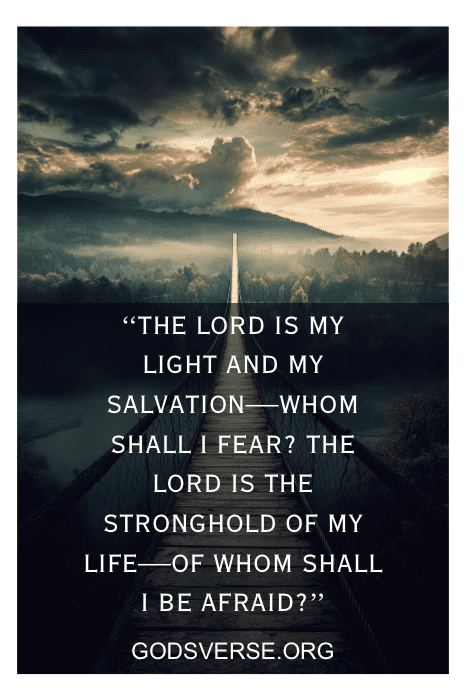
“The Lord is my light and my salvation — whom shall I fear? The Lord is the stronghold of my life — of whom shall I be afraid?”
A question that is also an answer. Psalm 27 is the anti-anxiety chapter of the Old Testament.
2 Timothy 1:7 (NIV)
“For the Spirit God gave us does not make us timid, but gives us power, love and self-discipline.”
Timidity is not from God. The power of the Holy Spirit replaces it with something else entirely.
Psalm 56:3–4 (NIV)
“When I am afraid, I put my trust in you. In God, whose word I praise — in God I trust and am not afraid. What can mere mortals do to me?”
David wasn’t fearless. He was afraid AND he trusted. Both things can be true at once.
Deuteronomy 31:6 (NIV)
“Be strong and courageous. Do not be afraid or terrified because of them, for the Lord your God goes with you; he will never leave you nor forsake you.”
God’s presence is the argument against fear — not our own internal willpower.
Isaiah 43:2 (NIV)
“When you pass through the waters, I will be with you; and when you pass through the rivers, they will not sweep over you.”
Not “I will remove the water.” But “you will not be swept away.” A different kind of promise — harder and better.
Psalm 138:3 (NIV)
“When I called, you answered me; you greatly emboldened me.”
The shortest verse in this section — and sometimes the most useful one to memorize and whisper.
When You Have to Do Something Hard
8 verses for when you already know what you’re supposed to do — you’re just terrified to do it. A hard conversation. A step of faith. A decision you’ve been circling for months.
There’s a reason Philippians 4:13 is the most tattooed verse in the world. But it’s also one of the most misused. Paul didn’t write it as a verse about athletic performance or career ambition. He wrote it from prison, describing how Christ’s strength had taught him to be content whether he had everything or nothing. The verse is about the power of Christ Jesus working through human limitations — not “I can do this because I’m strong enough.”
For more on what it looks like to push through when everything in you wants to quit, our collection of examples of endurance in the Bible pairs well with this section.
“I can do all this through him who gives me strength.” — Philippians 4:13 (NIV)
The “all this” is the hard thing in front of you. Not every hard thing in the world — the specific impossible-feeling thing you’re staring at right now. Christ Jesus gives strength in proportion to the need. No more, no less.
Ephesians 6:10 (NIV)
“Finally, be strong in the Lord and in his mighty power.”
The strength doesn’t originate from you. It flows through you from a stronger source.
Romans 8:31 (NIV)
“What, then, shall we say in response to these things? If God is for us, who can be against us?”
The math is simple. The room might be against you. Your circumstances might be against you. God isn’t.
1 Corinthians 16:13 (NIV)
“Be on your guard; stand firm in the faith; be courageous; be strong.”
Four commands. All from Paul to people who were about to go do something that cost them everything.
Hebrews 13:6 (NIV)
“So we say with confidence, ‘The Lord is my helper; I will not be afraid. What can mere mortals do to me?'”
Confidence in God’s help makes human opposition look like what it actually is — limited and temporary.
Zechariah 4:6 (NIV)
“Not by might nor by power, but by my Spirit, says the Lord Almighty.”
When your own strength is genuinely zero, this verse explains how the thing still gets done.
2 Chronicles 32:7 (NIV)
“Be strong and courageous. Do not be afraid or discouraged because of the king of Assyria and the vast army with him, for there is a greater power with us than with him.”
Hezekiah said this to people facing a real army with real spears. The principle scales to your situation.
1 Samuel 30:6 (NIV)
“David was greatly distressed because the men were talking of stoning him; each one was bitter in spirit because of his sons and daughters. But David found strength in the Lord his God.”
Everyone else had abandoned him. He found his source of strength in the one place no one could take from him.
Proverbs 3:5–6 (NIV)
“Trust in the Lord with all your heart and lean not on your own understanding; in all your ways submit to him, and he will make your paths straight.”
Leaning on your own understanding is what makes hard decisions feel impossible. Submission isn’t weakness here — it’s navigation.
A Real Moment
I know a man who spent three months unable to make a business decision that would affect his family, his employees, and everything he’d built. Every Sunday he’d come home from church and still not decide. He told me later that the morning he finally moved was the morning he stopped asking “what’s the smart move” and started asking “what does God want” — and the path became clear within hours. Not easier. But clear. Proverbs 3:5-6 doesn’t promise an easy road. It promises a straight one.
When You’re Fighting for Someone You Love
7 verses for when the struggle isn’t yours — it’s someone else’s. You’re the one holding vigil, praying through tears, and trying to stay standing while someone you love is falling.
Some of the hardest seasons aren’t about your own pain. They’re about watching someone else suffer and feeling completely helpless. If you’re also praying through something that’s triggering obsessive fear or anxiety spirals for someone you love, our Bible verses for OCD might offer specific comfort alongside this section.
“God is our refuge and strength, an ever-present help in trouble.” — Psalm 46:1 (NIV)
Ever-present. Not “sometimes present when things get really bad.” Not “present if you pray the right way.” The Heavenly Father is at the bedside, in the waiting room, in the courtroom, in the conversation you’re dreading — before you ask. That’s the promise.
The psalm that contains this verse goes further: “we will not fear, though the earth give way and the mountains fall into the heart of the sea” (Psalm 46:2). That’s not a metaphor for mild inconvenience. That’s the total structural collapse of everything familiar. And even then — not afraid. The God who is our refuge and strength holds through the kind of collapse that takes the mountains with it.
Romans 8:37–39 (NIV)
“No, in all these things we are more than conquerors through him who loved us. For I am convinced that neither death nor life, neither angels nor demons… nor anything else in all creation, will be able to separate us from the love of God that is in Christ Jesus our Lord.”
The love of God isn’t conditional on recovery or outcomes. It holds whether the news is good or not.
Isaiah 35:4 (NIV)
“Say to those with fearful hearts, ‘Be strong, do not fear; your God will come, he will come with vengeance; with divine retribution he will come to save you.'”
You can speak this verse over someone you love. Isaiah wrote it specifically to be delivered from person to person.
Hebrews 4:16 (NIV)
“Let us then approach God’s throne of grace with confidence, so that we may receive mercy and find grace to help us in our time of need.”
The throne of grace is open. You don’t have to be in a perfect spiritual state to show up and ask for help.
2 Thessalonians 3:3 (NIV)
“But the Lord is faithful, and he will strengthen you and protect you from the evil one.”
Faithfulness is a character trait — it doesn’t fluctuate based on how the situation looks today.
Isaiah 12:2 (NIV)
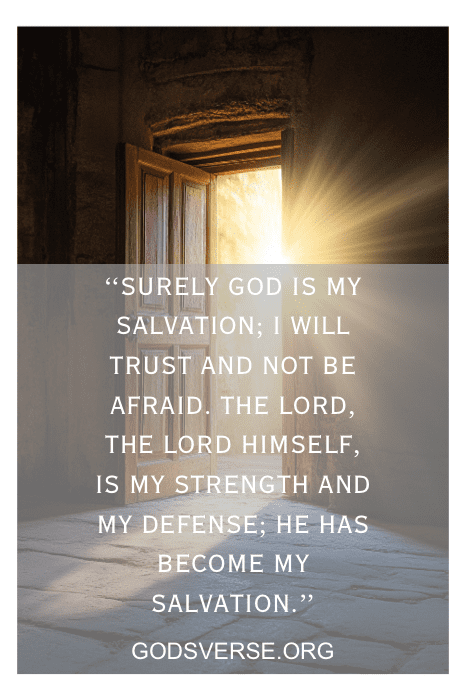
“Surely God is my salvation; I will trust and not be afraid. The Lord, the Lord himself, is my strength and my defense; he has become my salvation.”
When you’re fighting for someone else, this is the verse for your own tank. Refill before you keep going.
Psalm 91:2 (NIV)
“I will say of the Lord, ‘He is my refuge and my fortress, my God, in whom I trust.'”
Pray this for the person you love. Pray it over their house, their hospital room, their name.
When You Feel Like a Failure
8 verses for the person who fell. Who let people down. Who wonders if they’ve disqualified themselves from God’s plan.
Micah 7:8 might be the most underrated verse in the entire collection of Bible verses about strength. It’s not about preventing the fall — it’s about what happens after. “Though I have fallen, I will rise.” Not “though I have fallen, I’ll pretend I didn’t.” Not “though I have fallen, I’ll explain why it wasn’t my fault.” I fell. And I will rise. In that order.
On the mornings when shame is loudest, our post on the joy in the morning Bible verse from Psalm 30:5 may give you exactly the reminder you need.
“Do not gloat over me, my enemy! Though I have fallen, I will rise. Though I sit in darkness, the Lord will be my light.” — Micah 7:8 (NIV)
There’s defiance in this verse. Not the self-deluded kind — the earned kind. The kind that comes from knowing who your actual Lord God is. The darkness is real. The sitting is real. And the rising is just as real.
1 Peter 5:10 (NIV)
“And the God of all grace, who called you to his eternal glory in Christ, after you have suffered a little while, will himself restore you and make you strong, firm and steadfast.”
The God of all grace does the restoring — not you. Your job is to show up. His job is to rebuild you.
Habakkuk 3:19 (NIV)
“The Sovereign Lord is my strength; he makes my feet like the feet of a deer, he enables me to tread on the heights.”
Deer don’t just survive the mountain — they navigate it with precision. God doesn’t just get you through, he gives you footing to climb.
Philippians 1:6 (NIV)
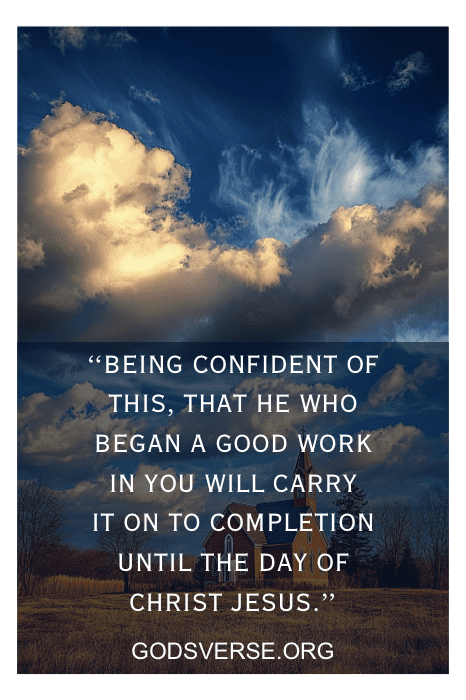
“Being confident of this, that he who began a good work in you will carry it on to completion until the day of Christ Jesus.”
God doesn’t abandon half-finished projects. Your story is not done because of this chapter.
Psalm 73:26 (NIV)
“My flesh and my heart may fail, but God is the strength of my heart and my portion forever.”
“My flesh and my heart may fail” — that’s honesty. The verse doesn’t pretend everything is fine. It finds something stronger than fine.
Romans 8:28 (NIV)
“And we know that in all things God works for the good of those who love him, who have been called according to his purpose.”
“All things” means this thing too. Even the failure. Even the choices you’d take back. God works in every piece of the material.
Psalm 31:24 (NIV)
“Be strong and take heart, all you who hope in the Lord.”
Write this on your bathroom mirror on the mornings when shame is the first thing you hear.
A Real Moment
I’ve sat across from people who were convinced that what they’d done had permanently disqualified them from anything good. That God might still save them, but He certainly couldn’t use them. Every single time, the thing that moved them wasn’t a pep talk — it was the idea that God in Christ Jesus specializes in repurposing wreckage. He always has. From Peter to Paul to every broken character in the New Testament, the pattern is the same: fallen, restored, useful.
When It Feels Like Spiritual Attack
7 verses for when the darkness feels deeper than circumstances. When it’s not just hard — it feels targeted, oppressive, and relentless.
Some seasons don’t feel like ordinary hard times. They feel like something is working against you in a way that goes beyond the natural. The New Testament is clear that spiritual warfare is real — and so is the armor that defeats it. Ephesians 6 describes the whole armor of God in military terms, and it’s worth reading the full passage on the evil day, not just memorizing verse 10. The armor is meant to be worn, not just acknowledged.
“Therefore put on the full armor of God, so that when the day of evil comes, you may be able to stand your ground, and after you have done everything, to stand.” — Ephesians 6:13 (NIV)
“After you have done everything, to stand.” Sometimes the victory looks like not falling. That counts. Standing your ground in the evil day — still upright at the end — is exactly what the whole armor of God was designed to produce.
James 1:2–3 (NIV)
“Consider it pure joy, my brothers and sisters, whenever you face trials of many kinds, because you know that the testing of your faith produces perseverance.”
Pure joy doesn’t mean fake happiness. It means the testing of your faith is producing something that cannot be taken back.
2 Chronicles 20:17 (NIV)
“You will not need to fight in this battle. Take up your positions; stand firm and see the deliverance the Lord will give you… Do not be afraid; do not be discouraged.”
Jehoshaphat sent worshippers ahead of the army. The worship went first. The victory came after. Same order still applies.
Hebrews 12:1–2 (NIV)
“Therefore, since we are surrounded by such a great cloud of witnesses, let us throw off everything that hinders… and let us run with perseverance the race marked out for us, fixing our eyes on Jesus, the author and perfecter of faith.”
The great cloud of witnesses isn’t watching you fail. They’re rooting for you to finish. Eyes on the author and perfecter of faith, not the obstacle.
Psalm 18:1–2 (NIV)
“I love you, Lord, my strength. The Lord is my rock, my fortress and my deliverer; my God is my rock, in whom I take refuge, my shield and the horn of my salvation, my stronghold.”
David used six different words for God’s protection in one breath. All of them were earned through actual experience of being defended.
Psalm 60:12 (NIV)
“With God we will gain the victory, and he will trample down our enemies.”
Short, blunt, and complete. This is a good one for the moments when you can’t pray anything longer than a sentence.
Deuteronomy 20:4 (NIV)
“For the Lord your God is the one who goes with you to fight for you against your enemies to give you victory.”
The Lord God goes with you — not ahead of you, not behind you. With you, in the battle.
The Military Secret Inside Joshua 1:9
Joshua 1:9 is one of the most tattooed, printed, posted, and cited verses on the subject of courage in the entire Holy Bible. But most people who quote it have no idea what God was actually saying — and when you find out, the verse changes completely.
God said it to Joshua the night before one of the most terrifying military operations in the Old Testament: crossing a flooding Jordan River with two million civilians to invade Canaan — an established, fortified civilization. No bridges. No boats. No guarantee. And God’s answer was two Hebrew words.
The verse immediately before it — Joshua 1:8 — tells him to keep the book of the law on his lips, meditate on it day and night, so that he “will be prosperous and have good success.” The courage and the Word of God work together. Chazaq and amats are the battle cry. God’s word is the fuel that makes both possible.
חָזַק — Chazaq “Be strong” / “Grip” / “Seize”
This is the word a commander shouts to troops before battle. It means to grip something tightly — your weapon, your position, your resolve. It’s not a gentle encouragement. It’s a military order. When God says chazaq, He’s saying: grip this situation. Do not let go. The word appears over 290 times in the Old Testament, almost always in contexts of war, crisis, and physical exertion.
The companion word to chazaq. Where chazaq is about gripping, amats is about bracing — planting your feet, setting your jaw, and refusing to be moved. In battle terms: this is the soldier who sees the enemy charge and does not run. God uses this word to tell Joshua (and you) not just to feel courage — but to physically, bodily, refuse to yield to fear.
חָזַק + אָמֵץ Together The full command of Joshua 1:9
Together, chazaq v’amats is the ancient equivalent of a battle cry. God didn’t give Joshua an inspirational speech. He gave him a military command with a promise: “Have I not commanded you? Grip hard and brace. Do not be afraid, do not be dismayed, for the Lord your God is with you wherever you go.” The courage isn’t optional. The presence is guaranteed. That’s the deal.
The New Testament carries this same language into the person of Jesus Christ himself. When Hebrews 12:2 describes him as the “author and perfecter of faith,” the word archegos (author) means “pioneer” — the one who goes first into the terrifying place, blazes the trail, and then turns back to tell you it can be done. The right hand of the throne of God isn’t an abstract idea — it’s where Christ Jesus is right now, advocating for the person reading this.
10 More Bible Verses for Strength and Courage
The following Bible verses didn’t fit neatly into one category — because strength and courage rarely fit neatly into one category. The word of God offers comfort for tough times, spiritual warfare, grief, and everything in between.
If you’re looking for something to start your morning with — a verse to read before you get out of bed — our post on a powerful Bible verse for morning gives you a short list built for exactly that purpose. And for those who run or walk and use movement to process hard seasons, our Bible verses for runners pairs perfectly with this collection.
Isaiah 40:31 (NIV)
“But those who hope in the Lord will renew their strength. They will soar on wings like eagles; they will run and not grow weary, they will walk and not be faint.”
The renewal goes in order: soar, then run, then walk. The bravest thing is sometimes just walking when you can’t run anymore.
Proverbs 18:10 (NIV)
“The name of the Lord is a fortified tower; the righteous run to it and are safe.”
Run to it. Not walk calmly. The name of the Lord is a tower you sprint toward when things are falling apart.
Romans 8:39 (NIV)
“Neither height nor depth, nor anything else in all creation, will be able to separate us from the love of God that is in Christ Jesus our Lord.”
The love of Christ is the one thing that cannot be stripped from you, regardless of what happens.
1 Peter 5:7 (NIV)
“Cast all your anxiety on him because he cares for you.”
All of it. Not the presentable stuff — all of it. The Heavenly Father can carry what you cannot.
Psalm 62:7 (NIV)
“My salvation and my honor depend on God; he is my mighty rock, my refuge.”
When your reputation, your security, and your self-worth feel threatened — they rest on the same rock.
Psalm 68:35 (NIV)
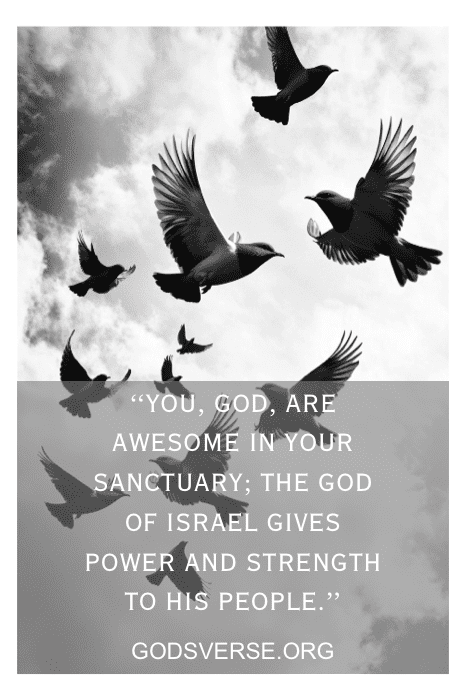
“You, God, are awesome in your sanctuary; the God of Israel gives power and strength to his people.”
God doesn’t hoard the power. He gives it to his people — specifically because they need it.
Exodus 15:2 (NIV)
“The Lord is my strength and my defense; he has become my salvation. He is my God, and I will praise him, my father’s God, and I will exalt him.”
Moses sang this immediately after walking through the Red Sea. Praise came first, before anyone knew what was next.
Romans 15:13 (NIV)
“May the God of hope fill you with all joy and peace as you trust in him, so that you may overflow with hope by the power of the Holy Spirit.”
The God of hope fills — you don’t manufacture it. Trust is the posture. Hope is the result.
2 Corinthians 4:17 (NIV)
“For our light and momentary troubles are achieving for us an eternal weight of glory that far outweighs them all.”
The eternal weight of glory isn’t added to your suffering — it’s being produced by it. The suffering has a purpose even when you cannot see it.
Psalm 46:1 (NIV)
“God is our refuge and strength, an ever-present help in trouble.”
Ever-present. Not “available if you reach out.” Already there. Already holding the situation you haven’t told him about yet.
What These Verses Are NOT Saying
Some of the most comforting verses in the Holy Bible are also some of the most misused. Here’s what this collection of Bible verses about strength and courage does NOT teach.
These Verses Are NOT About Positive Thinking
“Be strong and courageous” doesn’t mean convince yourself that everything will be fine. It means trust the one who holds the outcome — even when you cannot see how it ends. Biblical courage is not optimism. It’s obedience grounded in the character of God, not in predictions about how circumstances will turn out.
“I Can Do All Things” Is NOT About Achievement
Philippians 4:13 — the most quoted verse in this entire post — is not a motivational sports verse. Paul wrote it in prison, describing his ability to be content whether he had abundance or almost nothing. The “all things” he could do through Christ Jesus was survive suffering with peace intact. That’s a harder, more useful promise than the achievement version.
God’s Strength Does NOT Mean Yours Will Never Run Out
Isaiah 40:30 is explicit: “even young men stumble and fall.” Human strength runs out. That’s not a spiritual failure — that’s the design. When your strength runs out, you become eligible for God’s strength to flow in. The exhaustion isn’t the obstacle to receiving strength from God. It’s often the doorway.
A Prayer for Strength and Courage
For the Person Who Has Nothing Left
Heavenly Father, I come to you with nothing polished. Not the put-together version of me. Just what’s left after today.
O Lord, you said your power is made perfect in weakness. I am offering you my weakness right now. I am out of my own understanding. I’m past the point where I can manufacture strength or talk myself into courage. I need yours.
Be the ever-present help you promised. Hold me with the righteous right hand Isaiah described. Give me just enough strength for this hour — not the whole journey, just this hour.
For the thing in front of me, give me the chazaq — the grip that does not let go. And the amats — the braced, planted, refusal to be moved. Hold me with the mighty hand of God and the righteous right hand Isaiah promised.
I trust that the love of Christ Jesus cannot be taken from me. I trust that the God of hope is filling me even now, by the power of the Holy Spirit. Not because I feel it, but because your word says so. And your word does not return empty.
In the name of Jesus Christ, Amen.
Frequently Asked Questions
What is the most powerful Bible verse for strength and courage?
Joshua 1:9 is the most widely cited. “Have I not commanded you? Be strong and courageous. Do not be afraid; do not be discouraged, for the Lord your God will be with you wherever you go.” What makes it powerful is the word “commanded” — this isn’t a suggestion or a wish, it’s a divine order backed by a specific promise: God’s presence. For exhausted seasons specifically, Isaiah 40:29–31 may land even harder. It targets the weary by name. See the fear section above for a full breakdown of Joshua 1:9.
What does “be strong and of good courage” actually mean in Hebrew?
The two Hebrew words behind “be strong and courageous” in Joshua 1:9 are chazaq (grip hard, seize, brace) and amats (brace yourself, plant your feet, be firm). Together they’re the language of a military command — the equivalent of a general ordering troops to hold their position before battle. This is not poetic encouragement. It’s a direct order with the promise of God’s presence as its guarantee. See our full Hebrew word study above for details.
What is a good Bible verse for when you feel hopeless?
Romans 15:13 is one of the best: “May the God of hope fill you with all joy and peace as you trust in him, so that you may overflow with hope by the power of the Holy Spirit.” The God of hope isn’t passive — he fills. You don’t manufacture the hope; you trust, and the filling happens. Micah 7:8 is also worth holding in hopeless moments: “Though I have fallen, I will rise. Though I sit in darkness, the Lord will be my light.” For a more complete resource, we have a dedicated post on the best Bible verse for when you feel hopeless.
What is Philippians 4:13 really about?
“I can do all this through him who gives me strength” is almost always quoted as a performance verse — about athletic achievement, career success, or getting through a hard project. But Paul wrote it from prison, describing how Christ Jesus had taught him to be content whether he had everything or almost nothing. The “all things” he could do was endure any circumstance — abundance or suffering — with his soul intact. That’s actually the harder and more useful version of the promise. See our section on doing hard things for full context.
What Bible verse is good for anxiety and fear?
Isaiah 41:10 is one of the most direct: “So do not fear, for I am with you; do not be dismayed, for I am your God. I will strengthen you and help you; I will uphold you with my righteous right hand.” The victorious right hand — in the ancient world, the dominant hand of a warrior — is God’s grip on your situation. For the racing thoughts and worst-case spirals, 1 Peter 5:7 provides a practical action: “Cast all your anxiety on him because he cares for you.” All of it. That’s permission to give it over completely.
What does the Bible say about strength in difficult times?
The Holy Bible says a great deal — but its primary answer is that God’s strength flows specifically toward the weak and tired, not the already-strong. Isaiah 40:29: “He gives strength to the weary and increases the power of the weak.” 2 Corinthians 12:9 goes further: God’s power is “made perfect in weakness.” That means difficult times are not the obstacle to receiving God’s strength — they’re the condition that makes you most eligible to receive it. The word of God consistently frames exhaustion not as a spiritual failure, but as an invitation.
How do I find strength when I’ve failed or made a big mistake?
Micah 7:8 is where to start: “Though I have fallen, I will rise.” Then 1 Peter 5:10 — “the God of all grace… will himself restore you and make you strong, firm and steadfast.” The restoration is God’s job. Your job is to show up. The pattern throughout the New Testament is consistent: the people God used most significantly were the ones who had fallen most visibly and were most aware of their own brokenness. Peter denied Jesus three times. Paul persecuted Christians. Restoration is the central storyline, not the exception. See the full section on failure above.
What is a short Bible verse for strength I can memorize quickly?
Several of the most powerful verses are also the shortest. Psalm 29:11: “The Lord gives strength to his people; the Lord blesses his people with peace.” Psalm 46:1: “God is our refuge and strength, an ever-present help in trouble.” Nehemiah 8:10: “The joy of the Lord is your strength.” And Psalm 60:12: “With God we will gain the victory.” All of these can be memorized in under a minute and recalled at the exact moment you need them — in the waiting room, before the conversation, in the middle of the night.
George Hendricks is the founder and managing editor of Godsverse.org. He has written and published over 200 skit reviews, church resource guides, and Bible study articles. With a background in data-driven content strategy and digital publishing, George built Godsverse into one of the most comprehensive collections of church skit reviews and printable scripts online. When he's not writing, he's researching what churches actually need and figuring out how to deliver it.