Your team has been at it for weeks. The mission was clear when you started. Now someone’s gone quiet, two people keep disagreeing on everything, and you’re genuinely wondering if you should have just done this alone.
Everyone says teamwork makes the dream work. Scripture goes further — it says working together isn’t just practical, it’s theological. The body of Christ is designed to function as a unified team, and when one part hurts, the whole body feels it. God didn’t build lone rangers. He built a body.
But here’s what most Bible verse lists on this topic miss: different team struggles need different verses. The verse for a divided team is not the same as the verse for an exhausted one. This article is organized by your actual situation — find where your team is right now, go straight to that section, and you’ll have Scripture that fits. There’s also a Team Scripture Card worth saving and discussion questions you can use today.
Quick Assessment
Why does your prayer life keep falling flat?
It's usually one of four things — and each one needs a completely different strategy to break through. This 2-minute assessment tells you exactly which pattern is blocking you.
Division doesn’t always look like a fight. Sometimes it’s quiet — people going through the motions, a cold formality in the room, decisions made around someone instead of with them. The New Testament church knew this problem intimately. Paul spent more letters addressing division than almost any other topic.
A Real Moment
A worship team I know well fell apart over a scheduling conflict nobody addressed directly. One person felt overlooked, never said it out loud, and gradually stopped fully showing up. What started as a small wound turned into three months of passive distance. They came back together eventually — but it took someone finally naming what was happening and reading 1 Corinthians 1:10 out loud. That verse did what three months of avoided conversations couldn’t.
“I appeal to you, brothers and sisters, in the name of our Lord Jesus Christ, that all of you agree with one another in what you say and that there be no divisions among you, but that you be perfectly united in mind and thought.” — 1 Corinthians 1:10 (NIV)
Paul opens this letter with an appeal, not a command. He’s pleading with them — “in the name of our Lord Jesus Christ” — which is as serious as it gets. He’s not asking them to try harder at teamwork. He’s connecting unity directly to the identity of Christ himself. Division is not just a team problem. It’s a theological one.
“Make every effort to keep the unity of the Spirit through the bond of peace.” — Ephesians 4:3 (NIV)
Notice it says “keep” — not “create.” The unity of the Spirit already exists among God’s people. The work is protecting it. That reframes the whole conversation: you’re not trying to manufacture harmony from nothing. You’re guarding something God already placed among you.
Romans 15:5-6 (ESV)
“May the God of endurance and encouragement grant you to live in such harmony with one another, in accord with Christ Jesus, that together you may with one voice glorify the God and Father of our Lord Jesus Christ.”
This is a prayer Paul prays for his team — which means when unity feels impossible, you can start by asking God for it.
Philippians 2:2 (NIV)
“then make my joy complete by being like-minded, having the same love, being one in spirit and of one mind.”
Like-minded doesn’t mean identical. It means sharing the same love and the same ultimate purpose. That’s achievable even among very different people.
Psalm 133:1 (NIV)
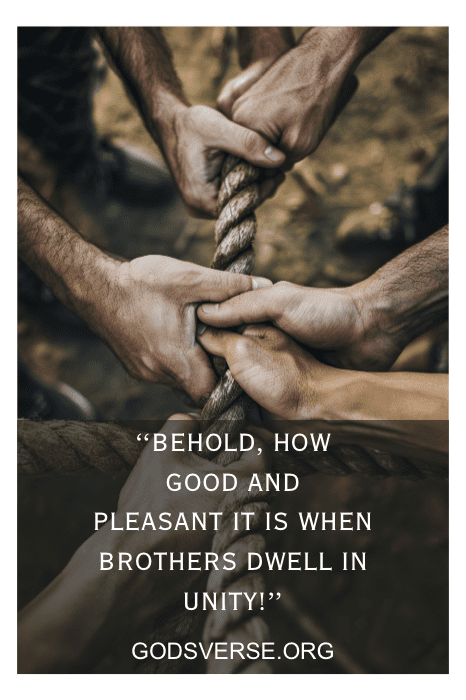
“How good and pleasant it is when God’s people live together in unity!”
Read this one out loud with your team. It’s short enough to memorize and powerful enough to reset the room when things have gone cold.
Ephesians 4:2 (NIV)
“Be completely humble and gentle; be patient, bearing with one another in love.”
Four things: humility, gentleness, patience, love. Any team conflict is usually missing at least two of these — and Paul says be completely all four.
“that all of them may be one, Father, just as you are in me and I am in you.” — John 17:21 (NIV)
This is Jesus praying for your team the night before he died. The standard he sets for team unity is the relationship between the Father and the Son — total, unbroken, characterized by mutual love and shared purpose. You won’t fully reach that. But it tells you the direction to move.
5-Minute Team Discussion
What would it look like for your team to “keep the unity of the Spirit” this week — not manufacture it, but protect what God has already placed here? Name one specific thing each person could do differently.
When Someone Isn’t Pulling Their Weight
This is the section nobody wants to look up — but almost every team needs.
There’s a reason Proverbs spends so much time on honest friendship, wise counsel, and direct words. The ancient world understood something we’ve learned to soften: love sometimes means saying the hard thing. And teams need that kind of love to survive long-term.
“As iron sharpens iron, so one person sharpens another.” — Proverbs 27:17 (NIV)
The KJV puts it “iron sharpeneth iron” — and both translations point to the same reality. Iron sharpening iron is not a comfortable process. There’s friction. It’s intentional contact between two hard things. But the result — a sharper blade — is worth it. This verse doesn’t describe easy teams. It describes useful ones.
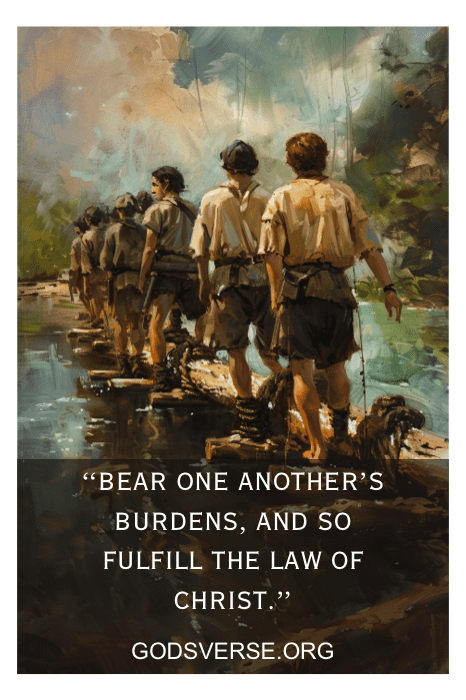
“Carry each other’s burdens, and in this way you will fulfill the law of Christ.” — Galatians 6:2 (NIV)
But here’s the tension you have to sit with: three verses later, Paul writes “each one should carry their own load” (Galatians 6:5). Same author, same letter. This isn’t a contradiction — it’s a distinction. There’s a difference between carrying someone’s crisis-weight (6:2) and doing their job for them indefinitely (6:5). Both matter. A healthy team knows which one applies.
1 Thessalonians 5:11 (NIV)
“Therefore encourage one another and build each other up, just as in fact you are doing.”
Accountability without encouragement breaks people down. Start by building up — then challenge. The order matters.
Proverbs 15:22 (NIV)
“Plans fail for lack of counsel, but with many advisers they succeed.”
Sometimes someone isn’t contributing because they don’t know how. Offer counsel before criticism. The abundance of counselors is wisdom, not weakness.
Proverbs 11:14 (NIV)
“For lack of guidance a nation falls, but victory is won through many advisers.”
This applies to knowing when and how to address a team problem, not just to big decisions. Bring wise people into the conversation.
Matthew 18:15 (NIV)
“If your brother or sister sins against you, go and point out their fault, just between the two of you. If they listen to you, you have won them over.”
Jesus says go directly, privately, first. Not to the group chat. Not to the team leader. To the person.
5-Minute Team Discussion
Is there a conversation your team has been avoiding? What’s the difference between carrying someone’s burden (Galatians 6:2) and enabling them to avoid their own load (6:5)? How would Proverbs 27:17 change how you have that conversation?
When Your Team Is Running on Empty
Most teams don’t fall apart because of drama. They fade out because of exhaustion. People quietly stop giving everything — and eventually stop showing up at all.
Nehemiah understood this better than most. His team rebuilt the walls of Jerusalem while actively defending against enemies, working through the night, each person with a weapon in one hand and a tool in the other (Nehemiah 4:17). Threatened on every side. And still — the people worked with all their heart (4:6). What kept them going wasn’t a pep talk. It was connection to a purpose they could see and a God they trusted.
“Let us not become weary in doing good, for at the proper time we will reap a harvest if we do not give up.” — Galatians 6:9 (NIV)
The phrase “at the proper time” is doing a lot of work here. It’s not “eventually, maybe.” It’s at the right time — which God determines, not your team’s calendar. The harvest is guaranteed. What isn’t guaranteed is whether your team will still be together when it arrives. Don’t quit before the proper time.
Isaiah 40:31 (NIV)
“but those who hope in the Lord will renew their strength. They will soar on wings like eagles; they will run and not grow weary, they will walk and not be faint.”
For exhausted teams: start here. Post it where your team meets. Read it together before any hard push.
Nehemiah 4:6 (NIV)
“So we rebuilt the wall till all of it reached half its height, for the people worked with all their heart.”
Half the wall done under direct threat. That’s what happens when people are connected to purpose, not just a task list.
Hebrews 10:24-25 (NIV)
“And let us consider how we may spur one another on toward love and good deeds, not giving up meeting together, as some are in the habit of doing, but encouraging one another.”
Tired teams stop showing up. This verse is a direct prescription: keep meeting, keep encouraging, don’t let the habit die when it costs something.
2 Chronicles 15:7 (NIV)
“But as for you, be strong and do not give up, for your work will be rewarded.”
The word will be rewarded — not might be, not probably. For a team that’s losing hope, this is a promise worth reading out loud.
A Real Moment
I’ve sat with enough ministry teams running on empty to recognize the pattern. Everyone’s still technically showing up — but the energy is gone and the conversations are shorter. And always, always, the thing that turns it around isn’t a new strategy. It’s someone stopping and asking: do we still know why we’re doing this? Reconnecting to purpose is what Galatians 6:9 is really about. The harvest matters. Don’t quit before you see it.
“And as for you, brothers and sisters, never tire of doing what is good.” — 2 Thessalonians 3:13 (NIV)
Six words. Print it and put it where your team works. The simplest endurance verse in the New Testament — and the hardest to live.
5-Minute Team Discussion
When did your team last stop and name the “why” behind what you’re doing? What would Nehemiah’s wall-builders remind you about right now — specifically the fact that they worked with all their heart even while threatened?
Before a Big Project or Mission
There’s a specific energy in a room before a team starts something big. Equal parts excitement and fear. The project feels both possible and overwhelming at the same time.
God’s Word has something direct for that moment — and it’s not “be careful.” It’s “go.”
“Two are better than one, because they have a good return for their labor: If either of them falls down, one can help the other up. But pity anyone who falls and has no one to help them up! … Though one may be overpowered, two can defend themselves. A cord of three strands is not quickly broken.” — Ecclesiastes 4:9-10, 12 (NIV)
This is the most concentrated teamwork passage in the entire Bible — and it comes from the most pessimistic book in Scripture. If even Ecclesiastes, which declares nearly everything vanity, stops to say that working together produces a good return, pay attention. The threefold cord has become shorthand for strong partnership for good reason: the principle is bulletproof. The KJV calls it a “threefold cord” — and it’s still unbroken.
If your team is starting something new and you want to plan it well, the Bible verses on planning collection is a strong companion to this section — especially the Proverbs passages on seeking wise counsel before major decisions.
Joshua 1:9 (NIV)
“Have I not commanded you? Be strong and courageous. Do not be afraid; do not be discouraged, for the Lord your God will be with you wherever you go.”
Read this before the first meeting of any new initiative. “Have I not commanded you” means this isn’t optional courage — it’s called-for courage.
Ephesians 2:10 (NIV)
“For we are God’s handiwork, created in Christ Jesus to do good works, which God prepared in advance for us to do.”
Good works — plural. Prepared in advance. Your team’s project is not an accident. It was anticipated before you ever formed the team.
Nehemiah 2:18 (NIV)
“I also told them about the gracious hand of my God on me… They replied, ‘Let us start rebuilding.’ So they began this good work.”
Nehemiah shared the vision. The people caught it. Sometimes launching a mission is that simple — tell your team what God put in your heart.
Proverbs 16:3 (NIV)
“Commit to the Lord whatever you do, and he will establish your plans.”
Commit first, plan second. Not the other way around. This is the right order for every team launch.
5-Minute Team Discussion
Where is the “gracious hand of God” already visible in what you’re about to do? Can your team name two or three signs that this project was prepared in advance by God — things that came together in ways you didn’t arrange?
When You’re Celebrating a Win Together
This section matters as much as any other. Celebrating badly — taking all the credit, immediately moving to the next thing, not pausing to name what God did — is a real risk for driven teams. Scripture gives a different model.
“I planted the seed, Apollos watered it, but God has been making it grow… For we are co-workers in God’s service; you are God’s field, God’s building.” — 1 Corinthians 3:6, 9 (NIV)
Paul is precise here: neither the planter nor the waterer gets credit for the growth. God makes things grow. Your team’s role is the work — not the outcome. You are God’s fellow workers in the Greek, which is an extraordinary title. But the win belongs to him. Let that shape every team celebration you have.
Colossians 3:23-24 (NIV)
“Whatever you do, work at it with all your heart, as working for the Lord, not for human masters, since you know that you will receive an inheritance from the Lord as a reward. It is the Lord Christ you are serving.”
When you celebrate, remember who you were actually serving. The win belongs to Christ.
1 Corinthians 15:58 (NIV)
“Always give yourselves fully to the work of the Lord, because you know that your labor in the Lord is not in vain.”
Not in vain. Every hour your team put in counted. Stop and actually say that to each other before moving to the next thing.
Nehemiah 8:10 (NIV)
“Go and enjoy choice food and sweet drinks, and send some to those who have nothing prepared. This day is holy to our Lord. Do not grieve, for the joy of the Lord is your strength.”
Nehemiah told his exhausted rebuilding team to go eat and celebrate together. Rest and rejoicing are not laziness — they’re commanded here.
Psalm 115:1 (NIV)
“Not to us, Lord, not to us but to your name be the glory, because of your love and faithfulness.”
The whole team reading this together after a big win might be the best thing you do. It resets everything to the right posture.
The Body of Christ: When Every Gift Matters
The deepest biblical case for working together isn’t about efficiency or strategy. It’s about identity.
Paul’s vision of the church as the body of Christ in 1 Corinthians 12 is the most fully developed theology of teamwork in all of Scripture. Every member has a role. Every spiritual gift is given by the same Holy Spirit. And crucially — no part of the whole body gets to say to another part, “I don’t need you.”
“There are different kinds of gifts, but the same Spirit distributes them. There are different kinds of service, but the same Lord. There are different kinds of working, but in all of them and in everyone it is the same God at work. Now to each one the manifestation of the Spirit is given for the common good.” — 1 Corinthians 12:4-7 (NIV)
Different gifts. Different kinds of service. Different kinds of working. Paul uses the word “different” three times in three sentences — deliberately. He wants you to sit with it. Diversity on a team is not a management problem. It’s the design of the Spirit. Every variety of gifts points back to the same source, and every gift is given for the same purpose: the common good. Not individual recognition. Not institutional success. The good of the whole.
“The eye cannot say to the hand, ‘I don’t need you!’ And the head cannot say to the feet, ‘I don’t need you!'” — 1 Corinthians 12:21 (NIV)
This is Paul calling out the specific temptation high-visibility team members face. The eye thinks it’s doing the important work. But try walking without feet. Every role matters — and the parts we give less honor to often have greater honor from God (12:24). If someone on your team feels like their contribution is invisible, this passage is for them directly.
1 Corinthians 12:12-13 (NIV)
“Just as a body, though one, has many parts, but all its many parts form one body, so it is with Christ. For we were all baptized by one Spirit so as to form one body.”
Your team’s diversity is not a weakness to overcome. It is the whole body of Christ doing what it was designed to do.
Ephesians 4:16 (NIV)
“From him the whole body, joined and held together by every supporting ligament, grows and builds itself up in love, as each part does its work.”
Growth happens when each part does its own work — not when one part does everyone else’s work. The whole body depends on each piece functioning.
Romans 12:4-6 (NIV)
“For just as each of us has one body with many members… so in Christ we, though many, form one body, and each member belongs to all the others. We have different gifts, according to the grace given to each of us.”
Each member belongs to all the others. That’s stronger than “we work together.” We belong to each other.
1 Peter 4:10 (NIV)
“Each of you should use whatever gift you have received to serve others, as faithful stewards of God’s grace in its various forms.”
Your gift is not yours to hold. It’s yours to steward on behalf of others. That’s what a team built on grace actually looks like.
Ephesians 4:11-13 (NIV)
“So Christ himself gave the apostles, the prophets, the evangelists, the pastors and teachers, to equip his people for works of service, so that the body of Christ may be built up until we all reach unity in the faith and in the knowledge of the Son of God.”
Different roles were given to equip the whole team — not to create a hierarchy. Every role serves the body.
Philippians 2:3-4 (NIV)
“Do nothing out of selfish ambition or vain conceit. Rather, in humility value others above yourselves, not looking to your own interests but each of you to the interests of the others.”
Selfish ambition is the number one killer of team culture. Humility — genuine, practiced humility — is the only antidote Paul prescribes.
A Real Moment
One of the most gifted people I’ve worked alongside was a communications director who almost never spoke in meetings. Her gift wasn’t words in the room — it was seeing patterns, noticing what was missing, connecting dots no one else caught. For two years, her team wasn’t using her right because they assumed her quietness meant she wasn’t contributing. When they changed how meetings ran to include her differently, everything improved. First Corinthians 12:21 had been the problem all along. They were saying “I don’t need you” without realizing it.
5-Minute Team Discussion
Is there someone on your team whose spiritual gift is not being fully used? Based on Philippians 2:3-4, what would it look like for each person to actively look out for the interests of the others — not just this week, but as a team habit?
The Team Scripture Card (Save This)
These 7 verses cover every major season a team moves through. Screenshot this section, print it, or bookmark the page — it’s worth having close when you need it.
When You’re Divided Ephesians 4:3
“Make every effort to keep the unity of the Spirit through the bond of peace.”
For Accountability Proverbs 27:17
“As iron sharpens iron, so one person sharpens another.”
When You’re Exhausted Galatians 6:9
“Let us not become weary in doing good, for at the proper time we will reap a harvest if we do not give up.”
Before a Big Mission Ecclesiastes 4:12
“A cord of three strands is not quickly broken.”
After a Win 1 Corinthians 3:9
“For we are co-workers in God’s service; you are God’s field, God’s building.”
For the Whole Team 1 Corinthians 12:7
“Now to each one the manifestation of the Spirit is given for the common good.”
Every Season Psalm 133:1
“How good and pleasant it is when God’s people live together in unity!”
What These Verses Are NOT Saying
These Verses Are NOT Saying: Avoid All Conflict
Biblical unity is not the same as false peace. Paul confronted Peter publicly (Galatians 2:11). Jesus cleared the temple courts. Unity means shared purpose and mutual love — not pretending everything is fine. Conflict addressed with honesty and care is healthier than conflict avoided indefinitely. “Bear with one another” (Ephesians 4:2) assumes there will be things to bear. The call is to do it in love, not to pretend nothing is wrong.
These Verses Are NOT Saying: Your Team’s Success Is Your Responsibility
First Corinthians 3:6-9 makes this plain: God makes things grow. You plant, you water, you show up consistently — but the outcome belongs to God. A team that takes full credit for wins will also take full blame for losses. Neither is accurate. You are co-workers with God in his service, not in place of him. Keep the two separate and your team’s emotional health will be far more stable.
These Verses Are NOT Saying: Teamwork Replaces Individual Responsibility
Galatians 6 holds both truths at the same time: carry each other’s burdens (6:2) and each person carries their own load (6:5). A healthy team does not replace personal accountability — it assumes it. Everyone bringing their full contribution is what makes it possible to carry each other’s extra weight when the hard seasons come. One without the other doesn’t work.
A Prayer for Your Team
For Unity, Endurance, and Work That Matters
Lord God, we come to you as a team — with different gifts, different strengths, and sometimes different frustrations.
Where we are divided, restore the bond of peace. Where we are exhausted, renew our strength. Where we are proud, replace selfish ambition with genuine humility. Where we are uncertain, give us the courage of Joshua and the purpose of Nehemiah’s people.
Remind us that we are your co-workers — not building our own thing, but your field and your building. Let the work of our hands bring glory to your name, and let the way we work together be a testimony to what you can do in a unified team.
In the name of our Lord Jesus Christ, Amen.
More Bible Verses on Working Together
These verses didn’t fit neatly into one section — but they’re worth having. For deeper personal study on how the Word of God applies to daily life and collaborative work, our collection of Bible verses for studying is a strong companion to everything covered here.
Romans 12:10 (NIV)
“Be devoted to one another in love. Honor one another above yourselves.”
Not equal — above. That’s a higher standard than most teams set for each other, and Paul doesn’t soften it.
Colossians 3:15 (NIV)
“Let the peace of Christ rule in your hearts, since as members of one body you were called to peace. And be thankful.”
Peace starts in individual hearts before it reaches the whole team. You can’t export what you don’t carry.
Acts 2:44 (NIV)
“All the believers were together and had everything in common.”
The first church team — no complicated organizational structure, just people fully committed to being together. It was enough to turn the world upside down.
John 13:35 (NIV)
“By this everyone will know that you are my disciples, if you love one another.”
How your team treats each other is a testimony. People outside the team are watching — and they notice.
Proverbs 13:20 (NIV)
“Walk with the wise and become wise, for a companion of fools suffers harm.”
Who you choose to work alongside shapes who you become. The people on your team are not incidental to your growth.
2 Corinthians 6:1 (NIV)
“As God’s co-workers we urge you not to receive God’s grace in vain.”
The grace God extended to your team was not wasted on passive recipients. Don’t let it land and produce nothing.
Hebrews 12:1 (NIV)
“Since we are surrounded by such a great cloud of witnesses, let us throw off everything that hinders and the sin that so easily entangles. And let us run with perseverance the race marked out for us.”
You’re not the first team to run this race. Every faithful team that came before you is in that cloud of witnesses. Run accordingly.
1 Corinthians 12:27 (NIV)
“Now you are the body of Christ, and each one of you is a part of it.”
Not you were — you are. Right now. In every difficult meeting, every completed task, every moment your team shows up for each other.
Frequently Asked Questions
What does the Bible say about working together as a team?
The Bible presents teamwork as both a practical necessity and a theological reality. Ecclesiastes 4:9-12 makes the practical case — two people produce a good return, and a threefold cord doesn’t break easily. But 1 Corinthians 12 goes deeper: the body of Christ is made up of different spiritual gifts given by the same Holy Spirit for the common good. Working together isn’t just efficient — it reflects how God designed his people to function. Philippians 2:3-4 adds the essential posture: do nothing from selfish ambition, look to the interests of others, and practice genuine humility.
What is a good Bible verse for a team motto or kickoff?
Several work well depending on your team’s purpose. Psalm 133:1 (“How good and pleasant it is when God’s people live together in unity”) is short, memorable, and powerful. Ecclesiastes 4:12 (“A cord of three strands is not quickly broken”) is ideal for teams focused on strength and perseverance. First Corinthians 12:7 (“To each one the manifestation of the Spirit is given for the common good”) works well for teams built around diverse spiritual gifts. For mission launches, Nehemiah 2:18 captures the moment of collective commitment perfectly — the people heard the vision and said “let us start rebuilding.”
What does Ecclesiastes 4:9-12 mean for modern teams?
Ecclesiastes 4:9-12 is the most direct teamwork passage in Wisdom literature. “Two are better than one, because they have a good return for their labor” — the phrase “good return” is the key. Two people working together produce more than the sum of their individual efforts. The threefold cord image (4:12) adds the dimension of resilience: solo workers break easily under pressure, but properly joined teams are hard to destroy. For modern teams, this passage justifies the investment in collaboration — the slower decisions, the harder conversations, the shared ownership — because it produces better outcomes than individual efficiency ever could.
What did the Apostle Paul teach about teamwork and the body of Christ?
The Apostle Paul’s fullest teaching on teamwork appears in 1 Corinthians 12 and Ephesians 4. In 1 Corinthians 12, he uses the body of Christ as the metaphor: different parts, different functions, same Spirit, and no part can say to another, “I don’t need you.” In Ephesians 4:11-16, he describes how Christ gave different roles — apostles, prophets, evangelists, pastors, teachers — specifically to equip the team for works of service, so that the whole body of Christ may be built up until it reaches unity in the knowledge of the Son of God. Paul’s teamwork theology is fundamentally about interdependence rooted in the love of Christ, not just organizational efficiency.
Is there a Bible verse about teamwork in the workplace?
Colossians 3:23-24 applies directly to workplace teams: “Whatever you do, work at it with all your heart, as working for the Lord, not for human masters.” It reframes the entire work context — you’re not serving your employer, you’re serving the Lord Christ. That changes motivation, work ethic, and how you treat the people alongside you. Proverbs 27:17 (“iron sharpens iron”) is also widely used in workplace contexts — healthy teams challenge and improve each other. And Philippians 2:3-4 provides the relational posture: no selfish ambition, genuine humility, looking out for others’ interests.
What does the Bible say about unity on a team?
Biblical unity is consistently tied to shared purpose, not identical personalities. Ephesians 4:3 calls teams to “keep the unity of the Spirit through the bond of peace” — note the word keep, not create. The unity of the Spirit already exists among believers; the work is protecting it. Romans 15:5-6 frames unity around glorifying God together “with one voice.” John 17:21 records Jesus praying that his followers “may be one” just as he and the Father are one — setting an extraordinary standard. Unity in Scripture is not uniformity. It’s people with different gifts, backgrounds, and perspectives held together by the same Spirit and the same love of Christ.
How can I use these verses in a team devotional or meeting?
Match the verse to where your team actually is — use the “Find Your Team’s Situation” table at the top of this article. For a 5-minute team devotional, read the verse aloud, then use one of the discussion questions from this article to open conversation. For a longer session, Proverbs 27:17 (“iron sharpens iron”) works well before any feedback or review meeting. Psalm 133:1 is short enough to read together before any gathering and powerful enough to change the temperature in the room. The Team Scripture Card in this article is designed to be bookmarked, screenshotted, or printed and brought to team meetings as a quick-reference tool whenever your team needs to find the right verse fast.
George Hendricks is the founder and managing editor of Godsverse.org. He has written and published over 200 skit reviews, church resource guides, and Bible study articles. With a background in data-driven content strategy and digital publishing, George built Godsverse into one of the most comprehensive collections of church skit reviews and printable scripts online. When he's not writing, he's researching what churches actually need and figuring out how to deliver it.