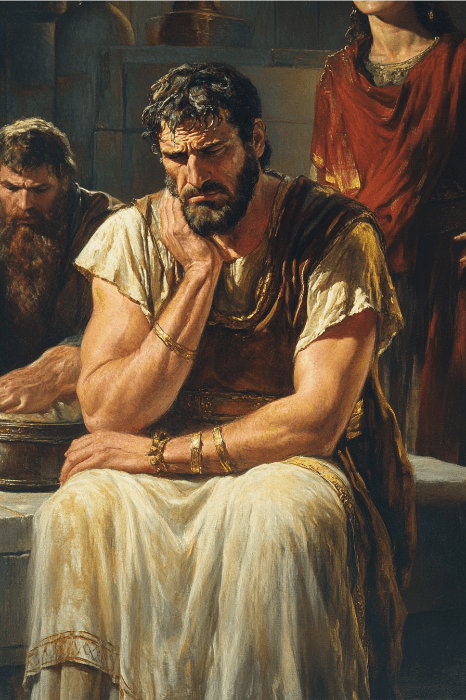
Job’s wife in the Bible has no name. Despite that, her story is unforgettable. That’s why her character is one of the most enigmatic ones in the entire Bible.
Biblical Mentions of Job’s Wife
The Book of Job presents one of the most profound narratives of suffering in the Bible. Among its many enigmatic figures, Job’s wife remains one of the most mysterious.
Quick Assessment
Why does your prayer life keep falling flat?
It's usually one of four things — and each one needs a completely different strategy to break through. This 2-minute assessment tells you exactly which pattern is blocking you.
She’s mentioned only briefly in Job 2:9-10. But her words have sparked centuries of debate among scholars and theologians.
In the passage, after Job experiences an unprecedented series of calamities, including the loss of his children, the yoke of oxen, and personal wealth, he is then afflicted with painful sores from head to toe.
Job’s wife utters her only recorded words in the depths of his suffering:
Free Resource
Get Your FREE Prayer Guide Now
and join the Daily Way Devotional: Join 25,000+ Subscribers
“Doust thou still retain thine integrity? Curse God, and die.”
This statement may seem an audacious questioning of the ways of God. It provokes Job’s response, where he rebukes her:
“Thou speakest as one of the foolish women speaketh. What? Shall we receive good things at the hand of God, and shall we not receive bad things?” – Job 2:10
Here, Job upholds his unwavering faith. It demonstrates his role as a model of perfect devotion despite the unusual challenge he faces.
The wife of Job never speaks again in the biblical texts, and the rest of the Book of Job remains silent about her fate. This lack of additional direct references has left her character open to interpretation.
Unlike Job’s friends, who engage in long philosophical debates about the meaning of suffering, Job’s nameless wife vanishes from the narrative after this singular exchange.
Scholars have long pondered her role in Job’s world. Was she a bad wife? An instrument of Satan? A woman consumed by grief?
Many think that Mrs. Job is just a minor character. However, her brief presence serves as a mainspring of events that tests Job’s initial response to suffering.
Undeserved Suffering
Her words highlight one of the ethical questions in the problem of undeserved suffering. Should a person remain faithful to a supposedly perfect God even when experiencing bad days?
Though Job’s suffering and eventual captivity of Job take center stage in the rest of the book, his wife’s role as a voice of despair underscores the human side of suffering. The meaning of Barak, the Hebrew word often translated as “curse” in this passage, has been widely debated.
Some suggest it could mean “bless.” But in context, it can be understood as a bitter rejection of God. This linguistic ambiguity further complicates interpretations of her words.
The Negative Interpretation of Job’s Wife’s Words
Many have historically viewed Job’s wife as a bad wife who failed her husband in his hour of trial of the hands. Her words have been seen as an attempt to lead servant Job astray. Thus, her statements made her the devil’s accomplice, if you think about the harshest interpretations.
By encouraging her husband to curse God, she appears to align with Satan’s challenge to God in Job 1:11 and 2:5, where Satan tests Job’s faith.
From this perspective, she’s not only faithless but actively working against the good shepherd’s care and trying to make Job abandon his faith.
This interpretation sees her as a weak and despairing figure. It contrasts with her tried husband, who, despite his loathsome sores and loss, refuses to blame God.
John Calvin viewed her words as emblematic of a heart lacking the fear of God. Some theologians even compare her role to Eve in the Garden of Eve, suggesting that, like Eve, she tempts her husband toward sin. This contributes to the suffering in Job’s life.
Her suggestion for Job to end his suffering by cursing God and dying is often seen as the final blow to his trials. It makes her an unsupportive and faithless companion.
Sympathetic Interpretation
On the other hand, there’s a more compassionate view that considers Job’s wife not as a villain. Rather, as a woman in utter agony. She grieves the loss of her children and family security.
In a single day, she lost everything. She lost her home, her status, and most devastatingly, her offspring.
The weight of seeing her husband, once an upright man, now covered in painful sores, sitting in ashes, may have driven her to despair.
Rather than being an instrument of Satan, she may instead be expressing her own doubts, overwhelmed by grief.
A Bad Wife
Some scholars argue that Job’s rejection of her words shouldn’t be read as condemnation. Rather, they must be viewed as a corrective one.
He doesn’t call her a bad wife. When he says “She speaks like one of the foolish women,” it implies that she’s usually wiser.
Her outburst could be understood as an emotional reaction to incomprehensible tragedy, rather than outright rebellion against God.
The text doesn’t say that Job’s wife abandoned him. Though absent at the end of the book, where Job is restored with new children, some believe she remained with him through his suffering.
If she is the mother of Job’s dead children sprint, her grief is profound. Her bitter words may reflect her own grief, instead of malice.
Human Response to Suffering
Some even suggest she represents a broader human response to suffering, contrasting Job’s unwavering faith with a reaction more aligned with the emotional turmoil many feel in times of despair.
Theologians have debated whether Job’s wife serves as a test for her husband’s faith or if she herself is a victim of these divine tests. If we compare her to other women in the bible, like Sarah or the daughter of Jacob, Job’s wife’s story lacks resolution. It makes her a minor character but one whose pain is evident.
Her reaction raises deep ethical questions about suffering, human endurance, and faith in the face of tragedy.
Job’s Wife in Jewish and Christian Traditions
The story of Job’s wife in the Book of Job has inspired various interpretations in both Jewish and Christian traditions.
Unlike the biblical text that leaves her nameless and offers only a brief mention, later religious literature expands upon her role.
In some Jewish traditions like in Talmudic sources, Job’s wife is given the name Sitis or Sitidos. This addition gives her more depth as a character and raises questions about her significance in the larger story of Job’s suffering.
Christian traditions depict Job’s wife in different ways. Some portray her harshly, reinforcing the negative interpretation of her words in Job 2:9, where she tells Job to curse God and die.
In this view, she’s seen as an instrument of Satan, testing Job further and serving as an antagonist in his hour of trial of the hand of God’s hand.
Others, however, view her sympathetically, recognizing her as a grieving mother who lost her children, wealth, and stability in a single day.
Divine Justice
These interpretations highlight the problem of undeserved suffering and the ethical questions surrounding divine justice.
The contrast between the biblical silence regarding Job’s wife and the elaborations found in later religious traditions illustrates how different faith communities have grappled with her role.
The biblical text doesn’t provide further details. These interpretations reflect ongoing attempts to understand her as either a righteous woman or a bad wife, showing the complexity of biblical figures.
Job’s Wife in the Restoration of Job
At the end of the Book of Job, Job’s fortunes are restored. According to Job 42:13-15, he’s blessed with new children, as well as renewed wealth and status among the people of the east.
However, the text doesn’t explicitly state whether these children were born to the same wife or a new one.
This ambiguity has led to debates among scholars and religious thinkers.
Some argue that Job remained with his tried wife, demonstrating resilience and endurance through their shared suffering. This perspective suggests that she, like Job, learned from their trials and was ultimately included in his restoration.
Others, however, speculate that Job remarried, possibly to an unmarried maiden, as part of the Good Shepherd’s care for his renewed life.
The absence of direct biblical confirmation leaves his question open to interpretation.
Regardless of whether she was the mother of Job’s new daughters, the role of Job’s wife in the rest of the book remains uncertain. The fact that Job’s family was restored without further mention of his wife’s provocative suggestion in Job 2:9 raises additional questions about her ultimate fate and significance in the royal road of Job’s redemption.
Lessons from Job’s Wife
The story of Job’s nameless wife offers valuable lessons about faith, suffering, and human emotion in the face of trials. Her brief words in Job 2:9 have been the subject of debate. They also serve as a cautionary example.
One lesson is the importance of faith during suffering. Job’s response to his wife in Job 2:10:
“Shall we receive good at the hand of God, and shall we not receive evil?”
This highlights the endurance of an upright man who accepts both good things and bad things from the divine. This teaches that the true faith is steadfast even in the darkest times.
Another lesson is the danger of speaking hastily in grief. Job’s wife, in her moment of utter agony, may have expressed her own doubts about the work of his hands or questioned the fairness of Job’s suffering.
Some view her as a devil’s accomplice. But others recognize her as a grieving mother who simply voiced the audacious questioning of the ways of God that many would have in such an unusual challenge.
Compassion and Understanding
This reminds us to approach those suffering with compassion and understanding.
The story of Job’s wife in the Bible reminds us that biblical figures are complex and not all of them are one-dimensional. The main character of Job’s wife plays a role in shaping the mainspring of events in the Book of Job. But her words have sparked centuries of interpretation.
She represents faith and doubt, grief and resilience, and serves as a reflection of the human experience in times of immense suffering.
Her fate remains unknown. But her brief but powerful presence in the biblical narrative raises ethical questions and offers an important lesson about faith, endurance, and the spirit of a prophet.
Her role in the story ultimately adds depth to the themes of suffering, divine justice, and the fear of God that define the contribution of Job to the literature.
Jane is a Roman Catholic on a journey of re-learning about God and deepening her understanding of the Bible. She has over a decade of experience as a copywriter. Her goal is to blend her passion for writing with her spiritual journey. She writes content that doesn’t just uplift but also connects with people who wish to seek a deeper understanding of God’s word. Follow Jane on LinkedIn or Instagram.