Tuesday nights used to terrify our church events coordinator. Not because anything was wrong — just because every planning session started the same way: “We need something to open with. Something funny. Not cheesy funny. Actually funny.” She’d spend an hour on Google, find five recycled skit ideas from 2009, and close the laptop defeated.
These 7 funny religious skits exist for that Tuesday night. They’re written for real church groups — volunteer casts, minimal props, audiences that range from skeptical teenagers to grandmothers who’ve heard every church pun twice. Each one lands a laugh and a truth. That’s the combination that makes people talk after the service ends.
Use the Skit Finder table below to get to the right one fast.
Cast size, run time, and occasion matter more than people think when choosing a humorous skit. Find your situation in the table and jump straight to the right one.
Why Funny Religious Skits Work Better Than You Think
There’s a moment in every good church skit where the audience is still laughing — and then the room goes quiet. That quiet moment is worth more than 20 minutes of straight preaching for some people in those seats. Humor breaks down the walls that a formal sermon doesn’t always reach.
I’ve watched close friends who hadn’t set foot in a church in years lean forward during a comedy skit — because suddenly the story felt human. The awkward situations, the misread intentions, the gap between who we’re trying to be and what we actually do — a good humorous skit holds all of that with honesty and warmth. And when the gospel moment lands at the end, it lands differently than it would from a pulpit.
Youth groups especially respond to church skits because they combine entertainment and message in a way that doesn’t feel like a trap. You’re not sneaking theology past anyone. You’re inviting them in through something they already enjoy.
A Real Moment
I sat in the back of a youth room once and watched a skit about two characters arguing over the wrong thing — a classic case of missing the point right in front of them. The teenagers were howling. Then the skit turned, and the message hit. Afterward, three different kids stayed late to talk to the director. Not about the skit. About what the skit was actually about. That’s the life application moment that funny skits make possible.
The best thing about a well-written christian skit: nobody feels lectured. But everybody leaves with something.
1. The Deacon Board Emergency
10 minCast: 4–6Light-hearted comedy
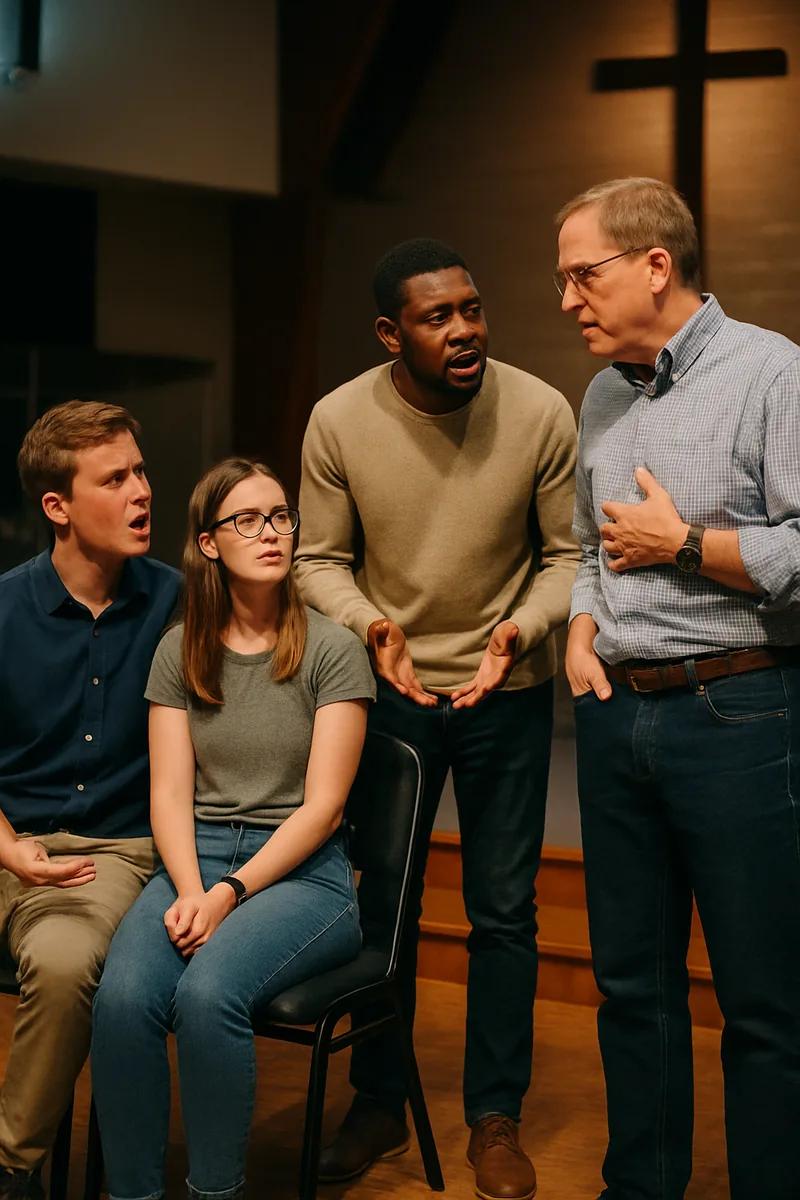
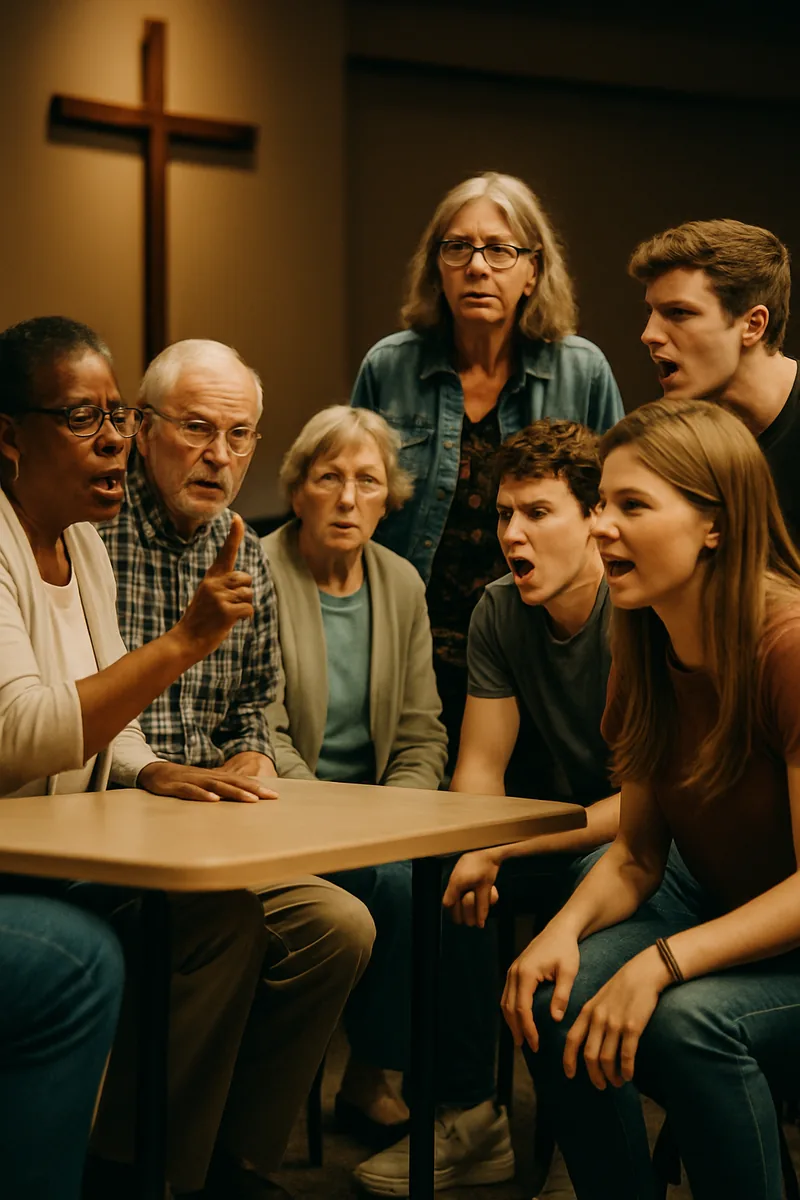
The deacon board has called an emergency meeting. The crisis? Someone switched the regular coffee with decaf before Sunday’s service — and the offering was down six hundred dollars. What starts as a hilarious debate about caffeine and church politics slowly becomes something none of them expected: an honest conversation about unity, grace, and what they’re actually fighting about.
This is one of the best short skits for smaller church gatherings and regular Sunday morning services. It works with as few as four main actors and needs almost no props beyond a folding table and a battered meeting folder.
Opening Scene
DEACON HAROLD: (slamming folder on table) I called this emergency meeting because what happened Sunday cannot happen again.
DEACON LINDA: (gravely) The decaf.
DEACON HAROLD: The decaf. Someone switched the regular — and the offering was DOWN six hundred dollars.
PHYLLIS: (gasping) I was trying to help Brother Tom with his blood pressure!
HAROLD: Phyllis. His blood pressure is fine. The budget is not.
The Gospel Moment
When the argument threatens to split the board three ways, the youngest deacon quietly reads Ephesians 4:2–3 aloud: “Be completely humble and gentle; be patient, bearing with one another in love.” Nobody responds immediately. Then Linda says, “I think we’ve been fighting about coffee.” Harold nods slowly: “I think we always were.”
Discussion Questions
What “small things” in your church community have caused bigger conflicts than they deserved?
What does Ephesians 4:2–3 say about bearing with one another? How does that apply to real church disagreements?
What does it actually look like to pursue unity when you genuinely disagree with someone?
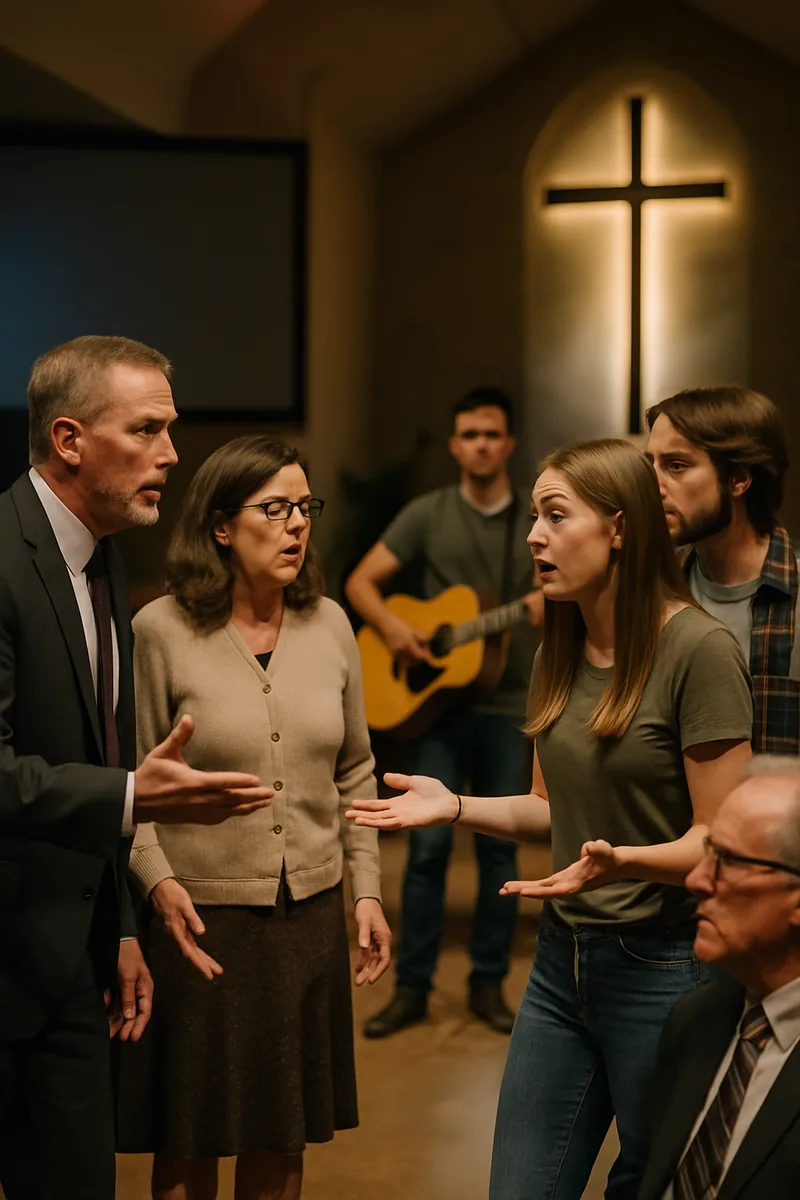
Two committees are locked in a standoff over Sunday’s service format. Team Traditional (hymns, organ, three-piece suits) versus Team Contemporary (screens, guitars, one ill-advised fog machine). They’re both right, both wrong, and both about to be humbled by each other. This is a funny line for every church that’s ever had this exact argument — which is every church.
This humorous skit works especially well with mixed-age casts. The comedy comes from the gap between what both sides think they’re arguing for and what they’re actually arguing for. It plays beautifully for younger audiences and the senior members who’ve seen it all before.
Opening Scene
MARGARET: (clutching hymnal) If we remove “How Great Thou Art” from the service, I will personally write the denomination.
TYLER: (adjusting beanie) Nobody under 40 owns a hymnal, Margaret. We need to reach younger audiences.
MARGARET: I AM younger audiences. I’m only 67!
PASTOR MIKE: (quietly, to himself) Lord, give me strength.
TYLER: We could compromise. Play it on acoustic guitar?
MARGARET: (staring) Like a campfire song.
The Gospel Moment
The breakthrough comes when Margaret admits she cried during the contemporary song last month — it reminded her of her late husband. Tyler goes quiet. “My grandmother taught me every hymn you just listed,” he says. “I know them all.” The fighting stops. Worship was never about the style. It was always about Who we’re singing to (John 4:24).
Discussion Questions
Have you ever let preferences about worship style matter more than the worship itself?
What does John 4:24 say about what God looks for in worship?
How can a church honor both tradition and fresh expression in a way that genuinely serves everyone in the room?
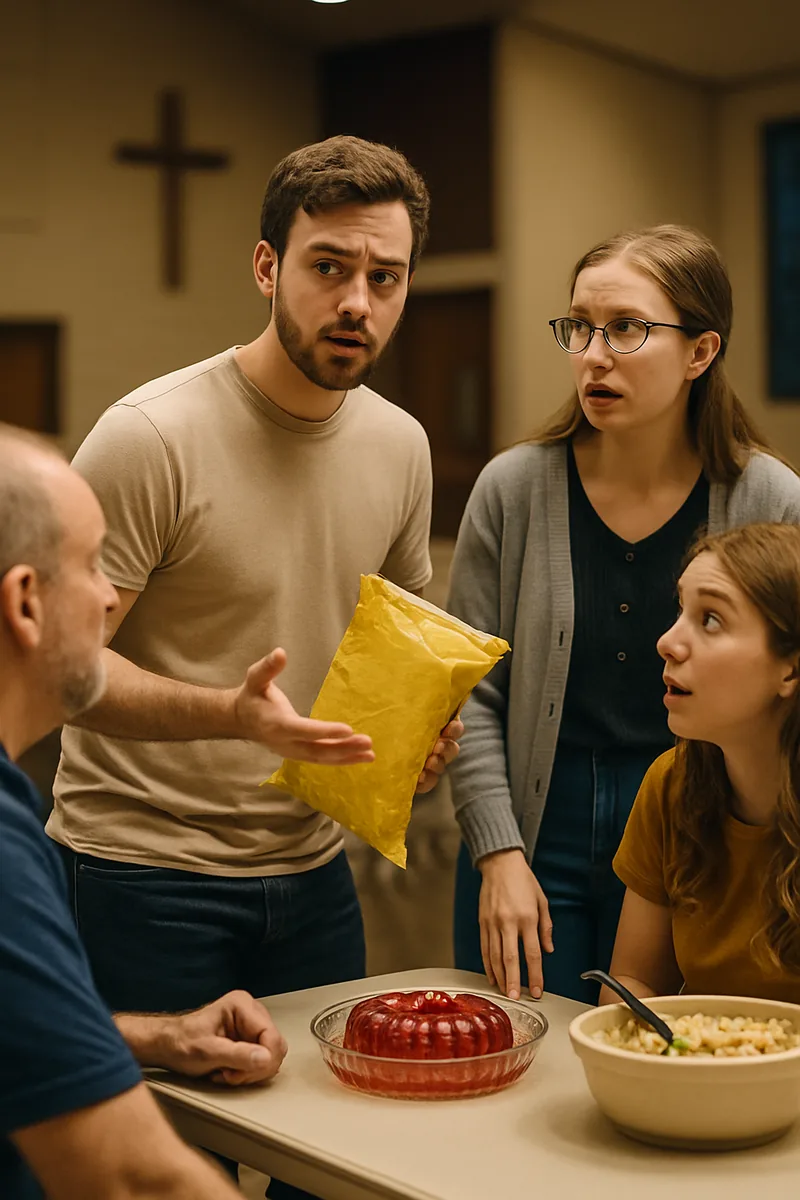
Church potluck tomorrow. Three dishes signed up. One hundred and twelve people registered. The church secretary and her volunteer are about to witness something familiar. This mini skit is a modern Feeding of the 5,000 — set in a fellowship hall, complete with a Jell-O mold and a bag of chips that somehow becomes enough.
One of the most versatile funny skits in this collection. It works for end-of-summer events, Sunday school teacher appreciation day celebrations, and regular Sunday services. The setup is instantly relatable for anyone who’s ever helped plan a church event.
Opening Scene
SECRETARY CAROL: (staring at sign-up sheet) We have a King Ranch casserole, a Jell-O mold, and a bag of chips.
VOLUNTEER DANNY: (horrified) For how many people?
CAROL: One hundred and twelve. One hundred and thirteen if you count Pastor’s wife.
DANNY: Should we cancel?
CAROL: (long pause) No. We pray. And we call Brenda.
The Gospel Moment
When the food somehow feeds everyone with leftovers to spare, Carol says quietly: “You know, there was a crowd of five thousand once. He fed them with five loaves and two fish.” Danny looks around at the full tables. “I think He can handle a Jell-O mold.” The comedy lands cleanly on Matthew 14:13–21 without ever feeling heavy-handed.
Discussion Questions
Have you ever seen God provide in a way that defied the math?
What does the Feeding of the 5,000 tell us about how God uses what little we have to offer?
Where in your life do you need to trust God with an “impossible potluck” right now?
Looking for even more options with a message? Check out our collection of funny Christian skits with a message — seven more scripts specifically designed for youth ministry and special events.
4. Angels Off Duty
15 minCast: 6–10Heavenly comedy
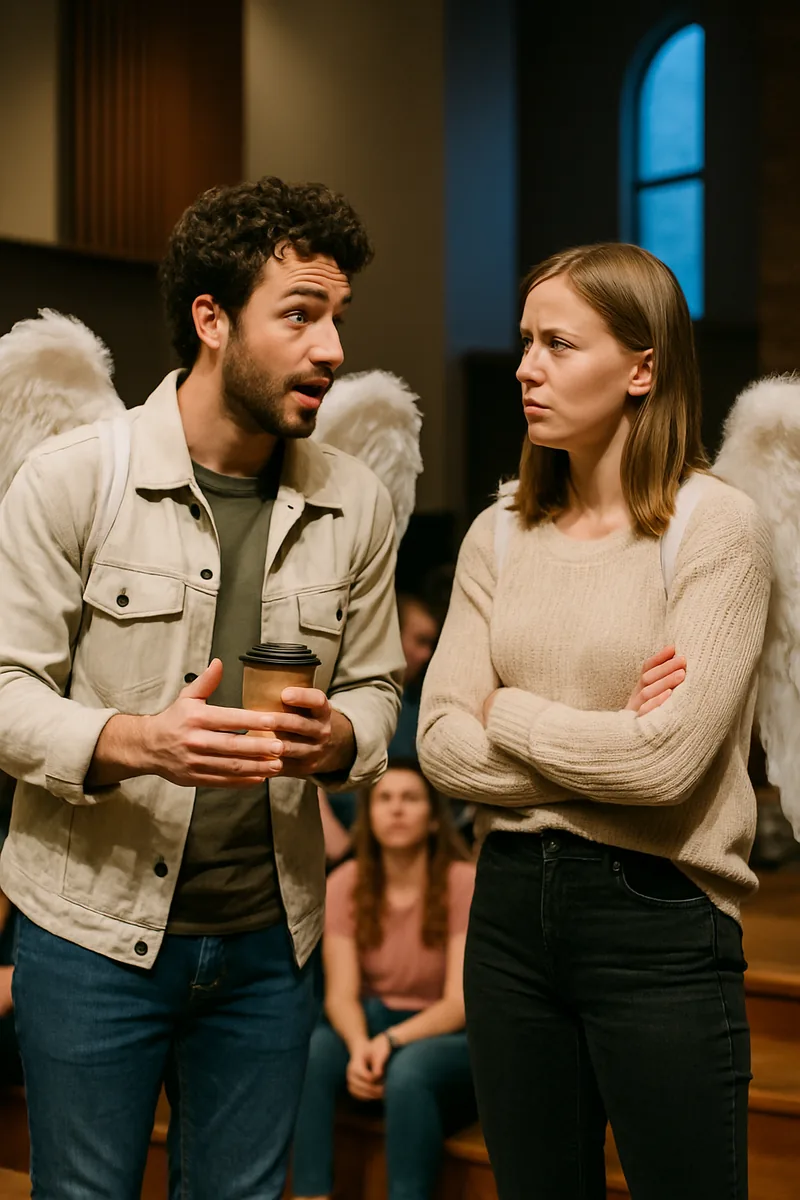
Two guardian angels on a break compare notes on their human assignments — a nervous teen giving her first youth group talk, a worship leader who forgets the words to the bridge mid-song, a pastor who accidentally preaches from last year’s notes. The comedy is genuinely funny. The theology underneath it is quietly solid. This is the skit that makes people laugh and then sit very still.
This one plays well for youth groups, young adult services, and church gatherings with a mix of ages. The angel characters give the skit a different kind of perspective — not preachy, just honest — which lets the spiritual content land without feeling like a sermon.
Opening Scene
ANGEL MIRA: (flopping down, exhausted) Seventy-two hours straight. My human walked into the wrong church three Sundays in a row and kept sitting down anyway.
ANGEL CAL: At least yours shows up. Mine cancelled quiet time for a productivity podcast.
MIRA: During prayer time?
CAL: (slowly) During. Prayer. Time.
MIRA: (staring) Humans.
The Gospel Moment
The angels talk about the teen who gave her first talk. Terrified, index cards everywhere. She got fifteen words in and then just said: “I love Jesus and I don’t know what else to say.” Cal pauses. “That was the best talk in that room in three years.” The audience laughs — then goes quiet. Sincerity beats polish. Every time. (Luke 15:10)
Discussion Questions
Do you think of your faith walk as something God is actively invested in — even on the ordinary, unspectacular days?
What does Luke 15:10 say about how heaven responds to our moments of sincere faith?
Have you ever said something simple and honest about your faith that connected more than you expected?
The Senior Saints and the Youth Group face off in the First Annual Church Bible Trivia Championship. The seniors know their Old Testament cold — Ruth, Esther, all of it. The youth have YouVersion and confidence. Neither team knows Romans chapter by chapter. It gets competitive. Then it gets humbling. Then it gets good.
This is one of the most naturally funny church skits in the collection because the character types write themselves. The comedy comes from people being exactly who they are — and discovering that knowing about the kingdom of heaven and being in it are two very different things.
Opening Scene
HOST PASTOR DAVE: Welcome to the First Annual Calvary Fellowship Bible Trivia Championship! Our teams today: the Senior Saints — (polite applause) — and Youth Surge! (airhorns from the back row)
SENIOR CAPTAIN RUTH: We’ve been studying since 1987. We are ready.
YOUTH CAPTAIN JORDAN: We’ve got the YouVersion app. So basically the same thing.
RUTH: (turning slowly to face Jordan)
The Gospel Moment
A trick question — “Who was Mephibosheth?” — stumps both teams. The quietest kid on the youth team answers: “Jonathan’s son. David showed him kindness because of a promise he’d already made — even though Mephibosheth didn’t think he deserved it.” Silence falls. Pastor Dave says: “Knowledge about the kingdom of heaven is good. But knowing you’re in it — that’s better.” (1 Corinthians 8:1)
Discussion Questions
Is there a difference between knowing Bible facts and truly knowing God? What does that difference look like in daily life?
What does 1 Corinthians 8:1 say about the relationship between knowledge and love?
What’s one part of Scripture you know well in your head but still struggle to live out?
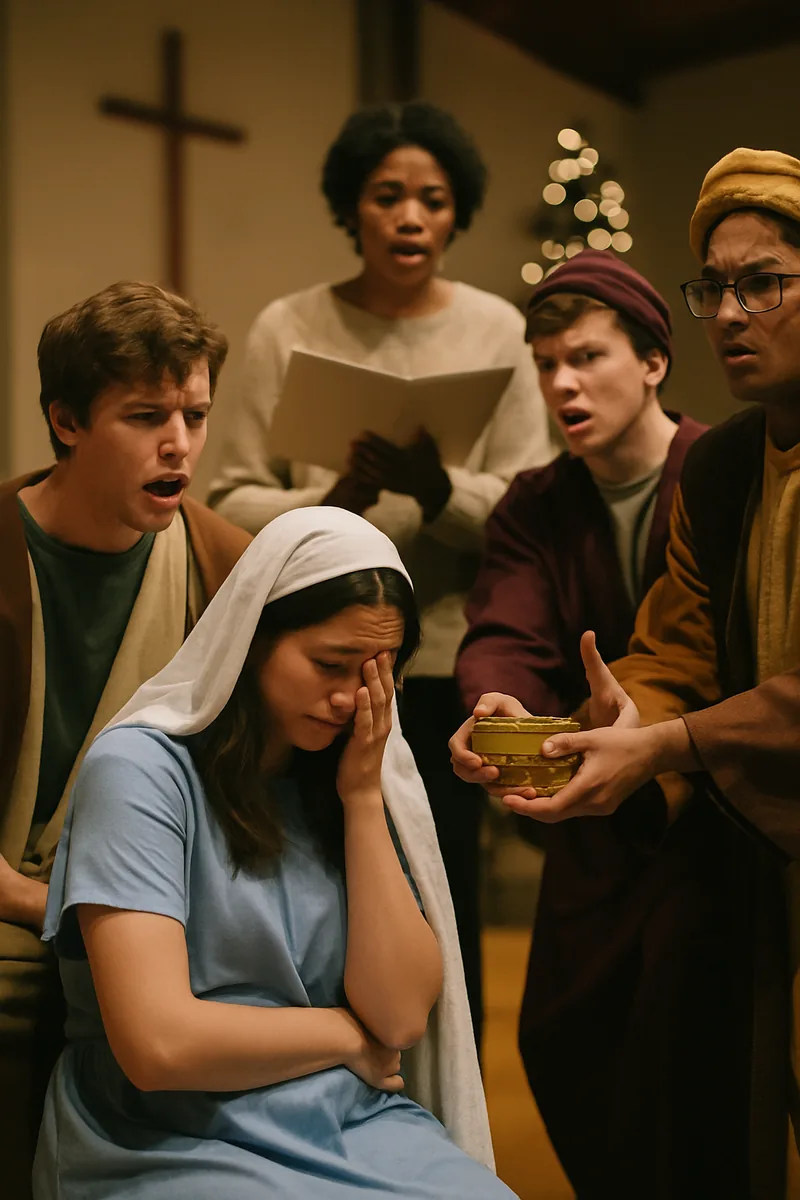
Mary has stage fright. Joseph forgot his lines. Two of the three wise men are fighting over who gets to hold the frankincense. The narrator just discovered the script references a PowerPoint that hasn’t existed since 2003. This is the Christmas story — just not the version anyone planned. And somehow, that makes it the most real version of all.
This is the christmas story skit your church has been waiting for. With a large cast of 8–12 and a built-in chaos that mimics every children’s Christmas pageant anyone has ever seen, this one gets the whole room — the children’s ministry parents, the grandparents, the teenagers in the back who “didn’t want to be here.” They all end up leaning forward by the end.
Opening Scene
DIRECTOR JUNE: (into headset) Where is Angel Three? Angel Three!
BACKSTAGE VOLUNTEER: She’s in the bathroom. Too many Christmas cookies.
JUNE: (closing eyes) Lord, give me patience.
(A child in a sheep costume runs past)
JUNE: Stop — sheep go left!
CHILD: I’m a dog. The innkeeper’s dog. I made it up.
JUNE: (staring) We don’t have dogs in the Christmas story.
CHILD: (cheerfully) We do now.
The Gospel Moment
Mid-performance, Mary drops Baby Jesus (the doll). Joseph reads the wrong lines. The star falls off the backdrop. Then the little girl playing Mary picks up the doll, holds it close, and says quietly: “It’s okay. He came anyway.” The audience goes completely still. June, watching from the wings, starts to cry. That is the Christmas story. He came anyway. (Luke 2:7)
Discussion Questions
Have you ever had something “go wrong” that turned into a more meaningful moment than if everything had gone right?
What does it mean that Jesus “came anyway” — into a world that was messy, noisy, and completely unprepared?
How does Luke 2:7 (“no room at the inn”) speak to how God often works in imperfect circumstances?
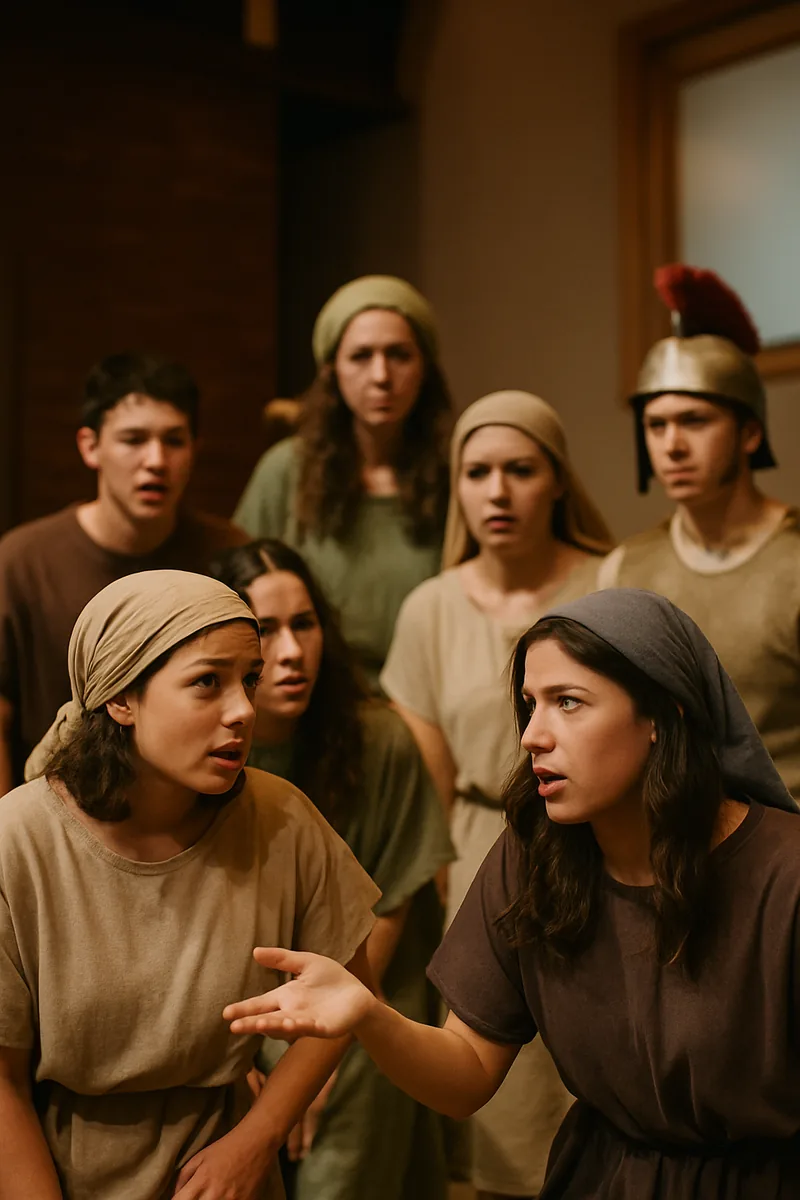
The Prodigal Son told from the perspective of the servants who watched the whole thing happen. Set in the time of Jesus, the servants argue, gossip, and speculate about who’s to blame and who’s in the right — complete with the roman soldiers at the road who can’t believe an estate owner is running. The comedy is layered. The theology lands hard. This is the feature-length funny religious skit for a congregation that’s ready to sit with a parable.
At twenty minutes with a cast of 8–12, this is a production — not a filler skit. It’s the right choice for a Good Friday or Easter service, a drama night, a special Sunday series on the parables, or any church worship service where you want the teaching and the entertainment to be inseparable. The main actors carry most of the dialogue, supported by a servant ensemble that can range from 8 to 12 depending on your group.
Opening Scene
SERVANT TOBIAS: (watching from the window) He’s back.
SERVANT MIRIAM: (dropping the laundry) The young master? The one who took his inheritance and left?
TOBIAS: That’s the one.
MIRIAM: How does he look?
TOBIAS: Like he spent his inheritance.
MIRIAM: I’m not cleaning his robe. Last time he—
TOBIAS: (grabbing her arm) Miriam. The master is running.
MIRIAM: Running?
TOBIAS: Running.
The Gospel Moment
When the older son refuses to come in and the servants debate whose side to take, the oldest servant speaks: “In thirty years of service, I have never seen the master run. Not once. Not for anyone.” She pauses. “He ran for the boy who left him.” One by one, the servants go back inside — changed. The real story was never the son’s. It was always the father’s. (Luke 15:20)
Discussion Questions
In Luke 15:11–32, who do you identify with most — the younger son, the older son, or the father? Why?
The father ran toward his son. What does that image tell you about how God responds when we return to Him?
Is there an “older brother” in you — someone who struggles to celebrate others receiving grace they don’t seem to have earned?
A few things worth knowing before you purchase any of these scripts.
All seven are delivered as digital PDFs — instant download, no waiting, no shipping. Each script includes the full dialogue for every character, complete stage directions, a props list (most require nothing more than your church already owns), and director’s notes on timing and blocking. These are written for volunteer casts. You don’t need trained actors. You need people willing to commit to the bit and a director who has read the script at least once before rehearsal — and ideally twice.
One purchase covers unlimited performances at your church. Buy it once, use it for years. If you want your cast in biblical dress for the Prodigal Son skit or want the deacons in actual suits for that board meeting, the director’s notes cover costume suggestions too.
For a broader look at every christian skit script we carry — including longer dramatic productions and shorter readings — visit our full church skits collection. We also have a separate series of Christian skits with a message that covers more dramatic formats if these lighter comedies aren’t the right fit for your service.
Common Questions About Funny Religious Skits
Do we need professional actors to pull off these skits?
Not at all. These are written specifically for church volunteers — people who have never been on centre stage in their lives. The scripts include character notes that tell directors what personality type fits each role, and the director’s notes explain how to coach someone through a comedic moment if they’ve never done it before. If your cast can do a live read-through and commit to the funny line, they can perform these.
What’s the right skit length for a Sunday morning service?
For a regular Sunday service, the 10-minute mini skits are usually the right fit — they work as a pre-sermon warm-up or an illustration without disrupting the overall service flow. The 15-minute skits work well for special services, Sunday nights, or church gatherings where the skit is the centerpiece. Save the 20-minute production for a drama night or a dedicated service built around it.
Are these appropriate for children as well as youth groups?
The Potluck Miracle and the Christmas Pageant Catastrophe play well for all ages, including children. The Deacon Board Emergency and Worship Wars are better suited to teens and adults who understand church culture well enough to appreciate the satire. Angels Off Duty and the Bible Trivia Championship are designed primarily for youth groups and young adult audiences. The Prodigal Son: Behind the Scenes is best for an adult or all-ages service.
Can we perform a skit more than once after purchasing?
Yes — one purchase covers unlimited performances at your church. A lot of churches run the same skit for a Christmas Eve service two years in a row with different casts. Because each one is tied to a specific Scripture and includes discussion questions, they hold up well to repeated use in different ways — as a youth group opener, a sermon illustration, or a different backgrounds event entirely.
Finding the right funny religious skit is less about finding the funniest script and more about finding the right script for your room. The Skit Finder table at the top of this page is the fastest way to match your occasion, cast size, and run time to the right one. When those three things align, the gospel moment at the end always lands cleaner than you expect.












I purchased The Potluck Miracle, 8/7/2026. The charge went through to my bank but it will not download or let me copy the play
Hi Deanna we just replied to your email. Please check.